


Plans to turn farmland into an industrial park may make the residents of the Ciding (崎頂) farming village in Jhunan Township (竹南) the next victims of a series of land expropriations and development projects in Miaoli County that have triggered nationwide protests over the past few years.
June is usually the time when watermelon farmers in Ciding — a major producer of the fruit in the county — share their harvest with visitors from across the nation at the Miaoli County Government-sponsored Ciding Watermelon Festival.
However, the village was quiet yesterday after the county government made a last-minute decision last week to relocate the festival to the village of Dapu (大埔) about 3km away, knowing that farmers opposed to the industrial park were likely to demonstrate at the event.
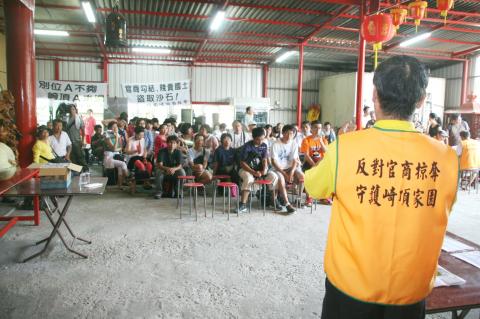
Photo: Loa Iok-sin, Taipei Times
Ciding farmers therefore decided to organize their own — much smaller — watermelon festival, without government funding.
“As usual, we are happy to share our harvest with our guests, but I want to say that, sadly, our farmland may be taken away by the county government to make way for an industrial park,” Ciding Self-Help Organization chairman Hsieh Wen-chung (謝文崇) told the crowd. “We are not against development in general, we just think that farmland should always be used for agriculture because neither you nor I own the land, it belongs to the future generations.”
Hsieh, 58, comes from a farming family that has lived in Ciding for several generations and says that he would fully support turning the village into an area dedicated to refined and organic agriculture.
“It’s especially unacceptable that the county government is going to try to attract investment from high-polluting industries, such as the textile, chemical and machinery sectors,” Hsieh said.
Chen Chin-lan (陳錦蘭), another resident, said that if factories from these high-polluting sectors set up shop in the industrial park, it would affect not only Ciding, but Jhunan Township and Hsinchu City.
“The name ‘Ciding’ means ‘top of the hill’ in Hoklo [commonly known as Taiwanese] and as the name indicates, it’s the highest place in Jhunan, so it’s not difficult to see that there is a high possibility of polluted water trickling down to Jhunan and Hsinchu City, which borders Ciding’s north,” Chen said.
Chen added that she thinks the real purpose of the project is real estate speculation.
“There are many idle industrial parks around the county and with many businesses moving their production abroad, I think the only thing the Ciding industrial park would succeed at is driving up real estate prices,” she said.
Frank Chang (張裕淵), a member of the self-help organization, said he questions the legitimacy of a contract that the county government signed with Sweeten Construction Co to build the park in July last year, before the land was expropriated and the necessary central government-level assessments made.
“It’s also questionable that Sweeten would get its entire NT$7 billion [US$232 million] budget on loan from state-owned banks, like the Bank of Taiwan,” Chang said.
While acknowledging that 95 percent of the land earmarked for the project is owned by the state and that farmers rent it from the National Property Administration, Chang said the law affords farmers priority in purchasing the land.
Miaoli County Deputy Commissioner Lin Chou-hsiang (林久翔), who attended the official watermelon festival in Dapu, declined to comment on the dispute when questioned by the Taipei Times.

NATIONAL SECURITY: Authorities are working to confirm the identities of the military personnel involved and investigating possible illegal conduct and regulatory violations Authorities are probing possible national security implications after Kinmen police and immigration officers on Sunday found a Chinese woman allegedly posing as a tourist while engaging in prostitution involving more than 10 military personnel. The woman, surnamed Chen (陳), has since been deported, authorities said, adding that investigators are still working to confirm the identities of those implicated, as the records only listed code names and aliases. The case stemmed from a report received by the Kinmen District Prosecutors’ Office on Friday last week from the Jinhu Precinct of the Kinmen County Police Bureau. On Sunday, police, along with the National Immigration

REASONS FOR TRAVEL: An assistant professor said that proposed amendments to penalize drivers if they used drugs overseas would not deter people from traveling People who operate a motor vehicle under the influence of marijuana would have their driver’s license revoked, even if they used the substance while overseas, the Ministry of Transportation and Communications said yesterday, citing proposed amendments to the Road Traffic Management and Penalty Act (道路交通管理處罰條例). The amendments would also authorize the government to revoke the licenses of people determined to have used Category 1 or Category 2 narcotics, even if they were not operating a vehicle while under the influence of drugs, as well as ban them from taking the license test for three years, the ministry said. People aged 18 or

GLOBALGIVING: ‘ Caving to external pressure is not acceptable for an organization that has cultivated justice reform and human rights for 30 years,’ one NGO said A slew of non-government organizations (NGOs) have withdrawn from the GlobalGiving fundraising platform after it announced it would use “Chinese Taipei” instead of “Taiwan” from next month. The Taiwan Good Rice Association wrote on Facebook on Friday that it was informed on April 28 via a teleconference call of the change, which was made because the platform wanted to operate in China. Taiwan Good Rice is to terminate all cooperative relationships with GlobalGiving in response to the platform’s “unilateral and non-negotiable” decision to remove references to Taiwan, the NGO said. “Taiwan is in the official name of Taiwan Good Rice Association and the

HEAVY WEATHER: Typhoon Jangmi is due to crash straight into the Ryukyus as airlines look to shift flights to larger aircraft or cancel flights to Okinawa entirely Taiwan’s international air carriers announced flight adjustments over the weekend as Typhoon Jangmi is forecast to hit the Ryukyu Islands today and tomorrow. The Central Weather Administration (CWA) upgraded Jangmi from a tropical storm to a typhoon at 8am yesterday, with the eye located 580km south of Naha city. It was moving north at 19kph. Today, China Airlines’ CI-120, CI-121, CI-122 and CI-123 flights between Taoyuan and Naha, Okinawa, have been canceled as well as CI-132 and CI-133 between Kaohsiung and Naha. EVA Air’s BR-112, BR-113, BR-186 and BR-185 flights between Taoyuan and Naha are also canceled. Low-cost carrier Tigerair Taiwan canceled IT-230,


 RSS
RSS