


Former premier Frank Hsieh (謝長廷) of the Democratic Progressive Party (DPP) pushed for a rebalancing of exchanges between Taiwan and China at a high-profile symposium on cross-strait relations in Hong Kong yesterday.
In his keynote speech, Hsieh said cross-strait interactions have become increasingly narrowed to exchanges between the Chinese Nationalist Party (KMT) and the Chinese Communist Party (CCP), with potentially serious consequences.
“This could cause undercurrents and trigger backlashes that would lead to an imbalance between the functions of political parties and the conducting of cross-strait exchanges,” he said.
“Cross-strait interactions are not the same as KMT-CCP interactions,” he said at the start of the two-day forum hosted by the Taiwan Reform Foundation — which he chairs — and the Chinese Academy of Social Science’s Taiwan Research Institute.
Hsieh said there are two major stances in Taiwanese mainstream public opinion regarding ties with China: one is the hope for cross-strait peace and commercial exchanges that create mutual prosperity; the other is the desire to maintain self-rule and preserve democratic values.
Whichever party holds power in Taiwan must maintain a balance between those two stances, something he hinted was not happening at present, Hsieh said.
“People in Taiwan today are worried about the model of the KMT and CCP monopolizing exchanges. They are concerned that the ‘status quo’ is being undermined and that democratic mechanisms are being distorted,” said Hsieh, who stressed that he was not representing the DPP at the forum.
Taiwan Research Institute director Yu Keli (余克禮) challenged Hsieh’s contention, saying that China welcomed Taiwanese from all circles to participate in cross-strait exchanges and that it was the DPP which had barred its members from engaging with Beijing in the past.
Yu also questioned the notion that the KMT and CCP were holding negotiations. Yu said that on June 7, 1991, the Chinese government authorized officials in charge of Taiwan affairs to begin talks with the Taiwanese government, and defined them as “cross-strait negotiations,” not “inter-party negotiations.”
On Jan. 31, 1995, then-Chinese president Jiang Zemin (江澤民) proposed that the two sides hold talks on ending cross-strait hostilities under the “one China” principle. Since then, “KMT-CCP negotiations” have been relegated to the dustbin of history, Yu said.
Now, “we expect to have joint discussions with all sectors in Taiwan on the peaceful development of cross-strait relations,” he said.
Yu did not mention the series of high-level meetings held between leaders of the KMT and the CCP since 2005, the most recent of which involved former KMT chairman Wu Poh-hsiung (吳伯雄) and CCP General-Secretary and Chinese President Xi Jinping (習近平) on June 13.
Wu’s use of the “one China” framework to describe cross-strait ties then has met strong criticism.

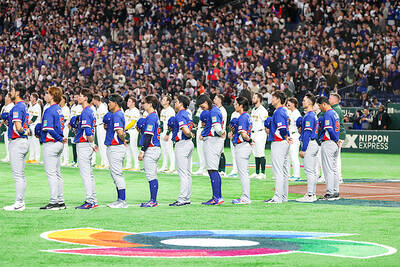
LOUD AND PROUD Taiwan might have taken a drubbing against Australia and Japan, but you might not know it from the enthusiasm and numbers of the fans Taiwan might not be expected to win the World Baseball Classic (WBC) but their fans are making their presence felt in Tokyo, with tens of thousands decked out in the team’s blue, blowing horns and singing songs. Taiwanese fans have packed out the Tokyo Dome for all three of their games so far and even threatened to drown out home team supporters when their team played Japan on Friday. They blew trumpets, chanted for their favorite players and had their own cheerleading squad who dance on a stage during the game. The team struggled to match that exuberance on the field, with
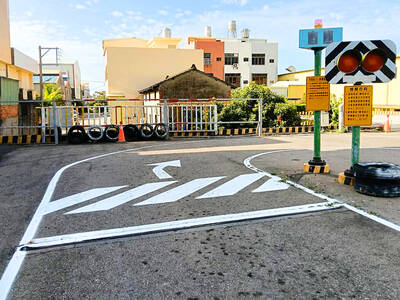
UPDATED TEST: The new rules aim to assess drivers’ awareness of risky behaviors and how they respond under certain circumstances, the Highway Bureau said Driver’s license applicants who fail to yield to pedestrians at intersections or to check blind spots, or omit pointing-and-calling procedures would fail the driving test, the Highway Bureau said yesterday. The change is set to be implemented at the end of the month, and is part of the bureau’s reform of the driving portion of the test, which has been criticized for failing to assess whether drivers can operate vehicles safely. Sedan drivers would be tested regarding yielding to pedestrians and turning their heads to check blind spots, while drivers of large vehicles would be tested on their familiarity with pointing-and-calling
A Taiwanese man apologized on Friday after saying in a social media post that he worked with Australia to provide scouting reports on Taiwan’s team, enabling Australia’s victory in this year’s World Baseball Classic (WBC), saying it was a joke and that he did not hold any position with foreign teams or Taiwan’s sports training center. Chen Po-hao (陳柏豪) drew the rage of many Taiwan baseball fans when he posted online on Thursday night, claiming credit for Australia’s 3-0 win over Taiwan in the opening game for Pool C, saying he worked as a physical therapist with the national team and
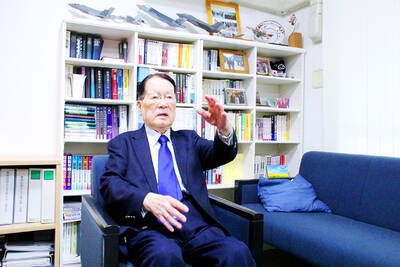
Whether Japan would help defend Taiwan in case of a cross-strait conflict would depend on the US and the extent to which Japan would be allowed to act under the US-Japan Security Treaty, former Japanese minister of defense Satoshi Morimoto said. As China has not given up on the idea of invading Taiwan by force, to what extent Japan could support US military action would hinge on Washington’s intention and its negotiation with Tokyo, Morimoto said in an interview with the Liberty Times (sister paper of the Taipei Times) yesterday. There has to be sufficient mutual recognition of how Japan could provide


 RSS
RSS