


Pro-independence groups yesterday paid tribute to Taiwanese independence activist Chen Chih-hsiung (陳智雄) at a press conference that commemorated Chen’s execution 50 years ago by the Chinese Nationalist Party (KMT) regime.
Chen’s daughter, Vonny Chen (陳雅芳), displayed her father’s final letters written before his execution — which she did not receive until March this year — at the news conference organized by the World United Formosans for Independence (WUFI).
Born in Pingtung in 1916, Chen was executed on May 28, 1963. According to WUFI, Chen was the first Taiwanese independence activist to be executed in Taiwan.
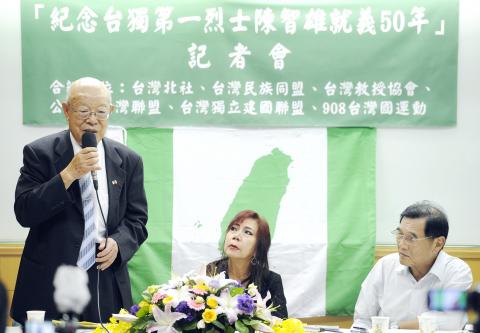
Photo: George Tsorng, Taipei Times
Vonny Chen, who grew up in Indonesia and does not speak Mandarin, told the press conference in English that her resentment toward her father as a child vanished after getting to know more about her father’s “courageous story” as she became older.
“I received compensation from Taiwan’s government about 10 years ago, but I could not care less about the money because I would rather have my father back,” Vonny Chen said, adding that she never knew about the letters and properties of her father in government archives until March.
Chen Chih-hsiung, described as “the No. 1 martyr for Taiwanese independence” by his acquaintances, was always high-spirited in his prison cell, said Liu Chin-shih (劉金獅), who stayed next door to him in prison.
Chen Chih-hsiung shouted “Long live Taiwan independence” twice before he was sent to the execution ground on that fateful day, Liu said.
Knowing that Chen had always been proud of his belief and refused to be intimidated by prison officials or the fear of death, the soldiers smashed his feet, pierced his cheek with steel wires and stuffed a cloth in his mouth before dragging him to the execution ground, Liu said.
A multilinguist, Chen worked as a translator in Indonesia for the Japanese Imperial Army during the Pacific War and after World War II, became a jewelry dealer there, where he assisted in the Indonesian independence movement and was imprisoned by the Dutch.
Chen later devoted his energy to the Taiwanese independence movement and was named ambassador to Southeast Asia by the Japan-based provisional government of the Republic of Taiwan in February 1958 and served in that capacity until he left for Japan later that year.
Chen was kidnapped by the KMT officials in Japan and returned to Taiwan the following year, but he kept working for the independence movement. He was arrested by the Taiwan Garrison Command in 1962 and charged with rebellion.

Considering that most countries issue more than five denominations of banknotes, the central bank has decided to redesign all five denominations, the bank said as it prepares for the first major overhaul of the banknotes in more than 24 years. Central bank Governor Yang Chin-lung (楊金龍) is expected to report to the Legislative Yuan today on the bank’s operations and the redesign’s progress. The bank in a report sent to the legislature ahead of today’s meeting said it had commissioned a survey on the public’s preferences. Survey results showed that NT$100 and NT$1,000 banknotes are the most commonly used, while NT$200 and NT$2,000

The Centers for Disease Control (CDC) yesterday reported the first case of a new COVID-19 subvariant — BA.3.2 — in a 10-year-old Singaporean girl who had a fever upon arrival in Taiwan and tested positive for the disease. The girl left Taiwan on March 20 and the case did not have a direct impact on the local community, it said. The WHO added the BA.3.2 strain to its list of Variants Under Monitoring in December last year, but this was the first imported case of the COVID-19 variant in Taiwan, CDC Deputy Director-General Lin Ming-cheng (林明誠) said. The girl arrived in Taiwan on

South Korea is planning to revise its controversial electronic arrival card, a step Taiwanese officials said prompted them to hold off on planned retaliatory measures, a South Korean media report said yesterday. A Yonhap News Agency report said that the South Korean Ministry of Foreign Affairs is planning to remove the “previous departure place” and “next destination” fields from its e-arrival card system. The plan, reached after interagency consultations, is under review and aims to simplify entry procedures and align the electronic form with the paper version, a South Korean ministry official said. The fields — which appeared only on the electronic form

The Ministry of Foreign Affairs (MOFA) is suspending retaliation measures against South Korea that were set to take effect tomorrow, after Seoul said it is updating its e-arrival system, MOFA said today. The measures were to be a new round of retaliation after Taiwan on March 1 changed South Korea's designation on government-issued alien resident certificates held by South Korean nationals to "South Korea” from the "Republic of Korea," the country’s official name. The move came after months of protests to Seoul over its listing of Taiwan as "China (Taiwan)" in dropdown menus on its new online immigration entry system. MOFA last week


 RSS
RSS