


Chinese dissident Chen Guangcheng (陳光誠) yesterday said he advocated the “one country, two systems” approach to cross-strait ties, but said rather than it meaning Beijing defines relations, it could be a mechanism used within China to allow people to choose the kind of society they wish to live in.
“I would love to see a poll in the region south of the Yangtze River which allows people to vote on the system of government they want to live under — a democratic and free society or an authoritarian society. After three years we could expand the voting to the area south of the Yellow River and eventually to the entire country,” said the exiled activist, who arrived in Taiwan on Sunday for an 18-day visit.
Chen made the remarks in response to media inquiries after a meeting with Democratic Progressive Party (DPP) Chairman Su Tseng-chang (蘇貞昌).
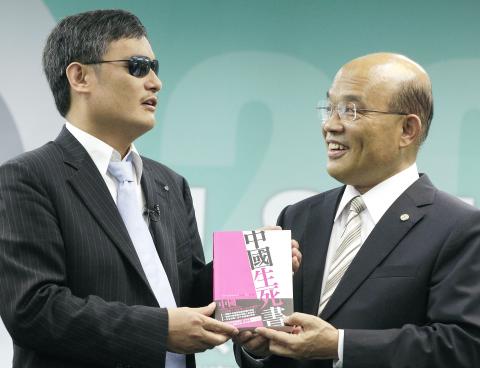
Photo: Pichi Chuang, Reuters
The “one country, two systems” mechanism he has in mind would depend on the will of the people rather than on the Chinese government, and should be flexible, said the 41-year-old, who fled China last year with help from Washington.
Pressed by reporters about his position on the issues of the “one China” framework and Taiwan independence, Chen said he supported the principle of self-determination, which is upheld by international human rights organizations.
“However, I think the concept of independence has become out of date in Taiwan,” he said, without elaborating.
Chen, a self-taught lawyer who was imprisoned because of his rights activism, was surprised to learn that Su first became involved in politics when he served as a lawyer for political prisoners after the Kaohsiung Incident.
The Chinese Nationalist Party (KMT) government during the White Terror period is very similar to the current Chinese Communist Party regime, as both suppress their people and the opposition in the name of “maintaining social stability,” Su said.
Judging from Taiwan’s experience, Su said that while most people during the White Terror era remained silent about the opposition movement or social activism, they privately supported the cause of the dangwai (黨外, “outside the party”) and that support eventually converged and brought about changes in Taiwan.
“I believe that the same thing could take place in China someday,” Su told Chen.
The two exchanged gifts before their 60-minute meeting, which was closed to the media. Su presented Chen with two CDs — Formosa (美麗島) by Aboriginal singer Kimbo, also known as Hu De-fu (胡德夫), and Songs of Madness (抓狂歌) by Blacklist Studio. Chen gave Su his new book: China, the Book of Living and Dying (中國生死書).
After the meeting, DPP spokesperson Lin Chun-hsien (林俊憲) said the party respected Chen’s opinions and supported the establishment of mechanisms in the legislature that focus on human rights in China.

Considering that most countries issue more than five denominations of banknotes, the central bank has decided to redesign all five denominations, the bank said as it prepares for the first major overhaul of the banknotes in more than 24 years. Central bank Governor Yang Chin-lung (楊金龍) is expected to report to the Legislative Yuan today on the bank’s operations and the redesign’s progress. The bank in a report sent to the legislature ahead of today’s meeting said it had commissioned a survey on the public’s preferences. Survey results showed that NT$100 and NT$1,000 banknotes are the most commonly used, while NT$200 and NT$2,000

The Centers for Disease Control (CDC) yesterday reported the first case of a new COVID-19 subvariant — BA.3.2 — in a 10-year-old Singaporean girl who had a fever upon arrival in Taiwan and tested positive for the disease. The girl left Taiwan on March 20 and the case did not have a direct impact on the local community, it said. The WHO added the BA.3.2 strain to its list of Variants Under Monitoring in December last year, but this was the first imported case of the COVID-19 variant in Taiwan, CDC Deputy Director-General Lin Ming-cheng (林明誠) said. The girl arrived in Taiwan on

South Korea is planning to revise its controversial electronic arrival card, a step Taiwanese officials said prompted them to hold off on planned retaliatory measures, a South Korean media report said yesterday. A Yonhap News Agency report said that the South Korean Ministry of Foreign Affairs is planning to remove the “previous departure place” and “next destination” fields from its e-arrival card system. The plan, reached after interagency consultations, is under review and aims to simplify entry procedures and align the electronic form with the paper version, a South Korean ministry official said. The fields — which appeared only on the electronic form

The Ministry of Foreign Affairs (MOFA) is suspending retaliation measures against South Korea that were set to take effect tomorrow, after Seoul said it is updating its e-arrival system, MOFA said today. The measures were to be a new round of retaliation after Taiwan on March 1 changed South Korea's designation on government-issued alien resident certificates held by South Korean nationals to "South Korea” from the "Republic of Korea," the country’s official name. The move came after months of protests to Seoul over its listing of Taiwan as "China (Taiwan)" in dropdown menus on its new online immigration entry system. MOFA last week


 RSS
RSS