


With summer’s heat arriving, enjoying time on the beach and in the sea may be attractive, but beachgoers around Keelung should be on their guard after Portuguese men-of-war were sighted off different parts of the northern coast.
The Portuguese man-of-war is a jellyfish-like siphonophore. Though each appears to be a single individual, the Portuguese man-of-war is actually an entity made up of interconnecting colonial organisms with different functions.
The creature is best known for its venomous sting, which can leave long whip-like red welts on victims. The sting can also lead to an allergic reaction in certain individuals, sometimes leading to fever or shock.
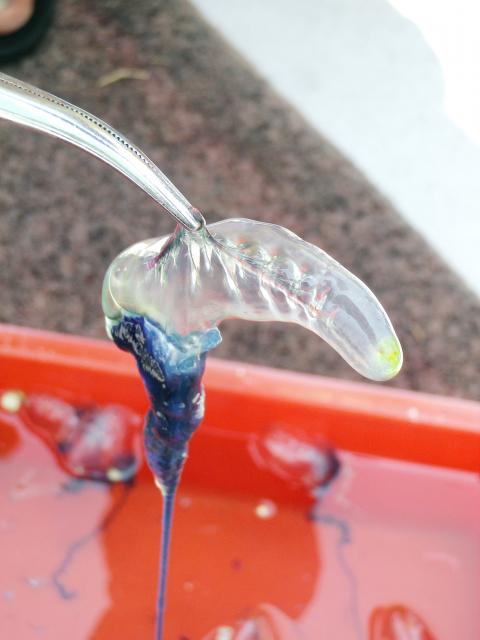
Photo: Lu Hsien-hsiu, Taipei Times
Keelung diving instructor Wang Ming-hsiang (王銘祥) caught 20 Portuguese men-of-war on Tuesday in waters off Waimushan Beach (外木山) during a survey trip with friends.
“There was a lot of trash floating about, and among it we noticed quite a number of jellyfish, as well as some Portuguese men-of-war,” Wang said, adding that he managed to scoop up 20 of the creatures within a 100m radius.
Wang suspects that there are more of them in nearby waters, adding that he gave the 20 men-of-war to the National Museum of Marine Science and Technology in Keelung.
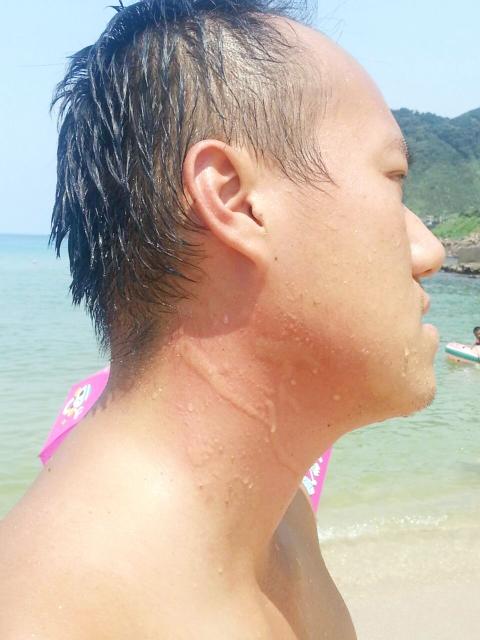
Photo: Lu Hsien-hsiu, Taipei Times
The museum’s exhibit and educational division chief Chen Li-shu (陳麗淑) said Portuguese men-of-war are usually found in the northern Atlantic Gulf Stream or off the south coast of Africa.
However, it is not uncommon to see a few of them drifting in waters off the Badouzih (八斗子) area of Keelung after the annual Dragon Boat Festival, Chen said, adding that this year had brought more of the creatures to Taiwanese waters than usual.
Chen urged tourists and other beachgoers to take care, as the tentacles of the Portuguese man-of-war contain venom which can remain active for several days even if the tentacle has been severed or the organism had died.
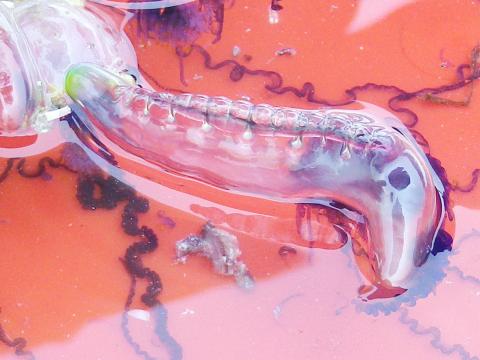
Photo: Lu Hsien-hsiu, Taipei Times
Chen Hui-tsai (陳輝財), the head of the emergency room at the Department of Health Keelung Hospital, offered tips on how to treat stings by Portuguese men-of-war.
Chen Hui-tsai said that a common treatment for jellyfish stings, bathing the area with urine, does not work with Portuguese man-of-war stings and will only make the pain more intense — if you are stung, instead wash the affected area with salt water.
Victims should also use a rigid object — such as a credit card — to scrape the stinger from the skin and seek expert medical advice as soon as possible, the doctor said.

ENTERTAINERS IN CHINA: Taiwanese generally back the government being firm on infiltration and ‘united front’ work,’ the Asia-Pacific Elite Interchange Association said Most people support the government probing Taiwanese entertainers for allegedly “amplifying” the Chinese Communist Party’s propaganda, a survey conducted by the Asia-Pacific Elite Interchange Association showed on Friday. Public support stood at 56.4 percent for action by the Mainland Affairs Council and the Ministry of Culture to enhance scrutiny on Taiwanese performers and artists who have developed careers in China while allegedly adhering to the narrative of Beijing’s propaganda that denigrates or harms Taiwanese sovereignty, the poll showed. Thirty-three percent did not support the action, it showed. The poll showed that 51.5 percent of respondents supported the government’s investigation into Taiwanese who have

South Korean K-pop girl group Blackpink are to make Kaohsiung the first stop on their Asia tour when they perform at Kaohsiung National Stadium on Oct. 18 and 19, the event organizer said yesterday. The upcoming performances will also make Blackpink the first girl group ever to perform twice at the stadium. It will be the group’s third visit to Taiwan to stage a concert. The last time Blackpink held a concert in the city was in March 2023. Their first concert in Taiwan was on March 3, 2019, at NTSU Arena (Linkou Arena). The group’s 2022-2023 “Born Pink” tour set a
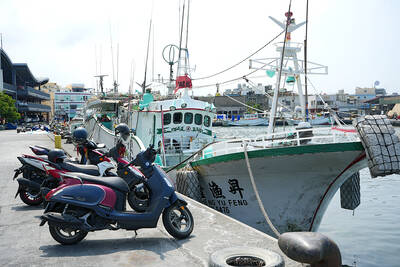
A Philippine official has denied allegations of mistreatment of crew members during Philippine authorities’ boarding of a Taiwanese fishing vessel on Monday. Philippine Bureau of Fisheries and Aquatic Resources (BFAR) spokesman Nazario Briguera on Friday said that BFAR law enforcement officers “observed the proper boarding protocols” when they boarded the Taiwanese vessel Sheng Yu Feng (昇漁豐號) and towed it to Basco Port in the Philippines. Briguera’s comments came a day after the Taiwanese captain of the Sheng Yu Feng, Chen Tsung-tun (陳宗頓), held a news conference in Pingtung County and accused the Philippine authorities of mistreatment during the boarding of

88.2 PERCENT INCREASE: The variants driving the current outbreak are not causing more severe symptoms, but are ‘more contagious’ than previous variants, an expert said Number of COVID-19 cases in the nation is surging, with the Centers for Disease Control (CDC) describing the ongoing wave of infections as “rapid and intense,” and projecting that the outbreak would continue through the end of July. A total of 19,097 outpatient and emergency visits related to COVID-19 were reported from May 11 to Saturday last week, an 88.2 percent increase from the previous week’s 10,149 visits, CDC data showed. The nearly 90 percent surge in case numbers also marks the sixth consecutive weekly increase, although the total remains below the 23,778 recorded during the same period last year,


 RSS
RSS