


While political parties have agreed to screen and vote on the just-signed cross-strait service trade agreement clause-by-clause, the Democratic Progressive Party (DPP) yesterday said it would keep pressuring the government because more negotiations are on Taiwan’s and China’s economic agendas.
“The service trade pact is not the last follow-up agreement of the Economic Cooperation Framework Agreement (ECFA). The service in goods agreement is coming up by the end of the year and it could create a larger impact on local businesses,” DPP spokesperson Lin Chun-hsien (林俊憲) told a press conference.
Lin said the party would work with civic groups to apply stronger pressure on President Ma Ying-jeou’s (馬英九) administration, and that DPP Chairman Su tseng-chang (蘇貞昌) is scheduled to meet with mayors and commissioners of DPP-governed cities and counties for discussions of countermeasures against the pact, which has caught many sectors on the liberalization list by surprise because they had not been consulted.
Lin said the ECFA has failed to benefit Taiwan’s economy as Ma had pledged when the agreement was signed three years ago, adding that the trade pact has instead increased Taiwan’s dependence on the Chinese economy.
Su yesterday warned Taiwanese about the ramifications of the trade pact, saying Beijing was trying to assert its cultural and political influence on Taiwan, in addition to economic absorption of Taiwan.
Former DPP chairperson Tsai Ing-wen (蔡英文), known for her expertise in trade negotiations early in her public service career, issued a second press release in as many days alerting people to what she labeled the gravity of the agreement and the government’s poor negotiating efforts.
Tsai said the Ma administration had entered the negotiations without a grand strategy and came home with a result of which the disadvantages far outweigh the benefits.
The administration has sacrificed small and medium-sized enterprises (SMEs) in exchange for limited benefits for larger corporations, she added.
Trade negotiations between Taiwan and China are very different from those between Taiwan and other foreign countries, because national security concerns would be high on the agenda, she said.
“We have seen this administration’s Achilles heel in its dealings with China. It is incompetent and untrustworthy,” Tsai said.
Meanwhile, former premier Frank Hsieh (謝長廷) said in his weekly radio talk show yesterday that the agreement was testimony to the current “imbalance” in cross-strait engagement, because the Ma administration tried to appease Beijing without any regard for the livelihoods of ordinary Taiwanese.
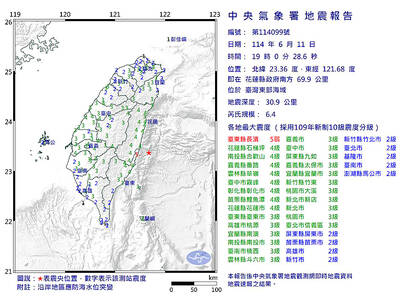
A magnitude 6.4 earthquake struck off the coast of Hualien County in eastern Taiwan at 7pm yesterday, the Central Weather Administration (CWA) said. The epicenter of the temblor was at sea, about 69.9km south of Hualien County Hall, at a depth of 30.9km, it said. There were no immediate reports of damage resulting from the quake. The earthquake’s intensity, which gauges the actual effect of a temblor, was highest in Taitung County’s Changbin Township (長濱), where it measured 5 on Taiwan’s seven-tier intensity scale. The quake also measured an intensity of 4 in Hualien, Nantou, Chiayi, Yunlin, Changhua and Miaoli counties, as well as

Credit departments of farmers’ and fishers’ associations blocked a total of more than NT$180 million (US$6.01 million) from being lost to scams last year, National Police Agency (NPA) data showed. The Agricultural Finance Agency (AFA) said last week that staff of farmers’ and fishers’ associations’ credit departments are required to implement fraud prevention measures when they serve clients at the counter. They would ask clients about personal financial management activities whenever they suspect there might be a fraud situation, and would immediately report the incident to local authorities, which would send police officers to the site to help, it said. NPA data showed

ENERGY RESILIENCE: Although Alaska is open for investments, Taiwan is sourcing its gas from the Middle East, and the sea routes carry risks, Ho Cheng-hui said US government officials’ high-profile reception of a Taiwanese representative at the Alaska Sustainable Energy Conference indicated the emergence of an Indo-Pacific energy resilience alliance, an academic said. Presidential Office Secretary-General Pan Men-an (潘孟安) attended the conference in Alaska on Thursday last week at the invitation of the US government. Pan visited oil and gas facilities with senior US officials, including US Secretary of the Interior Doug Burgum, US Secretary of Energy Chris Wright, Alaska Governor Mike Dunleavy and US Senator Daniel Sullivan. Pan attending the conference on behalf of President William Lai (賴清德) shows a significant elevation in diplomatic representation,
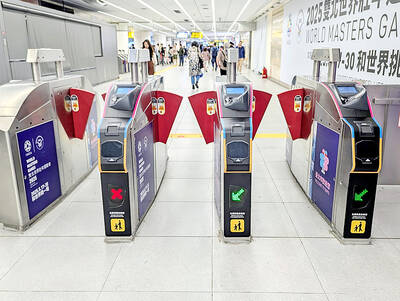
The Taipei MRT is to begin accepting mobile payment services in the fall, Taipei Rapid Transit Corp said on Saturday. When the company finishes the installation of new payment units at ticketing gates in October, MRT passengers can use credit cards, Apple Pay, Google Pay and Samsung Pay, the operator said. In addition, the MRT would also provide QR payment codes — which would be compatible with Line Pay, Jkopay, iPass Money, PXPay Plus, EasyWallet, iCash Pay, Taiwan Pay and Taishin Pay — to access the railway system. Currently, passengers can access the Taipei MRT by buying a single-journey token or using EasyCard,


 RSS
RSS