


Atayal writer and activist Walis Nokan criticized the government’s policy toward Aborigines as “welfare colonialism,” saying that it was doing Aboriginal communities more harm than good.
Walis said he wanted to remind government officials and social organizations that if they really want to help Aborigines, they should first talk to the people to find out what they need, then adopt an encouraging approach to help those communities achieve their goals.
The Atayal writer made the remarks at the launch of his new book, City Cruelty (城市殘酷), in Greater Taichung on Saturday. The book contains stories of maladjustment and other problems that Aborigines experience when they migrate to urban centers in search of employment.
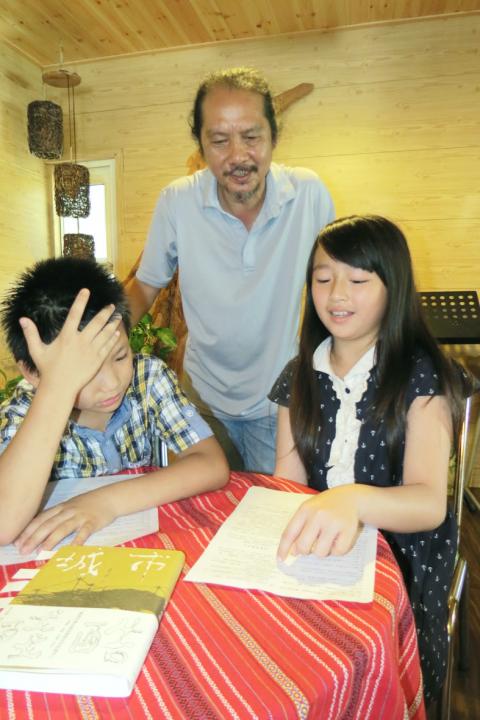
Photo: Hsieh Feng-chiu, Taipei Times
“Aborigines in Taiwan have been under colonial rule for more than 100 years. However, the free subsidies and general welfare programs available to Aborigines are not a good remedy for their problems,” said Walis, who worked many years in education and is an activist for Aboriginal societies.
“Under current policies, when fruit crops planted by Aborigine communities do not sell well, the government gives them benefits and subsidies for school tuition fee and financial aid for school lunches,” he said. “This kind of ‘welfare colonialism’ has created dependency among Aboriginals because they do not have to work hard and can still receive generous benefits and subsidies from the state. It also leads some to neglect their familial responsibilities, which are then passed on to teachers and social workers.”
“In some Aboriginal communities, even breakfasts are donated by philanthropic groups, so parents no longer have to provide breakfast to their children,” he added.
“For example, in the elementary school where I teach, students get free breakfast every Monday, Wednesday and Friday. Yet because these students’ parents no longer have to provide breakfast, some students are not given anything to eat on Tuesday and Thursday mornings. This is one way in which overly generous welfare programs have created irresponsible parents,” Walis said.
In the past, parents worried about not being able to pay their children’s tuition fees, but now they worry that their kids will not have breakfast or lunch when they are not in school, Walis said.
He added that many well-intentioned people often donate old books to Aboriginal communities, but that he has noticed that most of these second-hand books do not interest the students.
“When I was managing the school library, I asked friends in the city to buy new books and mail them to schools in Aboriginal mountain villages. When I announced that new books were coming, students would line up eagerly to borrow them. Having more current, exciting material is the most effective way to arouse children’s interest in reading,” he said.


UPGRADE: The Kang Ding-class frigate is replacing its Chaparall missiles with Tien Chien II and Hua Yang VLS, which would provide it with long-range, 360° air defense Taiwan plans to produce 1,200 to 1,376 Hai Chien II missiles (海劍二, Sea Sword II) — also known as TC-2N — to serve as the standard air defense system of the navy’s surface combatant fleet, a source said yesterday. Last week, the Hai Chien II, the naval version of the Tien Kung II missile (天劍二, Sky Sword II), completed a live-fire test in waters off the National Chungshan Institute of Science and Technology’s Jiupeng facility (九鵬) in Pingtung County’s Manjhou Township (滿州). The MIM72 Chaparral and other dated air defense missiles that currently arm Taiwanese ships have inadequate range to combat Chinese

REASONS FOR TRAVEL: An assistant professor said that proposed amendments to penalize drivers if they used drugs overseas would not deter people from traveling People who operate a motor vehicle under the influence of marijuana would have their driver’s license revoked, even if they used the substance while overseas, the Ministry of Transportation and Communications said yesterday, citing proposed amendments to the Road Traffic Management and Penalty Act (道路交通管理處罰條例). The amendments would also authorize the government to revoke the licenses of people determined to have used Category 1 or Category 2 narcotics, even if they were not operating a vehicle while under the influence of drugs, as well as ban them from taking the license test for three years, the ministry said. People aged 18 or
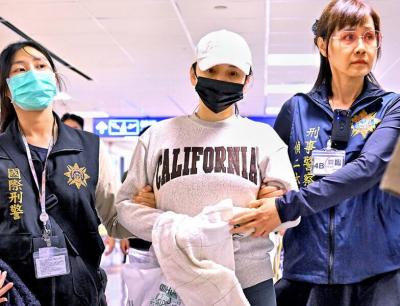
Johanne Liou (劉喬安), a Taiwanese woman who shot to unwanted fame during the Sunflower movement protests in 2014, returned to Taiwan last night after being deported from the US. She is to stand trial in Taiwan for charges involving embezzlement, fraud and drug crimes. The Criminal Investigation Bureau (CIB) said it took her into custody at Taiwan Taoyuan International Airport and would first question her before transferring her to the New Taipei District Prosecutors’ Office. She was arrested upon disembarking a flight from San Francisco that landed shortly before 7pm. Liou absconded to the US in 2019 after jumping bail

Shih Hsin University President Chen Ching-he (陳清河) yesterday issued a public apology for comments made in his commencement speech last week, stating that he has asked the school to suspend his duties and halt his wages for two months as a show of contrition. At the commencement ceremony on May 30, Chen said, “If you don’t manage your time well, or your own emotions, or your health, then I am telling every one of you — put a quick end to ‘you,’ because the world has no need for ‘you.’” The comments have sparked significant controversy online, and Chen through an open


 RSS
RSS