


One of the major complaints about living conditions in Greater Kaohsiung is the air pollution. Following renewed efforts by local residents and environmental groups, the city government said it will undertake measures to curb emissions and air pollutants in a bid to pressure the central government to pass environment-friendly amendments as soon as possible.
According to environmental groups, as early as 1999, measures regulating pollutant emission levels were proposed for inclusion in the Air Pollution Control Act (空氣污染防制法). However, the Ministry of Economic Affairs’ fear of the measures’ potential negative impacts on economic growth and industrial development has been blocking the act from being amended in that regard, the groups said.
The Greater Kaohsiung Government’s Environmental Protection Bureau announced earlier this week that in two years, it will complete a project to monitor and record pollutant emission levels at the city’s 420 factories.
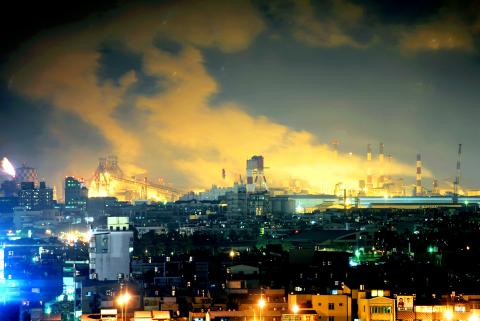
Photo: Chang Chung-yi, Taipei Times
Bureau director Chen Chin-de (陳金淂), who assumed the post in February, said that improving the city’s air quality is one of his major policy goals.
“The central government kept on delaying amendments to the Air Pollution Control Act, so we are unable to enforce air emission standards,” Chen said. “Despite this, we local governments should not shirk our responsibilities. We must have the preparatory work done beforehand, ahead of any amendment, so we can exert pressure on the central government.”
“As for the factory operators, they should also exercise self-restraint and come up with proposals on ways of reducing harmful emissions,” he added.
For factories violating air quality standards, the bureau said it would demand that they reduce their emissions to relieve Greater Kaohsiung residents from their nightmare of foul air.
The situation has worsened through the years as the clustering of industrial sectors, such as steel factories, power plants and petrochemical manufacturers, began in Greater Kaohsiung four decades ago.
The situation is not helped by the city’s geographic setting and its climatic conditions, which are not conducive to the natural dispersal of smog and air pollutants, bureau officials said. Often these conditions cause air pollutants to accumulate, resulting in a skyline cloaked in gray smog.
Most of the time, the levels of the city’s suspended particulates and ozone exceed air quality standards.
Wang Min-ling (王敏玲) of the Citizen of the Earth Foundation said her organization last year started a petition drive on the issue that has collected signatures from more than 12,000 Greater Kaohsiung residents. The appeal garnered support from city councilors across party lines, she added.
Amendments are also being proposed in the legislature, which, if passed, would allow the Environmental Protection Administration to enact air pollution emission regulations without requiring ministry approval, she said. The proposed draft bill has passed the first reading and is now under review in the legislature’s Social Welfare and Environmental Hygiene Committee, she added.

Considering that most countries issue more than five denominations of banknotes, the central bank has decided to redesign all five denominations, the bank said as it prepares for the first major overhaul of the banknotes in more than 24 years. Central bank Governor Yang Chin-lung (楊金龍) is expected to report to the Legislative Yuan today on the bank’s operations and the redesign’s progress. The bank in a report sent to the legislature ahead of today’s meeting said it had commissioned a survey on the public’s preferences. Survey results showed that NT$100 and NT$1,000 banknotes are the most commonly used, while NT$200 and NT$2,000

The Centers for Disease Control (CDC) yesterday reported the first case of a new COVID-19 subvariant — BA.3.2 — in a 10-year-old Singaporean girl who had a fever upon arrival in Taiwan and tested positive for the disease. The girl left Taiwan on March 20 and the case did not have a direct impact on the local community, it said. The WHO added the BA.3.2 strain to its list of Variants Under Monitoring in December last year, but this was the first imported case of the COVID-19 variant in Taiwan, CDC Deputy Director-General Lin Ming-cheng (林明誠) said. The girl arrived in Taiwan on

South Korea is planning to revise its controversial electronic arrival card, a step Taiwanese officials said prompted them to hold off on planned retaliatory measures, a South Korean media report said yesterday. A Yonhap News Agency report said that the South Korean Ministry of Foreign Affairs is planning to remove the “previous departure place” and “next destination” fields from its e-arrival card system. The plan, reached after interagency consultations, is under review and aims to simplify entry procedures and align the electronic form with the paper version, a South Korean ministry official said. The fields — which appeared only on the electronic form

The Ministry of Foreign Affairs (MOFA) is suspending retaliation measures against South Korea that were set to take effect tomorrow, after Seoul said it is updating its e-arrival system, MOFA said today. The measures were to be a new round of retaliation after Taiwan on March 1 changed South Korea's designation on government-issued alien resident certificates held by South Korean nationals to "South Korea” from the "Republic of Korea," the country’s official name. The move came after months of protests to Seoul over its listing of Taiwan as "China (Taiwan)" in dropdown menus on its new online immigration entry system. MOFA last week


 RSS
RSS