


Premier Jiang Yi-huah (江宜樺) yesterday took issue with a former high-ranking Chinese official who said that recognition of the so-called “1992 consensus” would eventually lead to unification between Taiwan and China.
In an interview with Hong Kong-based Phoenix television last month, former deputy chairman of China’s Association for Relations Across the Taiwan Straits Tang Shubei (唐樹備) said it would be inconsistent with the principle of the “1992 consensus” if the two sides were to remain separated indefinitely.
The Chinese Nationalist Party (KMT) believed the so-called “1992 consensus” was reached during a meeting in Hong Kong in 1992 between Taiwanese and Chinese representatives, under which both sides claim to have acknowledged that there is “one China,” with each side having its own interpretation of what “one China” means.
The Democratic Progressive Party insists the “1992 consensus” does not exist.
Tang said in the interview that the core spirit of the “1992 consensus” was “one China,” and that its goal is that both sides join efforts to pursue unification.
At the legislature’s question-and-answer session yesterday, the premier said he disagreed with Tang because the “1992 consensus” referred to an understanding that each side of the Strait has its own interpretation of what “one China” means.
The understanding, which was reached by both sides, does not contain anything related to unification and does not set a timeline for unification, Jiang said in answer to Taiwan Solidarity Union Legislator Huang Wen-ling’s (黃文玲) question on his views about Tang’s statement.
“Sometimes they [the Chinese side] overinterpret the meaning of the ‘1992 consensus,’” Jiang said.
Jiang added that the overarching principle guiding the KMT government’s cross-strait policies is to maintain the cross-strait “status quo.”
In related news, China’s new Taiwan Affairs Office (TAO) director, Zhang Zhijun (張志軍), yesterday said it was not necessary to set conditions for him to visit Taiwan.
Zhang was responding to recent remarks by Mainland Affairs Council Minister Wang Yu-chi (王郁琦), who said that Zhang was welcome to visit Taiwan “at an appropriate time, in a suitable capacity and when all related conditions are right.”
Wang added that he would not meet Zhang unless Zhang agrees to address him by his official title, instead of simply “Mr Wang.”
Zhang, who was attending a seminar in China’s Fujian Province, said that any related problems, such as in what capacity and format the visits should be made, can be resolved with sincerity.
However, throughout his talk, he did not refer to Wang by his title, but only referred to him as “those responsible for such affairs in Taiwan.”
Zhang added that his predecessor, Wang Yi (王毅), had never had the chance to visit Taiwan in the five years he was office.
“I hope not to harbor such regrets in my term,” Zhang said.
Zhang added that the TAO would continue to remove any obstacles that stand in the way of cross-strait relations and seek to promote understanding on both sides.
The office would also “seek to purge the rancor left by the pro-Taiwan independence consciousness and increase recognition of [Chinese] ethnicity (民族認同感),” he said.
Zhang said that by moving forward step by step and not setting restrictions, both sides can slowly come to a consensus on what to do, adding that starting dialogue through civil organizations is a viable method.
Through seminars hosted by groups on both sides of the Strait, the two sides can begin to accrue ideas at these peace seminars, he said.
Commenting on Zhang’s call for Taiwan to remove “all restrictions,” Democratic Progressive Party Policy Research Committee’s executive director Joseph Wu (吳釗燮) said that China was the one imposing restrictions with its insistence on “one China” during cross-strait talks.
China should respect Taiwan’s sovereignty and democracy and uphold the principle of equality, Wu said.
Only by adhering to these principles would Taiwanese feel respected by China, Wu said.

POLAM KOPITIAM CASE: Of the two people still in hospital, one has undergone a liver transplant and is improving, while the other is being evaluated for a liver transplant A fourth person has died from bongkrek acid poisoning linked to the Polam Kopitiam (寶林茶室) restaurant in Taipei’s Far Eastern Sogo Xinyi A13 Department Store, the Ministry of Health and Welfare said yesterday, as two other people remain seriously ill in hospital. The first death was reported on March 24. The man had been 39 years old and had eaten at the restaurant on March 22. As more cases of suspected food poisoning involving people who had eaten at the restaurant were reported by hospitals on March 26, the ministry and the Taipei Department of Health launched an investigation. The Food and
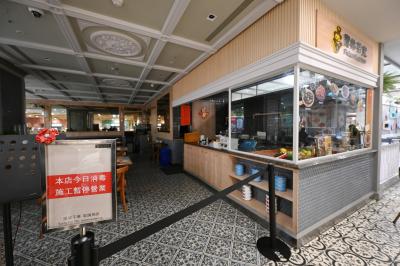
A fourth person has died in a food poisoning outbreak linked to the Xinyi (信義) branch of Malaysian restaurant chain Polam Kopitiam (寶林茶室) in Taipei, Deputy Minister of Health and Welfare Victor Wang (王必勝) said on Monday. It was the second fatality in three days, after another was announced on Saturday. The 40-year-old woman experienced multiple organ failure in the early hours on Monday, and the family decided not to undergo emergency resuscitation, Wang said. She initially showed signs of improvement after seeking medical treatment for nausea, vomiting and diarrhea, but her condition worsened due to an infection, he said. Two others who

The long-awaited Taichung aquarium is expected to open next year after more than a decade of development. The building in Cingshui District (清水) is to feature a large ocean aquarium on the first floor, coral display area on the second floor, a jellyfish tank and Dajia River (大甲溪) basin display on the third, a river estuary display and restaurant on the fourth, and a cafe and garden on the fifth. As it is near Wuci Fishing Port (梧棲漁港), many are expecting the opening of the aquarium to bring more tourism to the harbor. Speaking at the city council on Monday, Taichung City Councilor

Taiwanese should be mindful when visiting China, as Beijing in July is likely to tighten the implementation of policies on national security following the introduction of two regulations, a researcher said on Saturday. China on Friday unveiled the regulations governing the law enforcement and judicial activities of national security agencies. They would help crack down on “illegal” and “criminal” activities that Beijing considers to be endangering national security, according to reports by China’s state media. The definition of what constitutes a national security threat in China is vague, Taiwan Thinktank researcher Wu Se-chih (吳瑟致) said. The two procedural regulations are to provide Chinese


 RSS
RSS