


More than one year in the making, an eight-minute documentary featuring the arduous lives of “sea women,” female divers eking out a living by collecting edible seaweed, is being screened at the North Coast Exploratorium in New Taipei City’s (新北市) Shihmen District (石門), seeking to revive memories of a fast-disappearing way of life.
The film, titled Dancing with the Sea (與海共舞), was filmed in 3D by the North Coast and Guanyinshan National Scenic Area Administration.
It vividly presents how sea women, mostly in their senior years, dive into the sea without scuba gear to collect sea vegetables in exchange for a meager income to support their families.
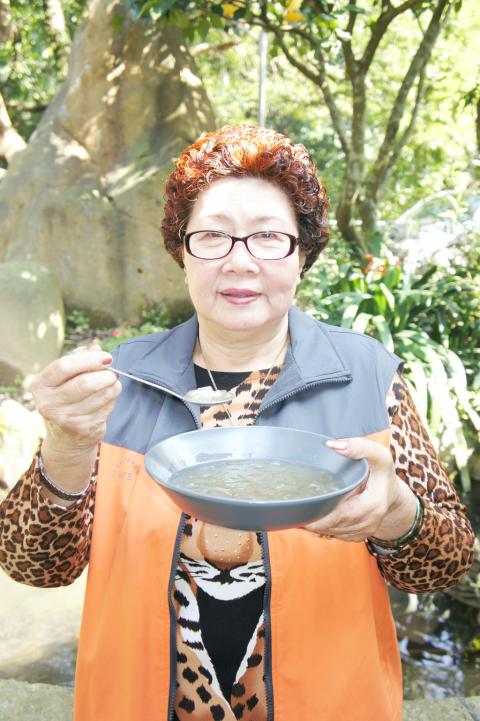
Photo: Lai Hsiao-tung, Taipei Times
“The sea women divers represent a type of fishing culture developed during the Japanese colonial period, when the coast of northern Taiwan was lined with traditional fishing villages,” North Coast and Guanyinshan National Scenic Area Administration director Chen Mei-hsiu (陳美秀) said.
At the time, because most households from these fishing villages were not well-off, women would dive into the sea during the low fishing season to harvest gelidium seaweed and hair moss, Chen said, adding that they would then sell the edible seaweed to supplement their family’s income.
“Due to the tremendous hardship and high risk entailed in being a sea woman, few young people today are willing to take up the traditional job, resulting in a sharp decrease in the number of existing sea women, most of whom only operate in areas near Yehliu (野柳) and are already in their 60s, 70s or 80s,” Chen said.
Among them is 71-year-old Lin Liu Pi-lan (林劉碧蘭), whose disadvantaged background forced her to take up seaweed harvesting at the age of 13.
Being the only daughter in a traditional fishing household, Lin Liu said that she was deprived of any opportunities for education and had to help ease the family’s financial burden by doing what other women at the time did.
After learning how to swim and dive by herself, Lin Liu began her life-long career as a sea woman.
Each year, during the gelidium’s peak season between the second and fifth months of the Lunar calendar, Lin Liu starts her day’s work hauling seaweed along the shore, before diving into the ocean without equipment to forage for more.
“After spending the entire afternoon working, I almost always come home with soreness and pain all over my body,” Lin Liu said, adding that although it was particularly painful for her to work under the sea in winter, she had no option but to “suck it up.”
To process gelidium into marketable jelly products, Lin Liu has to first wash the seaweed up to eight times and let it dry in the sun, before boiling it in water to dissolve the gelatinous agar.
After the dissolved agar solidifies, it is served with a few spoons of sugar-sweetened water to become what is known as “gelidium jelly,” Lin Liu said.
Because gelidium jelly does not fetch high prices, Lin Liu said she was happy to make NT$8,000 (US$270) a month peddling the seaweed.
Chen said being a sea woman is more than just an occupation, it also highlights the valuable aspects of the nation’s traditional fishing industry and that she hoped the documentary would help preserve and pass on this distinctive culture.

Considering that most countries issue more than five denominations of banknotes, the central bank has decided to redesign all five denominations, the bank said as it prepares for the first major overhaul of the banknotes in more than 24 years. Central bank Governor Yang Chin-lung (楊金龍) is expected to report to the Legislative Yuan today on the bank’s operations and the redesign’s progress. The bank in a report sent to the legislature ahead of today’s meeting said it had commissioned a survey on the public’s preferences. Survey results showed that NT$100 and NT$1,000 banknotes are the most commonly used, while NT$200 and NT$2,000

The Centers for Disease Control (CDC) yesterday reported the first case of a new COVID-19 subvariant — BA.3.2 — in a 10-year-old Singaporean girl who had a fever upon arrival in Taiwan and tested positive for the disease. The girl left Taiwan on March 20 and the case did not have a direct impact on the local community, it said. The WHO added the BA.3.2 strain to its list of Variants Under Monitoring in December last year, but this was the first imported case of the COVID-19 variant in Taiwan, CDC Deputy Director-General Lin Ming-cheng (林明誠) said. The girl arrived in Taiwan on

South Korea is planning to revise its controversial electronic arrival card, a step Taiwanese officials said prompted them to hold off on planned retaliatory measures, a South Korean media report said yesterday. A Yonhap News Agency report said that the South Korean Ministry of Foreign Affairs is planning to remove the “previous departure place” and “next destination” fields from its e-arrival card system. The plan, reached after interagency consultations, is under review and aims to simplify entry procedures and align the electronic form with the paper version, a South Korean ministry official said. The fields — which appeared only on the electronic form

The Ministry of Foreign Affairs (MOFA) is suspending retaliation measures against South Korea that were set to take effect tomorrow, after Seoul said it is updating its e-arrival system, MOFA said today. The measures were to be a new round of retaliation after Taiwan on March 1 changed South Korea's designation on government-issued alien resident certificates held by South Korean nationals to "South Korea” from the "Republic of Korea," the country’s official name. The move came after months of protests to Seoul over its listing of Taiwan as "China (Taiwan)" in dropdown menus on its new online immigration entry system. MOFA last week


 RSS
RSS