


One of the nation’s most important traditions creates mayhem in temples nationwide at midnight on Lunar New Year’s eve, as people flock to temples in the hope of being the first to put the first stick of incense of the year into the temple’s giant incense burner in the hope of ensuring good luck for the whole year.
Every year temples large and small are shrouded in a dense fog of incense smoke and packed with people praying for luck.
Thousands of people packed the outdoor square of Taipei’s Xingtian Temple (行天宮) before the clock struck midnight, waiting to race to the incense burner or simply to witness the spectacle.
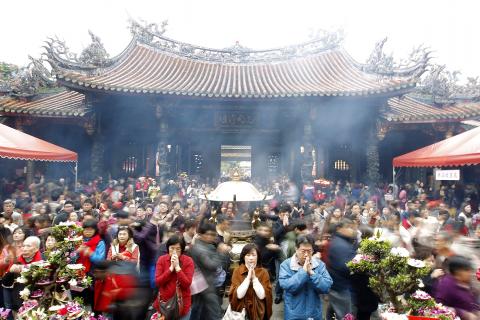
Photo: Pichi Chuang, Reuters
“It’s horrible,” one person cried, stuck tightly into the crowd moving slowly toward the burner, each person holding several burning sticks of incense in their hands.
Others complained of a lack of order as people swarmed to reach the burner.
However, the race is not necessary, Taiwanese folklore expert Liu Huan-yueh said, because the first incense stick of the year is a personal thing and does not require being the first among thousands.
Many myths and legends surround the origin of Lunar New Year activities, including the most popular one — the tale of the monster “Nian” (年), which is a homophone for the word “year” in Chinese.
The Taiwan Folklore and Culture Research Workshop run by Providence University’s Chinese literature department says “Nian,” who is reputed to live in a deep mountain forest, is the reason that people in ancient China began to celebrate Lunar New Year.
The stories say the fierce beast would come out of hiding every spring to attack people, especially children, around the Lunar New Year. To scare it off, people would set off firecrackers to make noise, light fires and wear red.
In Taiwan, the origin of the celebrations emerged from the mythology of a “Sinking Land,” the Taichung-based workshop said.
According to Taiwanese folk legend, a lower-ranked god named “Lamp Monkey” (燈猴), which protects the light in household oil lamps, is said to have complained to the Jade Emperor (玉皇大帝) about the behavior of mortals.
Lamp Monkey, angry because mortals did not know he existed, accused humans of being ungrateful and unwilling to work hard. The emperor decided to sink Taiwan into the sea on the eve of Lunar New Year as a punishment.
Informed of the bad news, the island’s residents put on their best clothes and prepared the most luxurious foods they could find to share with family members and friends on what they believed was to be the last night of their life.
The feast developed into traditional family reunion dinner on Lunar New Year’s eve. The Taiwanese practice of staying up throughout the night with the family originates from the idea of people staying up waiting for the island to sink.
Legend says the Jade Emperor eventually canceled the punishment after finding out that Lamp Monkey had lied about humans’ lack of respect for the gods. To celebrate, the humans set off firecrackers, congratulated each other on their “rebirth” and visited temples to thank the gods for their blessings.
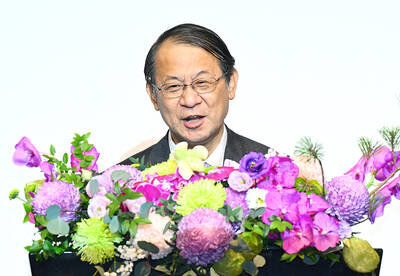
POSITIVE DEVELOPMENT: Japan and the US are expected to hold in-depth discussions on Taiwan-related issues during the meeting next month, Japanese sources said The holding of a Japan-US leaders’ meeting ahead of US President Donald Trump’s visit to China is positive news for Taiwan, former Japan-Taiwan Exchange Association representative Hiroyasu Izumi said yesterday. After the Liberal Democratic Party’s landslide victory in Japan’s House of Representatives election, Japanese Prime Minister Sanae Takaichi is scheduled to visit the US next month, where she is to meet with Trump ahead of the US president’s planned visit to China from March 31 to April 2 for a meeting with Chinese President Xi Jinping (習近平). Japan and the US are expected to hold in-depth discussions on Taiwan-related issues during the

‘LIKE-MINDED PARTNER’: Tako van Popta said it would be inappropriate to delay signing the deal with Taiwan because of China, adding he would promote the issue Canadian senators have stressed Taiwan’s importance for international trade and expressed enthusiasm for ensuring the Taiwan-Canada trade cooperation framework agreement is implemented this year. Representative to Canada Harry Tseng (曾厚仁) in an interview with the Central News Agency (CNA) said he was increasingly uneasy about Ottawa’s delays in signing the agreement, especially as Ottawa has warmed toward Beijing. There are “no negotiations left. Not only [is it] initialed, we have three versions of the text ready: English, French and Mandarin,” Tseng said. “That tells you how close we are to the final signature.” Tseng said that he hoped Canadian Prime Minister Mark Carney
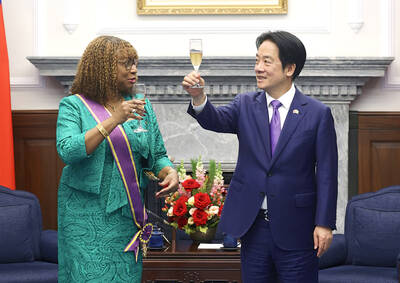
President William Lai (賴清德) yesterday bestowed one of Taiwan’s highest honors on Saint Vincent and the Grenadines (SVG) Ambassador Andrea Clare Bowman in recognition of her contributions to bilateral ties. “By conferring the Order of Brilliant Star with Grand Cordon on Ambassador Bowman today, I want to sincerely thank her, on behalf of the Taiwanese people, for her outstanding contribution to deepening diplomatic ties between Taiwan and SVG,” Lai said at a ceremony held at the Presidential Office in Taipei. He noted that Bowman became SVG’s first ambassador to Taiwan in 2019 and
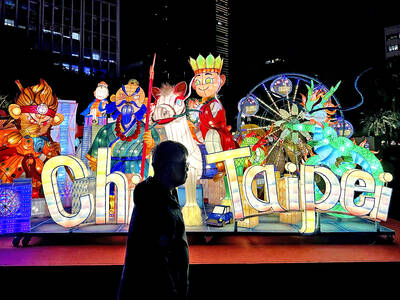
A man walks past elementary school artworks at the Taipei Lantern Festival in Ximen District yesterday, the first day of the event. The festival is to run from 5pm to 10pm through March 15.


 RSS
RSS