

When graduate student Wang Rong-lu (王融祿) and college senior Shao Chi-hong (邵繼泓) heard the announcement of the launch of the Puyuma Express (普悠瑪號) tilting train earlier this year, they were eager to buy tickets for the maiden service.
Rather than booking regular seats, they decided to book table seats, which the nation’s other tilting train service, the Taroko Express (太魯閣號), does not have. However, the administration required those wanting to book table seats to buy four tickets at a time.
“There were only two of us, so we decided to split the cost of four tickets,” Wang said. “The [table] is a new design and I wanted to see what it was like sitting in a seat facing the opposite direction to the train’s.”
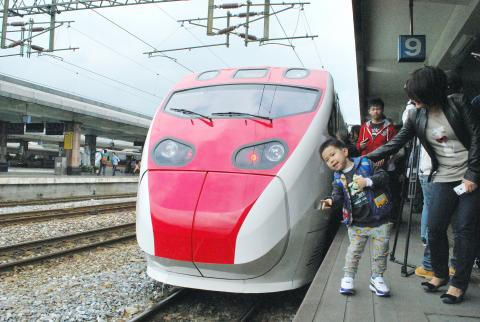
Photo: CNA
Wang also recalled the difficulty of booking tickets for the first running of the train.
“The first run happened to coincide with the rush for train tickets for the Lunar New Year holidays,” Wang said.
“We both tried to get onto the TRA system as soon as the booking session began at midnight. I got in eventually, but he [Shao] did not. I bought the tickets within five minutes of hitting the ‘refresh’ button a gazillion times,” he said.
They said they planned to take the train all the way to Hualien and take the Puyuma Express again in the afternoon when they returned.
Wang and Shao were two of the excited passengers boarding the new train at Shulin Station yesterday. Others also said that purchasing tickets required a group effort.
However, a woman surnamed Lu (呂) and her six-year-old son got on the train by accident.
She bought tickets for the Tzuchiang Express and thought that they could use them to board the Puyuma Express as well.
“We wanted to get a feel of the new train by traveling from Shulin to Banciao, but I did not know you had to designate the train service. They let me take it anyway. Hopefully, we’ll get to take the Puyuma Express all the way to Hualien next time,” she said.
Another student, surnamed Cheng (鄭), told the Taipei Times that he is from Hualien and left home early to take the Puyuma Express in Shulin.
While some of the passengers appeared to be impressed by the new tilting train’s facilities — velvet fabric-covered seats, spacious washrooms, a nursery room and vending machines — some noticed that the flat-panel screen displaying information about the train was smaller than that on the Taroko Express.
Children may also need help from their parents when boarding the train because it is higher than the platform.
Some also complained that they felt the train shaking when there was a curve in the track.
Train driver Tan Ming-te (譚明德) has been operating trains for more than 20 years. He also operated the Taroko Express when it was first unveiled to the media.
“The only difference [between the two tilting trains] is the way they tilt when driven through a curve,” Tan said.

The donation of offshore patrol vessel Kinmen to the Philippines includes provisions that protect Taiwanese fishers and facilitate security cooperation across the First Island Chain, officials said yesterday. The comment was made during the Cabinet’s comprehensive administrative report at the legislature after Chinese Nationalist Party (KMT) Legislator Hsu Yu-chen (許宇甄) expressed concerns about the decision to give a ship to a country whose coast guard had in 2013 fired on a Taiwanese trawler and killed its captain without provocation. The Cabinet should lay out the safeguards that have been established to prevent the Philippine government from using the Kinmen to harass, expel
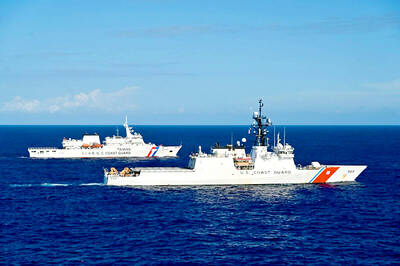
GROWING TIES: The CGA is planning a goodwill mission to the Philippines, in what would be the first time since 1975 a Taiwanese paramilitary vessel has visited the country The Coast Guard Administration (CGA) plans to significantly expand its participation in international security cooperative frameworks and its operational capabilities, a budget proposal for next year showed. The budget indicates a transformation of the CGA from a maritime law enforcement arm into a national defense and intelligence gathering entity capable of tackling larger regional security matters. The proposal showed that personnel from the coast guard’s Intelligence Division and Special Action Support Center are to participate in high-level national security talks with the US. As the CGA has dealt with China’s rising “gray zone” threats around Taiwan, it has become a valuable asset to
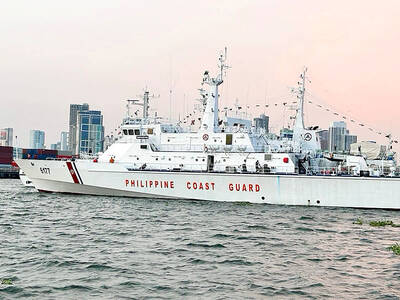
A patrol vessel donated by the Coast Guard Administration (CGA) to the Philippines was commissioned into the Philippine Coast Guard (PCG) on Friday, a Philippine non-governmental organization said. The CGA on Sept. 16 confirmed media reports that Taiwan had donated a retired 500-tonne patrol vessel to the Philippines. The Manila-based We Protect Our Seas (WPS) foundation, which served as an intermediary in the transfer, said that the vessel was formerly the CGA’s 500-tonne petrol vessel Kinmen (CG123). The WPS, in a statement issued on Friday, said the vessel, renamed as the BRP Sarangani, had been commissioned into the PCG the
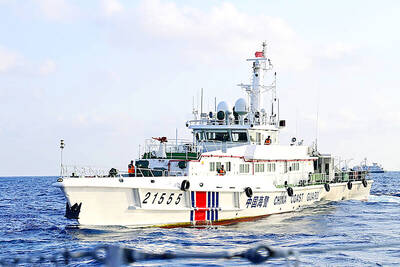
‘GRAY ZONE’ TACTICS: Beijing sent two China Coast Guard vessels to escort a ‘supposedly private research ship,’ a Philippine Coast Guard spokesman said The Coast Guard Administration (CGA) yesterday confirmed that it had recently deployed three patrol vessels to waters in Taiwan’s overlapping exclusive economic zone with the Philippines to monitor three Chinese vessels. CGA Deputy Director-General Hsieh Ching-chin (謝慶欽) said the agency regularly monitors Chinese vessels around Taiwan, and that the deployment south of Oluanpi (鵝鑾鼻), Taiwan proper’s southernmost point, was carried out in accordance with standard procedures. He added that the waters fall within the overlapping exclusive economic zones of Taiwan and the Philippines, which extend 200 nautical miles (370km) from their coastlines. Hsieh made the comments when asked about a


 RSS
RSS