


The National Communications Commission (NCC) is scheduled to make public the bidding price for fourth-generation (4G) telecoms service licenses by the end of June, the regulator said yesterday. Many in the industry believe the price will be higher than that for third-generation (3G) services.
The government announced last year that it would release a total of 270MHz of radio frequencies in the spectrum of 700MHz, 900MHz and 1,800MHz for 4G service use.
The commission drafted regulations governing the issuance of the licenses and held a public hearing in November last year.
The commission has made some changes to the draft regulations after hearing opinions from telecoms operators, reducing the minimum units needed to launch mobile broadband services from 15MHz to 10MHz, both to upload and download speeds, spokesperson Yu Hsiao-cheng (虞孝成) said.
If there are five or more qualified bidders, the total frequencies each bidder can obtain will be capped at 35MHz, Yu said, adding that the cap would be raised to 40MHz if there were only four qualified bidders.
For three or fewer bidders, the frequencies each can obtain is capped at 45MHz, he added.
Those interested in obtaining a license must have at least NT$6 billion (US$207.1 million) in capital and be able to afford a bid bond of NT$1 billion. They will also have to pass a qualification review before they can attend the bidding, Yu said.
The commission will use a simultaneous, multiple-round and ascending bid auction system, Yu said. Each bidder will be able to quote the price for each round onve, with the quoted price being a multiple of NT$5 million.
A quote would be considered ineffective if the bidder violates the bidding requirementd.
A bidder would be disqualified if it does not quote the price or places an ineffective bid during the first round.
A bidder would be banned from quoting prices if it gives up the right to do so more than three times in the second and following rounds.
Telecoms carriers must meet several requirements before they are permitted to sell or trade the frequencies they obtain, Yu said.
“Our concern was that some would simply bid for frequencies and then sell them for a higher price without first building the infrastructure needed to provide services,” Yu said.
Therefore bidders will be required to build at least 250 base stations as well as other relevant infrastructure before they can sell their frequencies, he said. Carriers must also obtain approval for the transaction and the certification of the network infrastructure from the commission before a deal could take effect.
Tsai Kuo-tung (蔡國棟), a specialist with the commission’s competitive policy division, said there are still carriers offering the global system for mobile communication (GSM) service in the frequencies up for bid. Some may not obtain the frequency they thought they owned through the bidding process, Tsai said.
The commission only allows GSM service carriers to trade the frequencies, Tsai said, adding they are not required to build facilities first.
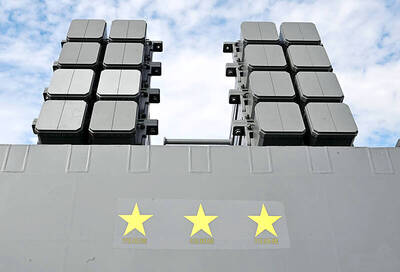
UPGRADE: The Kang Ding-class frigate is replacing its Chaparall missiles with Tien Chien II and Hua Yang VLS, which would provide it with long-range, 360° air defense Taiwan plans to produce 1,200 to 1,376 Hai Chien II missiles (海劍二, Sea Sword II) — also known as TC-2N — to serve as the standard air defense system of the navy’s surface combatant fleet, a source said yesterday. Last week, the Hai Chien II, the naval version of the Tien Kung II missile (天劍二, Sky Sword II), completed a live-fire test in waters off the National Chungshan Institute of Science and Technology’s Jiupeng facility (九鵬) in Pingtung County’s Manjhou Township (滿州). The MIM72 Chaparral and other dated air defense missiles that currently arm Taiwanese ships have inadequate range to combat Chinese

REASONS FOR TRAVEL: An assistant professor said that proposed amendments to penalize drivers if they used drugs overseas would not deter people from traveling People who operate a motor vehicle under the influence of marijuana would have their driver’s license revoked, even if they used the substance while overseas, the Ministry of Transportation and Communications said yesterday, citing proposed amendments to the Road Traffic Management and Penalty Act (道路交通管理處罰條例). The amendments would also authorize the government to revoke the licenses of people determined to have used Category 1 or Category 2 narcotics, even if they were not operating a vehicle while under the influence of drugs, as well as ban them from taking the license test for three years, the ministry said. People aged 18 or

HEAVY WEATHER: Typhoon Jangmi is due to crash straight into the Ryukyus as airlines look to shift flights to larger aircraft or cancel flights to Okinawa entirely Taiwan’s international air carriers announced flight adjustments over the weekend as Typhoon Jangmi is forecast to hit the Ryukyu Islands today and tomorrow. The Central Weather Administration (CWA) upgraded Jangmi from a tropical storm to a typhoon at 8am yesterday, with the eye located 580km south of Naha city. It was moving north at 19kph. Today, China Airlines’ CI-120, CI-121, CI-122 and CI-123 flights between Taoyuan and Naha, Okinawa, have been canceled as well as CI-132 and CI-133 between Kaohsiung and Naha. EVA Air’s BR-112, BR-113, BR-186 and BR-185 flights between Taoyuan and Naha are also canceled. Low-cost carrier Tigerair Taiwan canceled IT-230,
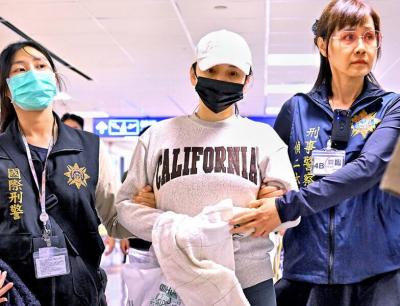
Johanne Liou (劉喬安), a Taiwanese woman who shot to unwanted fame during the Sunflower movement protests in 2014, returned to Taiwan last night after being deported from the US. She is to stand trial in Taiwan for charges involving embezzlement, fraud and drug crimes. The Criminal Investigation Bureau (CIB) said it took her into custody at Taiwan Taoyuan International Airport and would first question her before transferring her to the New Taipei District Prosecutors’ Office. She was arrested upon disembarking a flight from San Francisco that landed shortly before 7pm. Liou absconded to the US in 2019 after jumping bail


 RSS
RSS