


With temperatures dropping in recent weeks, consumers should pay close attention to the labeling on “hot spring” powders, as only one out of 44 products recently tested by the Consumer Protection Committee was found to actually contain substances extracted from thermal spring water, while the rest contained a mixture of chemicals and bath salts.
In October, the committee conducted tests on 44 hot spring powders, some claiming to have curative effects, purchased from shopping centers and department stores in seven cities and counties.
Apart from a bath powder imported from Japan by Taipei-based Yuantai Trading Co, the others were mainly comprised of chemicals such as sodium hydrogen carbonate and sodium sulfate, as well as bath salts, according to test results released on Monday.
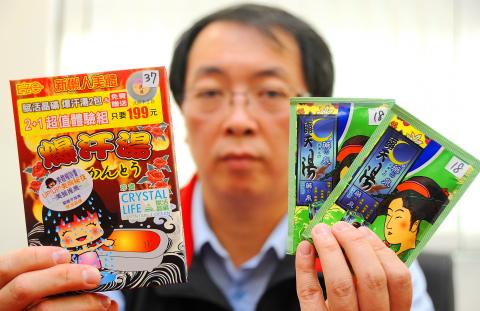
Photo: Liu Hsin-de, Taipei Times
“Customers who purchase such products may end up bathing in water laced with chemicals,” consumer protection official Wang Teh-ming (王德明) said.
Some of the products tested exaggerated their effects or provided deceitful labeling information, which not only misleads customers, but also constitutes violations of several regulations, the report said.
A product imported by Adoration International Co, which claimed curative effects for sprains, eczema, neuropathic pain and hemorrhoids, was found to be in violation of Article 69 of the Pharmaceutical Affairs Act (藥事法), Food and Drug Administration Director Lin Cheng-chin (林澄琴) said.
The article forbids advertisements or labels regarding the medical efficacy of any products that are not defined in the act as medications
In response, Adoration proprietor Lin Ching-kuo (林進國) said the product’s claimed medical capabilities were direct translations from the packaging of its Japanese manufacturer and pledged to recall the product and make the necessary corrections.
Three other items tested which trumpeted the effects of stimulating blood circulation and metabolism may also contravene the Fair Trade Act (公平交易法) by bearing false and exaggerated advertising labels, Lin Cheng-chin said. Transgressions are punishable by a maximum fine of NT$25 million (US$783,000).
Additionally, five products manufactured by Tengchi Ltd could incur fines of up to NT$100,000 as stipulated by the Statute for Control of Cosmetic Hygiene for listing vitamin C, milk extracts and natural mineral substances among their ingredients, none of which were found in tests, the report said.
When reached for comment, an accountant at Tengchi, surnamed Wang (王), said: “How could [the tested products] possibly contain milk extracts, as the term only refers to the fragrance of the product itself? We will pull the products in question off the shelves for re-packaging.”
Meanwhile, one product was found to have allegedly misappropriated the name of Changhua-based Shoufu Biotech Co as its manufacturer. Shoufu owner Liu Yi-cheng (劉怡成) has signed an affidavit saying that the company’s shipment records prove that the company was not the producer of the products.
Urging people to wash with clean water after using such products to prevent harmful substances left on the skin from further oxidizing, Gaston Wu (吳家誠), a professor in chemistry at National Taiwan Normal University, said soaking in water containing sodium hydrogen carbonate and sodium sulfate could lead to skin inflammation and infection.
“Since children have less resistance to disease, parents should be more careful,” Wu said.
Wu said that since most hot spring water in the country is at high temperature and under strict control, it is extremely difficult to acquire thermal water and have it processed into powders.
“Domestic manufacturers who claim their hot spring bath powders are extracted from hot spring water may actually use ‘second-hand thermal spring water’ in which people have bathed,” Wu said.

Considering that most countries issue more than five denominations of banknotes, the central bank has decided to redesign all five denominations, the bank said as it prepares for the first major overhaul of the banknotes in more than 24 years. Central bank Governor Yang Chin-lung (楊金龍) is expected to report to the Legislative Yuan today on the bank’s operations and the redesign’s progress. The bank in a report sent to the legislature ahead of today’s meeting said it had commissioned a survey on the public’s preferences. Survey results showed that NT$100 and NT$1,000 banknotes are the most commonly used, while NT$200 and NT$2,000

The Centers for Disease Control (CDC) yesterday reported the first case of a new COVID-19 subvariant — BA.3.2 — in a 10-year-old Singaporean girl who had a fever upon arrival in Taiwan and tested positive for the disease. The girl left Taiwan on March 20 and the case did not have a direct impact on the local community, it said. The WHO added the BA.3.2 strain to its list of Variants Under Monitoring in December last year, but this was the first imported case of the COVID-19 variant in Taiwan, CDC Deputy Director-General Lin Ming-cheng (林明誠) said. The girl arrived in Taiwan on

South Korea is planning to revise its controversial electronic arrival card, a step Taiwanese officials said prompted them to hold off on planned retaliatory measures, a South Korean media report said yesterday. A Yonhap News Agency report said that the South Korean Ministry of Foreign Affairs is planning to remove the “previous departure place” and “next destination” fields from its e-arrival card system. The plan, reached after interagency consultations, is under review and aims to simplify entry procedures and align the electronic form with the paper version, a South Korean ministry official said. The fields — which appeared only on the electronic form

The Ministry of Foreign Affairs (MOFA) is suspending retaliation measures against South Korea that were set to take effect tomorrow, after Seoul said it is updating its e-arrival system, MOFA said today. The measures were to be a new round of retaliation after Taiwan on March 1 changed South Korea's designation on government-issued alien resident certificates held by South Korean nationals to "South Korea” from the "Republic of Korea," the country’s official name. The move came after months of protests to Seoul over its listing of Taiwan as "China (Taiwan)" in dropdown menus on its new online immigration entry system. MOFA last week


 RSS
RSS