

The Executive Yuan’s recent approval of the Taoyuan Aerotropolis project has made many local residents fearful that the new development will result in them being forcefully relocated and losing their farmland.
To solicit public opinion and establish a dialogue with concerned residents, local and central government agencies are to conduct public hearings about the aerospace industrial park and its accompanying special zoning development at the Dayuan (大園) and Lujhu (蘆竹) township offices, and also at the Taoyuan County Government’s offices.
In addition, eight town hall meetings will be held in the affected local villages on Saturdays, starting last weekend and ending on Jan. 5. The meetings will be jointly organized by the Ministry of Transportation and Communications and the Taoyuan County Government’s Urban and Rural Development Bureau.
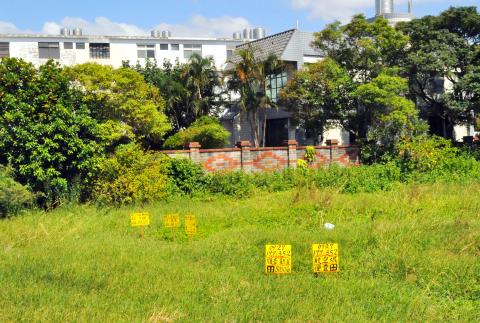
Photo: Lee Jung-ping, Taipei Times
The government’s green-lighting of the NT$463 billion (US$15.78 billion) Taoyuan Aerotropolis project has given the housing market in the surrounding areas a big boost, judging by the numerous real-estate agency billboards and banners littering the fields, roads and buildings in the areas close to the planned development.
However, most locals have mixed feeling about the project. They recognize the potential economic benefits, but hope the government can protect their rights to retain their homes and will not force them to relocate, as has happened in the past.
According to one estimate, the Taoyuan Aerotropolis project and its surrounding special zoning development would encompass 20 villages in the Dayuan and Lujhu townships, covering 4,686 hectares of land. Of these, 3,211 hectares would require land expropriation by the government, which would affect 12,000 households and 18,000 individuals.
Since the public hearings got under way this month, village wardens in the affected areas are working to ensure that each household is aware of when and where the meetings will take place. They are also discussing the issues with residents to gather their opinions so that everyone’s views could be heard at the meetings.
Kuo Cheng-ming (郭正明), mayor of Dahai Village (大海) in Dayuan Township, said most of the long-term residents of the village, such as those from his father’s and grandfather’s generation, have had to move their homes twice in the past decades due to government land expropriation — first for the construction of the Taoyuan Air Force Base and then for the Taiwan Taoyuan International Airport.
“We never thought we would have to move again,” he said.
Kuo added that outsiders who have the impression that locals are getting rich from the project because of real-estate prices jumping to between NT$50,000 and NT$60,000 per ping (3.3m2) in some places have the wrong idea.
“Some villagers do not own land and now all three generations of their family may possibly have to move. It is painful for them. Also, when the land is expropriated by the government, the residents may not be able to afford new homes with the compensation they are paid. Will they still have a house to live in? Things remain very uncertain for a lot of people,” he said.
Kuo called for special allowances to be made for the many villagers living in old houses for which they did not obtain proper construction permits, which would mean they are not eligible for compensation if forced to relocate.
Yang Chuan-chu (楊全居), mayor of Kengkou Village (坑口) in Lujhu Township, said the law stipulates that residents may only apply for permits to build farm housing once and so many farmers in his village are worried that once their farm residences are torn down, they will not have the right to apply again to build new ones.
“The government should make special allowances in these cases, as it did during the Taiwan High-Speed Railway construction project, so that villagers can rebuild their houses somewhere else,” Yang said.
Urban and Rural Development Bureau head Wu Chi-min (吳啟民) said that if the views and opinions expressed by the residents are reasonable and justified, the Taoyuan County Government will champion their demands to the central government so the project can be a win-win situation for both the developers and the township residents.

NATURE TAKES ITS COURSE: The agency’s head said he felt a sense of loss watching red-banded snakes eat the babies, as they had decided on non-intervention The Forestry and Nature Conservation Agency yesterday released a documentary on a hundred-pace viper that had incubated 16 eggs, all of which hatched, but only a baby viper escaped after they were attacked by red-banded snakes. The agency’s Taichung branch last year launched the viper reproduction monitoring project soon after forest rangers Lin Chun-yu (林俊佑) and Chou Chia-cheng (周家成) spotted a pregnant hundred-pace viper in a grass-covered burrow near a parking lot in Tbulan Village (松鶴部落). The Atayal village, in Taichung’s Heping District (和平), is headed by Ecyang Yapu, who was positive about the project and assisted in access control and power

The Coast Guard Administration (CGA) yesterday said that it had deployed vessels to “monitor” Chinese ships operating in waters off the east coast. The CGA said it dispatched vessels in response to a China Coast Guard announcement that it had carried out another “routine law-enforcement patrol” in waters off the east coast. “The CGA firmly rejects China’s cognitive warfare campaign of ‘law enforcement in name, jurisdictional expansion in practice,’” it said on X. As of 11am yesterday, two China Coast Guard ships were “loitering and drifting” about 105 nautical miles (195km) and 74 nautical miles east of Green Island (綠島) respectively, it said. It

A sharp rise in compensation to be paid by air force officers who leave before completing their required service could indicate an increase in pilots leaving the military early, an analyst said on Friday, warning that the trend could worsen a shortage of experienced personnel. Chieh Chung (揭仲), a researcher at the Association for Strategic Foresight, issued the warning even though the number of volunteer military personnel is expected to increase next year. The planned headcount for volunteer military personnel, covering officers, noncommissioned officers (NCO) and enlisted soldiers, is 158,223 for next year, up 4,258 from 153,965 this year, Chieh said. The increase
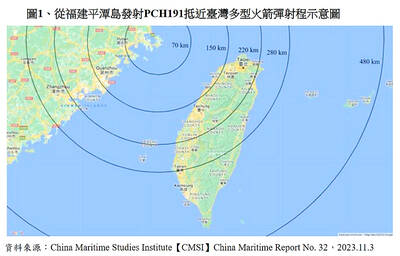
Potential improvements to munitions used by China’s long-range rocket-artillery units could extend their range to cover the entire Miyako Strait, which might give the Chinese People’s Liberation Army (PLA) the ability to secure the strategic waterway, the Mainland Affairs Council (MAC) said in a report. The PLA’s long-range rocket-artillery units deployed along the Taiwan Strait are concentrated along the coast of Fujian Province, including Changle, Pingtan and Shishi, the quarterly report on China said. The artillery brigades of the PLA’s 71st, 72nd and 73rd group armies have been deployed, with preparations for potential battlefield operations under way since August 2022, the report


 RSS
RSS