


Taiwan is one of the few countries that does not have Confucius Institutes — outposts of the Chinese government that have sprung up around the world — but local academics are eager to look into the strategic considerations of the cultural centers.
Under a two-year project at Academia Sinica’s Center for Asia-Pacific Area Studies, researchers tentatively concluded that political outreach in the form of language teaching and cultural exchanges aimed at improving China’s image abroad has been met with concern about academic autonomy in host institutions.
“There are three T’s and one D seen as taboo in Confucius Institutes — Taiwan, Tibet, [the] Tiananmen Square [massacre] and the Dalai Lama … Falun Gong is also an absolute no-no,” said Michael Hsiao (蕭新煌), chairman of Academia Sinica’s Institute of Sociology, who leads the project.
Hsiao said he learned the implicit rules about off-limit topics during interviews with staff at host institutions in Southeast Asian countries and in the US during his fieldwork.
A large part of the project was to collect empirical evidence on how China implements the institutes, the impact on host countries and how they respond to the strategy.
China established the Office of Chinese Language Council International — known as Hanban — under the State Council in 1987 to promote Chinese language learning worldwide.
The office launched an initiative to establish Confucius Institutes within higher education institutions in 2004, following a related program which partners with schools abroad to open “Confucius Classrooms.”
The institutions are named after Confucius, a philosopher in ancient China, who believed a harmonious society is built on personal morality.
According to last year’s annual report, there are 358 institutes, and 500 Confucius Classrooms in 105 countries, Hsiao said.
The Chinese government’s goal is to exceed 1,000 insitutes by 2020, Hsiao added.
The rapid increase in the number of institutes gives Beijing convincing evidence of the initiatives’ success, Hsiao said.
From 2006 to last year, the growth rate in Confucius Institutes was 586 percent, with the number of institutes jumping from 125 to 858.
The number of countries hosting the offices increased from 49 to 105, a 114 percent increase, he said.
There are reportedly more than 40 countries and more than 200 institutions still on the waiting list for such projects, he added.
“It’s a smart move. However, criticism has arisen,” Hsiao said, when presenting a paper which examines the risk of the initiative and China’s “soft power” diplomacy at an international workshop titled: “Confucius Institutes in Asia and Beyond” on Nov. 30 at Academia Sinica.
There have been several disputes in universities in the US and Europe about whether to accept Confucius Institutes, and these cases “really show that money talks,” Hsiao said.
“People in favor of the institutes say they bring in revenue and provide opportunities for students to learn Chinese. Those opposed to the initiative worry they place limitations on academic freedom and dislike the political machinations behind them,” he said.
Hsiao said knew of one case where a professor was ousted from her position as director of an Asia-Pacific study center and transferred to another department because she was opposed the institutes.
“How do they work? She told me that China gives money to people who are not well known and who will research from peripheral and insignificant positions and thus develop pro-China attitudes. They just buy you out,” Hsiao said.
China spends large amounts on the project, Hsiao said. From 2006 onwards, the initative’s annual budget was 350 million yuan (US$56.2 million), 460 million yuan, 820 million yuan, 1.23 billion yuan, 859 million yuan and 1.21 billion yuan, he said.
Confucius Institutes have two defining features which contrast them with the likes of the Goethe Institute or the British Council, said Wang Juei-chi (王瑞琦), a research fellow at the Institute of International Relations (IIR) at National Chengchi University.
First, they are funded by the Chinese government and operate under its guidelines and directions via a Beijing headquarters.
Second, they are affiliated with higher-education institutions and operate within host universities on a partnership basis, while the financing is shared between Hanban and host institutions, Wang said.
Such attributes combined with Hanban’s funding for facilities, maintenance, teachers, and educational materials have raised concerns about their influence on academic freedom and the possibility of industrial espionage, she said.
A study of the implementation of Confucius Institutes in Thailand, by Alan Yang (楊昊), an assistant research fellow at the Institute of International Relations, said China is “extremely strict in its review of political attitudes of volunteers” who work and teach at the institutes.
Participants are required to state their “social connections” and “political inclinations.”
They are also required to make a political declaration that they “do not participate in the Falung Gong movement or any other activities that harm China’s national interests,” Yang said.
Hsiao described how Chinese teachers and volunteers are more like “civil diplomats” rather than “academics.”
In Thailand, China places particular emphasis on the training of Thai-Chinese teachers.
The Thai government selects teachers and college graduates to study in China for one or two years to learn Chinese before they can return to Thailand to teach under a bilateral teaching framework agreement in place since 2006, Yang said.
Yang’s study found that Cambodia is very supportive of the Confucius initiative and mobilizes government staff and Chinese school students to take part in related activities, which “display the obvious intention of the government to promote the initiative.”
Nguyeh Van Chinh, a professor at Vietnam National University, said that Vietnam is the only country in the Mekong region which does not seem to welcome Confucius Institutes.
There is a popular conception in Vietnam that teaching Chinese is not simply about providing language skills, he said.
“It is believed that the language conveys Chinese history, culture and way of thinking to Vietnamese,” he said.
Nguyeh’s study corroborated the finding of Yang regarding how Hanban controls the institutes.
In Thailand, each institute has the freedom to design its own programs, but they must be approved before implementation, he said.
“Hanban places a strong emphasis on the importance of textbooks originating from China and institute’s boards have limited power as they are placed directly under the administration of headquarters in Beijing,” Nguyeh’s study said.
In recent years, China has shifted its focus from Asia to the EU and the US, Hsiao said.
“If you look at the global map of Confucius Institutes, you can see the hierarchy of importance. Europe and North America now have more than three-fourths of all the institutes,” he said.
The initiative is aimed at persuading international society to recognize a new and benign China — it is rising with a civilized, democratic, open and progressive image, despite the fact that it remains unsupportive of human rights, he said.
Chang Mau-kuei (張茂桂), a research fellow at Academic Sinica’s Institute of Sociology, said that through the establishment of the institutes, Beijing tries to use Confucianism to define China.
However, “it is always a problem to use Confucianism to represent China,” Chang said.
“In China, Confucius temples were never built by the people. They were always built by the state, by the empire, by the dynasty. Confucianism is a state ideology. Even today, on Confucius’ birthday, it’s the state leaders or the mayors who go there to pray. So we can say Confucius represents guan wen hua [官文化, official culture], not China,” Chang said.
Confucianism is only part of China, Chang added.
“You have to add Muslim, Uyghurs, Tibetans, Buddhism and numerous minority people to encapsulate the entire China,” he said.
The institutes serve as “state cosmetics” and do not help understanding of the real China, Chang said.
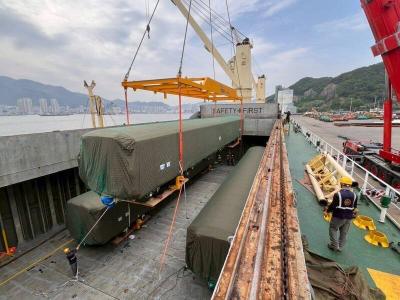
The first of 10 new high-capacity trains purchased from South Korea’s Hyundai Rotem arrived at the Port of Taipei yesterday to meet the demands of an expanding metro network, Taipei Rapid Transit Corp (TRTC) said yesterday. The train completed a three-day, 1,200km voyage from the Port of Masan in South Korea, the company said. Costing NT$590 million (US$18.79 million) each, the new six-carriage trains feature a redesigned interior based on "human-centric" transportation concepts, TRTC said. The design utilizes continuous longitudinal seating to widen the aisles and optimize passenger flow, while also upgrading passenger information displays and driving control systems for a more comfortable
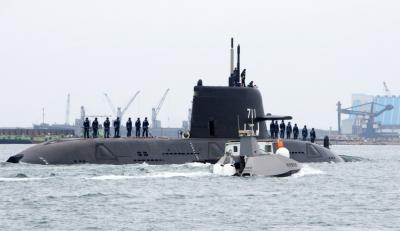
Taiwan's first indigenous defense submarine, the SS-711 Hai Kun (海鯤, or Narwhal), departed for its 13th sea trial at 7am today, marking its seventh submerged test, with delivery to the navy scheduled for July. The outing also marked its first sea deployment since President William Lai (賴清德) boarded the submarine for an inspection on March 19, drawing a crowd of military enthusiasts who gathered to show support. The submarine this morning departed port accompanied by CSBC Corp’s Endeavor Manta (奮進魔鬼魚號) uncrewed surface vessel and a navy M109 assault boat. Amid public interest in key milestones such as torpedo-launching operations and overnight submerged trials,
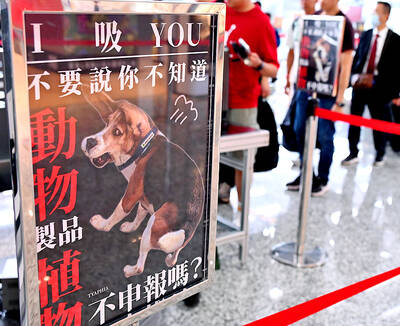
Quarantine awareness posters at Taiwan Taoyuan International Airport have gone viral for their use of wordplay. Issued by the airport branch of the Animal and Plant Health Inspection Agency, the posters feature sniffer dogs making a range of facial expressions, paired with advisory messages built around homophones. “We update the messages for holidays and campaign needs, periodically refreshing materials to attract people’s attention,” quarantine officials said. “The aim is to use the dogs’ appeal to draw focus to quarantine regulations.” A Japanese traveler visiting Taiwan has posted a photo on X of a poster showing a quarantine dog with a

SECURITY RISK: A university student sent a general alarm signal to THSRC’s control center on April 5, causing four operating trains to temporarily halt services The Ministry of Transportation and Communications yesterday pledged to submit a report on ways to harden the communication security of railway systems after a university student hacked into Taiwan High Speed Rail Corp’s (THSRC) radio communications system and disrupted operations of four high-speed rail trains last month. Investigation by the police and prosecutors found that the university student and radio enthusiast, surnamed Lin (林), first used a software-defined radio (SDR) filter to analyze THSRC signals, downloaded the data to a computer, cracked the parameters and then programmed the codes into his radio devices. Lin then sent a general alarm signal to


 RSS
RSS