


After rediscovering long-forgotten World War II air-raid shelters in Hualien City, six elementary-school children have produced hand-drawn maps of their locations in hopes of reviving public interest and encouraging local authorities to take steps to preserve them as historic sites.
The students, from Yichang Elementary School in Jian Township (吉安), found the 25 air-raid shelters while doing research for a history project competition held from September to last month.
The shelters were built toward the end of Japanese colonial rule for people to take refuge against US bombing raids. The US was heavily engaged in the war against Japanese forces in Japan and its Asian colonies — including Taiwan — during the latter phase of World War II.
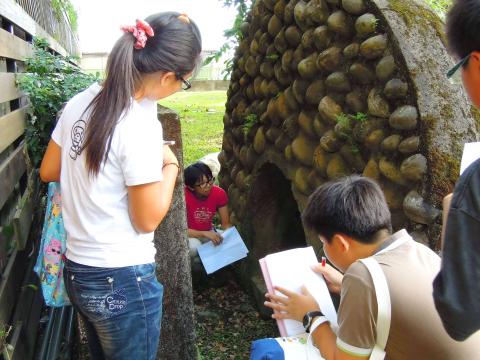
Photo courtesy of Yichang Elementary School
It took about three months of research and investigation by the six students — Tsai Wei (蔡維), Ho Wei-min (何維敏), Chen Ting-yu (陳亭毓), Yeh Kuang-yu (葉冠宇), Wu Ming-han (吳明翰) and Chiu Tung-yu (邱東宇) — to find and compile information on the underground shelters.
The six undertook the investigation with enthusiasm, checking old files, going on field visits and photographing each site.
They created a “Hualien Air-Raid Shelter Survey Checklist” detailing their observations of the conditions and dimensions of each structure, taking photos and interviewing senior residents to collect information about the sites.
The project received an “Award of Excellence” in a competition on local history research by the Hualien County Bureau of Education late last month.
The students’ research shows that Hualien City still has 25 air-raid shelters, six of which are the property of the Taiwan Railways Administration (TRA).
The shelters can be found around the Hualien Railroad Culture Museum, Hualien Pine Garden (which served as the headquarters of Japanese naval officers during war), Hualien Weather Station, the Generals’ Residence Complex (residences for Japanese generals and high-ranking officers during the war), Dong Ching Temple, Keng Shen News Building, Chung Cheng Sports Complex at Hua Gang Mountain, the old Taiwan Railways Administration Hospital, the old Hualien Winery, the old Hualien City Railway Station, Feng Shing Bakery Shop and King Tang Cafe buildings downtown, among other locations.
One of the students, Ho, said most of the air-raid shelters were built by government agencies during the war for officers and staff to take cover when necessary. The remainder were built by private citizens, with wealthy families constructing underground shelters around their house using bricks and mortar, while others dug trenches for shelter.
Ho said the shelters were used to hide from US bombing raids during the war. After the war, they were used for air-raid drills, in case of an attack from communist China.
Talking about the research and interviews for the project, Tsai said they prepared the questions beforehand, and then wrote a report afterward.
He added that they had to prepare a briefing report and oral presentation to enter the competition and answer questions posed by a panel of judges.
After the rigors of the competition, he said: “We learned quite a lot from this project. Compared with taking classes in school, this is so much more fun.”
Another team member, Chiu, said: “We hope to put the project report on the Internet to share it with other people.”
“It can provide useful information for visitors who might be interested in exploring these air-raid shelters,” he said.
Chung Hui-yu, their teacher and supervisor, said the objective of the project was for students to conduct their own research, pinpoint problems and find solutions.
She said the students also found that quite a number of the shelters were in ruins, because nobody was responsible for their preservation and management.
As many of them are still TRA properties, the students visited the Hualien County Cultural Affairs Bureau, TRA offices and other agencies, suggesting that they make use of the air-raid shelters to promote “cultural tourism” in Hualien.
She added that the students had presented other ideas that the government could consider, with the group producing hand-drawn maps, “exploration route” pamphlets and postcards on the locations and travel routes to the shelters that visitors can use while taking a walking or cycling tour of the city.

Considering that most countries issue more than five denominations of banknotes, the central bank has decided to redesign all five denominations, the bank said as it prepares for the first major overhaul of the banknotes in more than 24 years. Central bank Governor Yang Chin-lung (楊金龍) is expected to report to the Legislative Yuan today on the bank’s operations and the redesign’s progress. The bank in a report sent to the legislature ahead of today’s meeting said it had commissioned a survey on the public’s preferences. Survey results showed that NT$100 and NT$1,000 banknotes are the most commonly used, while NT$200 and NT$2,000

The Centers for Disease Control (CDC) yesterday reported the first case of a new COVID-19 subvariant — BA.3.2 — in a 10-year-old Singaporean girl who had a fever upon arrival in Taiwan and tested positive for the disease. The girl left Taiwan on March 20 and the case did not have a direct impact on the local community, it said. The WHO added the BA.3.2 strain to its list of Variants Under Monitoring in December last year, but this was the first imported case of the COVID-19 variant in Taiwan, CDC Deputy Director-General Lin Ming-cheng (林明誠) said. The girl arrived in Taiwan on

South Korea is planning to revise its controversial electronic arrival card, a step Taiwanese officials said prompted them to hold off on planned retaliatory measures, a South Korean media report said yesterday. A Yonhap News Agency report said that the South Korean Ministry of Foreign Affairs is planning to remove the “previous departure place” and “next destination” fields from its e-arrival card system. The plan, reached after interagency consultations, is under review and aims to simplify entry procedures and align the electronic form with the paper version, a South Korean ministry official said. The fields — which appeared only on the electronic form

The Ministry of Foreign Affairs (MOFA) is suspending retaliation measures against South Korea that were set to take effect tomorrow, after Seoul said it is updating its e-arrival system, MOFA said today. The measures were to be a new round of retaliation after Taiwan on March 1 changed South Korea's designation on government-issued alien resident certificates held by South Korean nationals to "South Korea” from the "Republic of Korea," the country’s official name. The move came after months of protests to Seoul over its listing of Taiwan as "China (Taiwan)" in dropdown menus on its new online immigration entry system. MOFA last week


 RSS
RSS