


Huang Yu-siang (黃裕翔) was born with a gift and a devastating disability. He has a huge talent for music, but he is blind. His story has become a movie that has captivated audiences nationwide.
The film, Touch of the Light (逆光飛翔), marks a double triumph for the 25-year-old. First he overcame overwhelming odds by becoming a successful pianist in real life. Then he beat the odds once more by playing himself on the big screen.
“I was surprised by the warm reactions at home and abroad. Many people told me they were encouraged by the film to persist in their dreams,” Huang said in an interview.
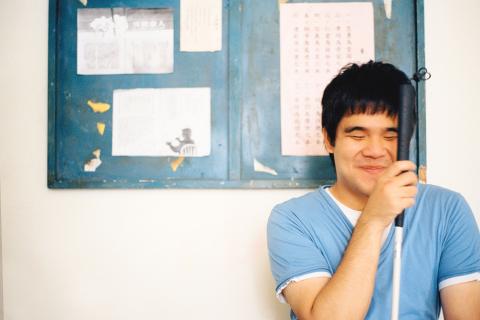
Photo: AFP
His musical gift was discovered at the age of two when he could play on the piano songs he had heard only once. He went on to win many competitions and became the first blind person in Taiwan to obtain a bachelor’s degree in music, majoring in piano.
His story was made into a short film in 2008 by Taiwanese director Chang Jung-chi (張榮吉), which attracted the attention of acclaimed Hong Kong filmmaker Wong Kar-wai (王家衛), who encouraged Chang to develop it into a full-length feature.
It has become the top-grossing movie in Taiwan since its September release, winning over fans including President Ma Ying-jeou (馬英九), who praised its “subtle character portrayals” on his Facebook page.
The film has also been welcomed by civil groups that hope it will sharpen the focus on the plight of the nation’s blind.
While attitudes toward those with disabilities have improved in recent years, support groups and charities say society still has some way to go when it comes to equality.
Although facilities for the physically impaired can be impressive — wheelchair ramps abound in cities — the fact remains that blind people face drastically limited opportunities.
“The visually impaired are a minority among the minorities, as employers are more willing to hire the physically or hearing-impaired,” said Chiang Pei-fen, a spokeswoman for the Taiwan Foundation for the Blind.
“Most visually impaired people are still limited to working as masseurs or in telemarketing, and even though general workplace acceptance is improving, there is still a big gap between the number of job seekers and employers willing to hire them,” Chiang said.
Despite his gift, Huang himself has suffered discrimination. He said he was mocked by fellow students at school and was rejected by a junior-high school music program because he could not see the scores.
The real shock came when Huang left home to attend university, where he struggled to cope, with some classmates reluctant to accommodate him.
“It was a difficult time adjusting to a new environment, but I came to realize that I could not always sit back and wait for other people to come to me. I had to take the initiative to make friends,” he said.
His adjustment process and the friendships he eventually developed form the bulk of the plot in Touch of the Light.
The experience has transformed Huang from a “shy, introverted” boy who dared not respond to people greeting him, he said, to a celebrity musician and actor who mingles with fans and has traveled abroad to promote his work.
“Acting makes me feel more confident and I have become more outgoing and more active, reaching out to other people,” said Huang, who is now a household name and often approached in the street by fans.
Even though the movie is based on Huang’s experiences, Chang stressed that it is really about “pursuing dreams and breaking stereotypes.”
“In the movie the character’s friends are not overly protective and do no treat him like an ‘endangered species’ as I want to break the sentimental pitying or worrying for the blind or other minority groups,” Chang said.
Huang has been nominated for the Outstanding Taiwanese Filmmaker category that encompassed actors, directors and other aspects of filmaking at this month’s Golden Horse Film awards, regarded as the Chinese-language Academy Awards. Chang is vying for best new director.
However, the jury is still out on whether the film’s success will translate into greater acceptance of the blind.
“It draws attention to the challenges visually impaired people face, but it remains to be seen how much can be translated into actual support for them,” Chiang said.

NATIONAL SECURITY: Authorities are working to confirm the identities of the military personnel involved and investigating possible illegal conduct and regulatory violations Authorities are probing possible national security implications after Kinmen police and immigration officers on Sunday found a Chinese woman allegedly posing as a tourist while engaging in prostitution involving more than 10 military personnel. The woman, surnamed Chen (陳), has since been deported, authorities said, adding that investigators are still working to confirm the identities of those implicated, as the records only listed code names and aliases. The case stemmed from a report received by the Kinmen District Prosecutors’ Office on Friday last week from the Jinhu Precinct of the Kinmen County Police Bureau. On Sunday, police, along with the National Immigration

GLOBALGIVING: ‘ Caving to external pressure is not acceptable for an organization that has cultivated justice reform and human rights for 30 years,’ one NGO said A slew of non-government organizations (NGOs) have withdrawn from the GlobalGiving fundraising platform after it announced it would use “Chinese Taipei” instead of “Taiwan” from next month. The Taiwan Good Rice Association wrote on Facebook on Friday that it was informed on April 28 via a teleconference call of the change, which was made because the platform wanted to operate in China. Taiwan Good Rice is to terminate all cooperative relationships with GlobalGiving in response to the platform’s “unilateral and non-negotiable” decision to remove references to Taiwan, the NGO said. “Taiwan is in the official name of Taiwan Good Rice Association and the

HEAVY WEATHER: Typhoon Jangmi is due to crash straight into the Ryukyus as airlines look to shift flights to larger aircraft or cancel flights to Okinawa entirely Taiwan’s international air carriers announced flight adjustments over the weekend as Typhoon Jangmi is forecast to hit the Ryukyu Islands today and tomorrow. The Central Weather Administration (CWA) upgraded Jangmi from a tropical storm to a typhoon at 8am yesterday, with the eye located 580km south of Naha city. It was moving north at 19kph. Today, China Airlines’ CI-120, CI-121, CI-122 and CI-123 flights between Taoyuan and Naha, Okinawa, have been canceled as well as CI-132 and CI-133 between Kaohsiung and Naha. EVA Air’s BR-112, BR-113, BR-186 and BR-185 flights between Taoyuan and Naha are also canceled. Low-cost carrier Tigerair Taiwan canceled IT-230,

REASONS FOR TRAVEL: An assistant professor said that proposed amendments to penalize drivers if they used drugs overseas would not deter people from traveling People who operate a motor vehicle under the influence of marijuana would have their driver’s license revoked, even if they used the substance while overseas, the Ministry of Transportation and Communications said yesterday, citing proposed amendments to the Road Traffic Management and Penalty Act (道路交通管理處罰條例). The amendments would also authorize the government to revoke the licenses of people determined to have used Category 1 or Category 2 narcotics, even if they were not operating a vehicle while under the influence of drugs, as well as ban them from taking the license test for three years, the ministry said. People aged 18 or


 RSS
RSS