


The US’ Asia-Pacific policy aims to “create a proper balance” to ensure that “there is not one entity here that has too much influence in the region,” US representative Rob Wittman, a member of the US House Armed Services Committee, said in Taipei yesterday.
Wittman made the remarks when he was asked to offer his views on how he assesses the Chinese military threat against Taiwan under Chinese Vice President and new Chinese Communist Party General Secretary Xi Jinping (習近平) before he attended a dinner banquet hosted by Deputy Minister of Foreign Affairs Tung Kuo-yu (董國猷) at the ministry.
“When we look at our relationships with Taiwan, we look at them in the context [of our relationships] with all the other partner nations in the Asia-Pacific [region]. We visited Japan; we also visited the Republic of Korea [South Korea] and others to make sure that we renew the importance of these relationships in their minds,” Wittman said.
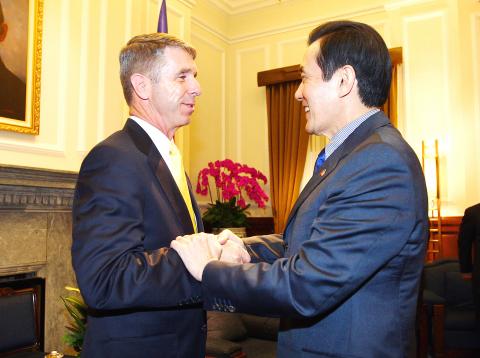
Photo: CNA
The most strategic element of the US-Taiwan relationship, as well as of partnerships between the nations in the region, is to make sure that “we understand that jointly, the US, along with its Asia-Pacific partners here, create a proper balance to make sure that there is not one entity here that has too much influence in the region,” he said.
Wittman was leading a US congressional delegation on a three-day visit to Taiwan starting on Monday. They met President Ma Ying-jeou (馬英九) and Minister of Foreign Affairs David Lin (林永樂) yesterday, and also visited the nation’s naval facilities.
The delegation of eight people includes US representatives Madeleine Bordallo, David Cicilline and Bill Flores.
During their meeting with Ma, the disputes surrounding the Diaoyutai Islands (釣魚台), which Wittman called the “Senkaku Islands” — the Japanese name for the islets — and issues related to the nation’s policy on ractopamine residues in imports of US beef and pork products were discussed, Wittman said.
“We are happy to learn that the issue with US beef and pork has been taken up here. That’s quite good news for us — that we can continue our agricultural trade,” he said.
Deputy Minister of National Defense Andrew Yang (楊念祖) and Chinese Nationalist Party (KMT) Legislator Hsieh Kuo-liang (謝國樑) were also invited to join the dinner.
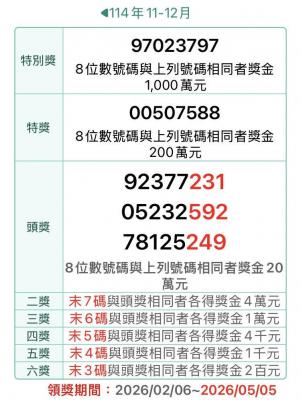
Seven of the 17 NT$10 million (US$311,604) winning receipts from the November-December uniform invoice lottery remain unclaimed as of today, the Ministry of Finance said, urging winners to redeem their prizes by May 5. The reminder comes ahead of the release of the winning numbers for the January-February lottery tomorrow. Among the unclaimed receipts was one for a NT$173 phone bill in Keelung, while others were for a NT$5,913 purchase at Costco in Taipei's Neihu District (內湖), a NT$49 purchase at a FamilyMart in New Taipei City's Tamsui District (淡水), and a NT$500 purchase at a tea shop in New Taipei City's
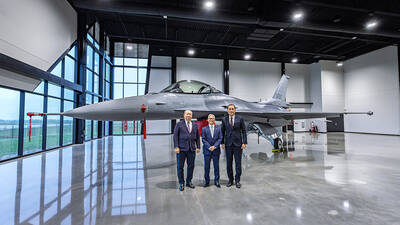
Taiwanese officials were shown the first of 66 F-16V fighter jets purchased by Taiwan from the United States, the Ministry of National Defense said yesterday, adding the aircraft has completed an initial flight test and is expected to be delivered later this year. A delegation led by Deputy Minister of National Defense Hsu Szu-chien (徐斯儉) visited Lockheed Martin’s F-16 C/D Block 70 (also known as F-16V) assembly line in South Carolina on March 16 to view the aircraft. The jet will undergo a final acceptance flight in the US before being delivered to Taiwan, the
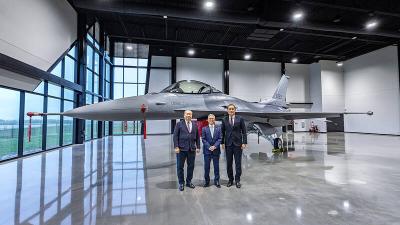
Deliveries of delayed F-16V jets are expected to begin in September, Minister of National Defense Wellington Koo (顧立雄) said today, after senior defense officials visited the US last week. The US in 2019 approved a US$8 billion sale of Lockheed Martin F-16 jets to Taiwan, a deal that would take the nation’s F-16 fleet to more than 200 jets, but the project has been hit by issues including software problems. Koo appeared today before a meeting of the legislature’s Foreign Affairs and National Defense Committee, which is discussing different versions of the special defense budget this week. The committee is questioning officials today,
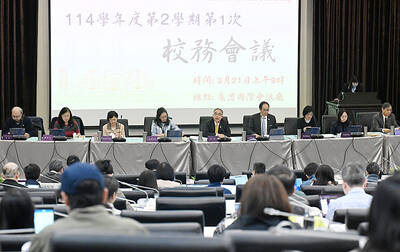
TALENT SCOUTING: The university is investing substantial funds in its future to bring in the kind of researchers that would keep the college internationally competitive National Taiwan University (NTU) plans to invest NT$2 billion (US$62.6 million) to launch two programs aimed at attracting and retaining top research talent, university president Chen Wen-chang (陳文章) said yesterday. The funding would support the “Palm Grove Scholars Project,” which targets academics aged 40 to 55. Up to 20 scholars would be selected, each receiving as much as NT$10 million annually, Chen said. The initiative is designed to attract leading researchers to Taiwan and strengthen NTU’s global competitiveness by fostering a more research-friendly environment and expanding international collaboration, he said. NTU is also introducing a “Hong Hu” chair grant, which would provide Palm


 RSS
RSS