


New Chinese Communist Party leader (CCP) Xi Jinping (習近平) will focus on solidifying his power base in the initial stage and will not change China’s policy toward Taiwan in the short term, academics said in Taipei yesterday.
Xi will be faced immediately with issues such as domestic problems, relations with the US and territorial disputes in the East China Sea and the South China Sea, Tamkang University professor Chao Chun-shan (趙春山) said.
The new leader’s Taiwan policy “will not change — at least not in the short term,” Chao said.
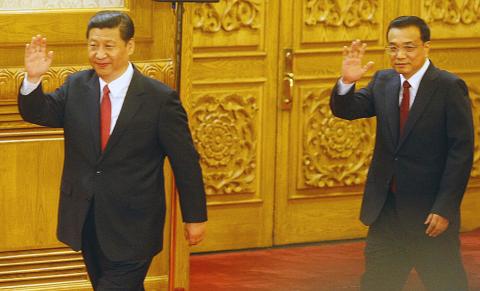
Photo: CNA
In addition, the Mainland Affairs Council and Straits Exchange Foundation recently underwent top personnel changes and China will need time to observe if there are any shifts in Taiwan’s cross-strait policy, Chao said.
Xi yesterday was elected general secretary of the CCP for the next 10 years.
Under Xi’s leadership over the next decade, there are three factors that have to be taken into consideration when viewing China’s policy toward Taiwan, Chao said.
First and foremost is the US’ policy toward Asia, especially toward China after the Nov. 6 US presidential election, which is also to affect China and Taiwan’s policy toward each other, Chao said.
Second, China will have to consider its internal situation, focusing on domestic stability and whether other corruption scandals, such as the one involving the former CCP boss in Chongqing, Bo Xilai (薄熙來), will surface, the professor said.
The third factor is Taiwan’s seven-in-one elections in 2014 and its presidential election in 2016, which would indicate any shifts in the popularity of the Chinese Nationalist Party (KMT) and the Democratic Progressive Party, Chao said.
He also said that outgoing Chinese President Hu Jintao’s (胡錦濤) policy toward Taiwan had won recognition in the international community and Xi will basically follow the same path.
Wang Kao-cheng (王高成), a professor at Tamkang University, said Xi will basically follow in Hu’s footsteps, focusing on the “peaceful development” of cross-strait ties.
However, at some point, China will want to develop political relations with Taiwan, in addition to the present trade ties, he said.
Yang Kai-huang (楊開煌) of Ming Chuan University said that even if Xi makes changes in China’s policy toward Taiwan, they would not be too dramatic, unless Taiwan in 2016 elects a new government that completely rejects the “one China” policy.
However, in Xi’s second five-year term, he could develop his own thoughts on cross-strait ties, Yang said.
In addition to strengthening economic and cultural cross-strait exchanges, Xi may look to opening political dialogue and consultation and “even the possibility of a peace agreement,” Yang said.
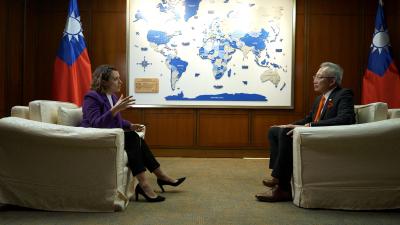
“China is preparing to invade Taiwan,” Deputy Minister of Foreign Affairs Francois Wu (吳志中) said in an exclusive interview with British media channel Sky News for a special report titled, “Is Taiwan ready for a Chinese invasion?” the Ministry of Foreign Affairs said today in a statement. The 25-minute-long special report by Helen Ann-Smith released yesterday saw Sky News travel to Penghu, Taoyuan and Taipei to discuss the possibility of a Chinese invasion and how Taiwan is preparing for an attack. The film observed emergency response drills, interviewed baseball fans at the Taipei Dome on their views of US President
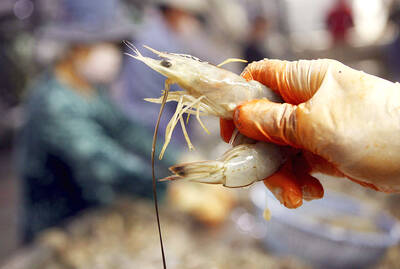
ECONOMIC BENEFITS: The imports from Belize would replace those from Honduras, whose shrimp exports have dropped 67 percent since cutting ties in 2023 Maintaining ties with Taiwan has economic benefits, Ministry of Foreign Affairs officials said yesterday, citing the approval of frozen whiteleg shrimp imports from Belize by the Food and Drug Administration (FDA) as an example. The FDA on Wednesday approved the tariff-free imports from Belize after the whiteleg shrimp passed the Systematic Inspection of Imported Food, which would continue to boost mutual trade, the ministry said. Taiwan’s annual consumption of whiteleg shrimps stands at 30,000 tonnes, far exceeding domestic production, the ministry said. Taiwan used to fill the gap by importing shrimps from Honduras, but purchases slumped after Tegucigalpa severed diplomatic ties with Taiwan
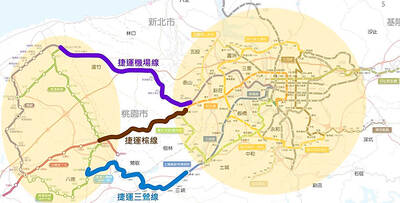
The Executive Yuan yesterday approved a southwestern extension of the Sanying MRT Line from New Taipei to Bade District (八德) in Taoyuan, with a goal of starting construction by late 2026. The 4.03-kilometer extension, featuring three new stations, will run from the current terminus at Yingtao Fude Station (LB12) in New Taipei City to Dannan Station (LB14), where it will connect with Taoyuan’s Green Line, New Taipei City Metro Corp said in a statement. This extension will follow the completion of core Sanying Line, a 14.29-kilometer medium-capacity system linking Tucheng (土城), Sansia (三峽)

CARGO LOSS: About 50 containers at the stern of the ‘Ever Lunar’ cargo ship went overboard, prompting the temporary closure of the port and disrupting operations Evergreen Marine Corp, Taiwan’s largest container shipper, yesterday said that all crew members aboard the Ever Lunar (長月) were safe after dozens of containers fell overboard off the coast of Peru the previous day. The incident occurred at 9:40am on Friday as the Ever Lunar was anchored and waiting to enter the Port of Callao when it suddenly experienced severe rolling, Evergreen said in a statement. The rolling, which caused the containers to fall, might have been caused by factors including a tsunami triggered by an earthquake in Russia, poor winter sea conditions in South America or a sudden influx of waves,


 RSS
RSS