


The National Cheng Kung University (NCKU) earlier this week voted to remove a bronze statue of Chiang Kai-shek (蔣介石) from its campus and to relocate the structure to an indoor location.
The move came after protests led by students earlier this year.
At a school affairs meeting on Wednesday, more than half of those present voted to relocate the statue — currently located nearby Cheng Kung Lake (成功湖) on the campus — to the university’s archive. The relocation is slated to take place early next year.
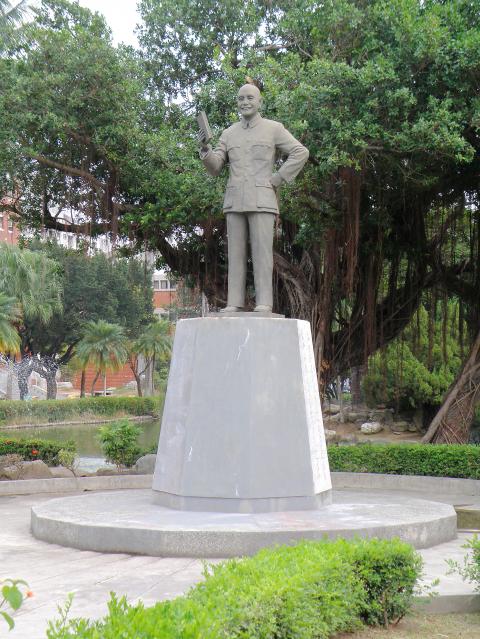
Photo: Meng Ching-tzu, Taipei Times
An official from the university was quoted as saying that “the statue is part of history. There is no need to destroy it, otherwise these pieces of history won’t be found in the future.”
On Feb. 28 this year, a group of NCKU students marked the 65th anniversary of the 228 Incident by staging an art installation on campus to symbolize the horrific and brutal moment in Taiwanese history in the hope of raising public awareness about the nation’s past mistakes.
Members of the student organization 02 Group (零貳社) — whose name is a phonetic translation of “protest” in Hoklo (commonly known as Taiwanese) — hung a placard reading “1947-2012” on the statue and placed the names of victims of the 228 Massacre around the statue.
The 228 Incident refers to a massacre that sparked a massive 1947 nationwide uprising against the then-Chinese Nationalist Party (KMT) regime. The uprising was brutally crushed in a violent crackdown spearheaded by the state. That tragic event also marked the beginning of the White Terror era that saw thousands of people arrested, imprisoned and executed.
The students’ art installation this February stirred heated debate at the university about whether the statue should be removed.
Chen Yi-chen (陳以箴), head of the 02 Group, said the school’s decision to move the statue is a major breakthrough.
“This is just the beginning. We should dismantle all the symbols of authoritarian rule which still exist on campus,” she said.
She added that the university is treating the decision as a simple act of relocating a statue and is unwilling to consider the wider issues of authoritarianism on campus.
“Our university is quite conservative. In classrooms, administration facilities, in the interactions between faculty and students there are still leftovers of a past authoritarian mentality. Such a mentality needs be removed,” she said.

Considering that most countries issue more than five denominations of banknotes, the central bank has decided to redesign all five denominations, the bank said as it prepares for the first major overhaul of the banknotes in more than 24 years. Central bank Governor Yang Chin-lung (楊金龍) is expected to report to the Legislative Yuan today on the bank’s operations and the redesign’s progress. The bank in a report sent to the legislature ahead of today’s meeting said it had commissioned a survey on the public’s preferences. Survey results showed that NT$100 and NT$1,000 banknotes are the most commonly used, while NT$200 and NT$2,000

The Centers for Disease Control (CDC) yesterday reported the first case of a new COVID-19 subvariant — BA.3.2 — in a 10-year-old Singaporean girl who had a fever upon arrival in Taiwan and tested positive for the disease. The girl left Taiwan on March 20 and the case did not have a direct impact on the local community, it said. The WHO added the BA.3.2 strain to its list of Variants Under Monitoring in December last year, but this was the first imported case of the COVID-19 variant in Taiwan, CDC Deputy Director-General Lin Ming-cheng (林明誠) said. The girl arrived in Taiwan on

South Korea is planning to revise its controversial electronic arrival card, a step Taiwanese officials said prompted them to hold off on planned retaliatory measures, a South Korean media report said yesterday. A Yonhap News Agency report said that the South Korean Ministry of Foreign Affairs is planning to remove the “previous departure place” and “next destination” fields from its e-arrival card system. The plan, reached after interagency consultations, is under review and aims to simplify entry procedures and align the electronic form with the paper version, a South Korean ministry official said. The fields — which appeared only on the electronic form

The Ministry of Foreign Affairs (MOFA) is suspending retaliation measures against South Korea that were set to take effect tomorrow, after Seoul said it is updating its e-arrival system, MOFA said today. The measures were to be a new round of retaliation after Taiwan on March 1 changed South Korea's designation on government-issued alien resident certificates held by South Korean nationals to "South Korea” from the "Republic of Korea," the country’s official name. The move came after months of protests to Seoul over its listing of Taiwan as "China (Taiwan)" in dropdown menus on its new online immigration entry system. MOFA last week


 RSS
RSS