


The agricultural tourism season is in full swing and colorful rice paddies in three areas of the nation have been attracting attention in recent weeks.
Unique patterns have been created in rice paddies in Greater Tainan, Miaoli and Yunlin counties from Japonica and Indica rice strains, which are characterized by strong colors, local agricultural officials said.
In Tainan, for example, a pattern featuring an image of a water buffalo created from purple Indica and green Japonica rice varieties can be visited free of charge until the end of next month, by which time the design will have grown out.
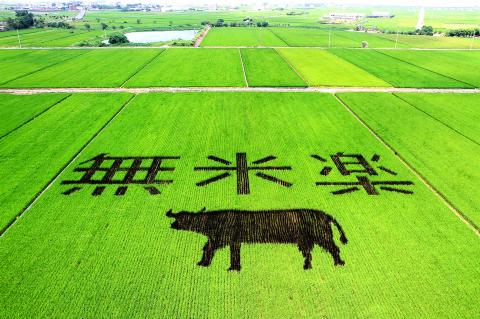
Photo: Wang Han-ping, Taipei Times
It took Lo Cheng-tsung (羅正宗), a director at the Tainan District Agricultural Research and Extension Station, four months to design a water buffalo on a computer and replicate it in a 1.77 hectare rice paddy.
“I am not that impressed with my own work,” said Lo, who had never designed a rice paddy mural before.
“The buffalo looks too thin to me,” he said.
Nevertheless, hundreds of tourists have flocked to see his creation, enjoying both the unique artwork and the rustic charm of the countryside. Lo and other officials said they want to continue to explore the potential of agricultural tourism and perhaps develop a new business model.
“If you treat the rice paddies as billboards, a whole new niche market could be created,” said Chang Su-chen (張素貞), a researcher at a government agricultural station in Miaoli.
Chang said the station is encouraging farmers to work with interested individuals or companies to grow specially designed rice paddies.
Patterns could include a company logo, a simple picture or even a marriage proposal. Such rice murals could turn traditional villages into tourist attractions, Chang said. She also said farmers will benefit from the potential partnerships due to the fees they could be paid and because they could sell the colored rice after the pattern has grown out. The technological skill to create a blueprint of a design will be provided by the agricultural station for free, Chang said.
To allow more room for creativity, Chang said, she and her colleagues are also working to develop more colorful rice types.
“We have created white and light-yellow strains so far,” she said. “We will be able to treat the rice paddies as real canvases in the near future.”

FUKUOKA SITUATION: Japanese media reported that the pathogen is expected to be identified by the summer, while the CDC downplayed the idea that it was hMPV A “mysterious cold-like illness” reported in Japan’s Fukuoka Prefecture does not seem to be a new disease, but Japanese authorities have been asked about the situation, the Centers for Disease Control (CDC) said yesterday. The Fukuoka Prefectural Medical Association on Wednesday told a news conference that a “mystery cold” that has become a hot topic on social media is “highly likely to be caused by some kind of viral infection,” Japan’s KBC News reported. “Many people are experiencing symptoms starting with a sore throat, followed by a runny nose, phlegm and a severe cough,” KBC News reported, citing association officials. Health authorities are

Nvidia Corp CEO Jensen Huang (黃仁勳) arrived in Taiwan yesterday ahead of upcoming AI and technology events, saying he plans to meet with clients and Taiwan Semiconductor Manufacturing Co Chairman C.C. Wei (魏哲家) during his visit. After landing at Taipei Songshan Airport, Huang posed for photos with fans and handed out Yakult drinks to reporters and supporters waiting at the scene, saying he has “a lot to do” during the trip. Asked about reports that Nvidia’s planned headquarters site in Taipei’s Beitou Shilin Technology Park could break ground on May 27, Huang said that if the company holds an event, he would

The Ministry of Finance this afternoon announced the winning numbers for the March-April uniform invoice lottery. The winning number for the NT$10 million (US$318,060) special prize is 19531471, and the winning number for the NT$2 million grand prize is 85941329. Three numbers were drawn for the NT$200,000 first prize: 07225810, 20231230 and 83518781. Those with receipts matching the last seven digits of any of the first-prize numbers will win the NT$40,000 second prize, while those matching the last six digits will win the NT$10,000 third prize. Those whose receipts match the last five digits of the first-prize numbers can claim the NT$4,000 fourth prize,
Taiwan Travelogue (臺灣漫遊錄), which earlier this week became the first Taiwanese novel to win the International Booker Prize, is to be adapted into a television series through a Taiwan-Japan coproduction, producer Chang Chen-yu (張辰漁) said yesterday. Chang, a producer at World Softest Production Film Co, wrote on Facebook that the company had been searching for projects with international appeal that retain a strong Taiwanese identity after colleagues and Japanese partners strongly recommended the novel. After reading the book, Chang said he immediately decided to pursue the screen rights. “A great story has the power to transcend time and borders, and connect countless people,”


 RSS
RSS