


Soldiers and staff formerly under the command of General Sun Li-jen (孫立人) gathered on the eve of the Mid-Autumn Festival to attend the opening ceremony of the Sun Li-jen Memorial Hall in Taipei on Saturday.
Sun, called the “Rommel of the East” by his Western counterparts, was present in many of the battles of the Second Sino-Japanese War, including the Republic of China’s (ROC) military deployment in the so-called China-Burma-India theater, winning acclaim for providing relief to British forces in the region and re-establishing the Ledo Road, the alternative to the Burma Road, which was the primary supply route of the ROC’s Western allies before it was cut off by Japanese forces.
Erwin Rommel was a German general who participated in both World Wars and is most recognized for his desert warfare tactics in Nazi Germany’s North African campaign — fought primarily between the British Commonwealth and Axis allies Germany and Italy.
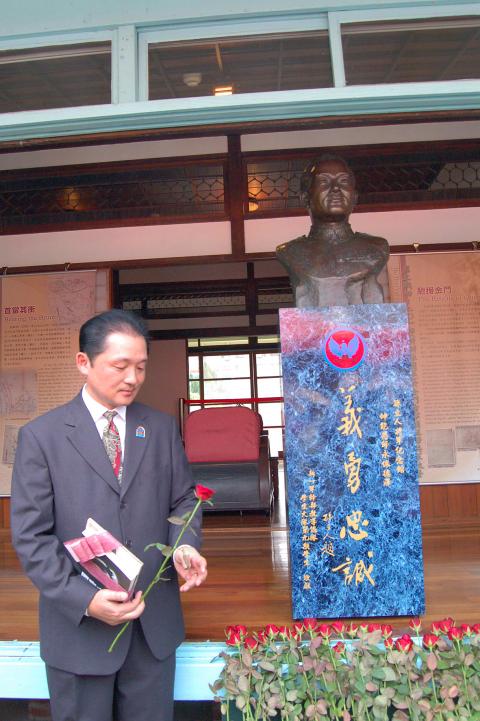
Photo: Su Meng-chuan, Taipei Times
On the eve of the Mid-Autumn Festival 65 years ago, Sun led the officers of the New 1st Army of the Nationalist Forces to Taiwan, relocating a training center to the island in an effort to train more troops for the ongoing civil war between the Chinese Nationalist Party (KMT) and the Chinese Communist Party.
One of the members of this force, 85-year-old Teng Hsueh-jui (鄧雪瑞), said that when they were training in northeastern China, Sun had always striven to make sure they had enough hot water to bathe with and leather coats to ward off the cold, adding that the general treated his soldiers just as he would his family.
“If it had not been for the general, we [the officers under his command] would not have been able to make a life in Taiwan,” Teng said.
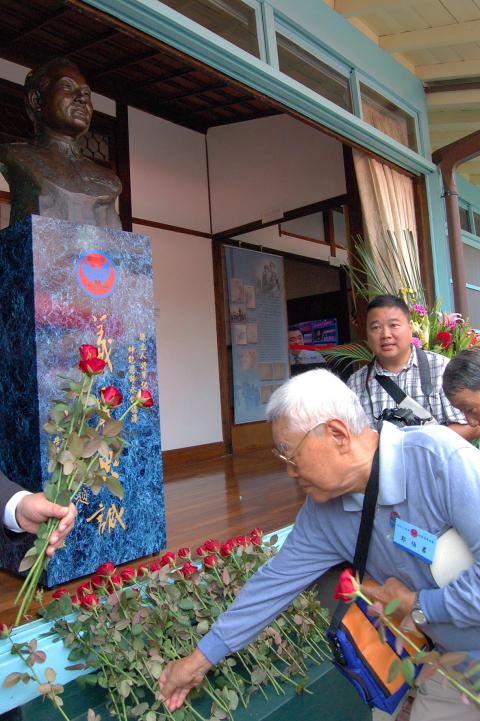
Photo: Su Meng-chuan, Taipei Times
To commemorate the general, the soldiers under his command collected funds to make a bronze statue of him — cast by artist Wang Hsiu-chi (王秀杞) — and donated it to the Sun Li-jen Museum, located in the house in which Sun had been kept under house arrest for 33 years.
In 1955, Sun was relieved of his command by former ROC leader Chiang Kai-shek (蔣介石) due to allegations that he was planning a mutiny and sheltering Communists, and he was kept under house arrest until the order was remanded by then-president Lee Teng-hui (李登輝) in 1988. However, Sun was only able to enjoy his freedom for two years before passing away in 1990.
His second son, Sun Tien-ping (孫天平), said on Saturday that his father often said he had never done anything that he regretted, but he did feel apologetic toward his former subordinates.
“I wish to thank everyone for not giving up on my father and even collecting funds to make a statue in his honor,” Sun Tien-ping said, adding that he firmly believed “justice and history would restore the truth of the matter.”
Taipei City Hall has registered Sun’s residence as a historic heritage site and, with the agreement of Sun’s family, has turned the house into a memorial museum, which is open on the second and fourth Sunday of every month.

REASONS FOR TRAVEL: An assistant professor said that proposed amendments to penalize drivers if they used drugs overseas would not deter people from traveling People who operate a motor vehicle under the influence of marijuana would have their driver’s license revoked, even if they used the substance while overseas, the Ministry of Transportation and Communications said yesterday, citing proposed amendments to the Road Traffic Management and Penalty Act (道路交通管理處罰條例). The amendments would also authorize the government to revoke the licenses of people determined to have used Category 1 or Category 2 narcotics, even if they were not operating a vehicle while under the influence of drugs, as well as ban them from taking the license test for three years, the ministry said. People aged 18 or

GLOBALGIVING: ‘ Caving to external pressure is not acceptable for an organization that has cultivated justice reform and human rights for 30 years,’ one NGO said A slew of non-government organizations (NGOs) have withdrawn from the GlobalGiving fundraising platform after it announced it would use “Chinese Taipei” instead of “Taiwan” from next month. The Taiwan Good Rice Association wrote on Facebook on Friday that it was informed on April 28 via a teleconference call of the change, which was made because the platform wanted to operate in China. Taiwan Good Rice is to terminate all cooperative relationships with GlobalGiving in response to the platform’s “unilateral and non-negotiable” decision to remove references to Taiwan, the NGO said. “Taiwan is in the official name of Taiwan Good Rice Association and the

HEAVY WEATHER: Typhoon Jangmi is due to crash straight into the Ryukyus as airlines look to shift flights to larger aircraft or cancel flights to Okinawa entirely Taiwan’s international air carriers announced flight adjustments over the weekend as Typhoon Jangmi is forecast to hit the Ryukyu Islands today and tomorrow. The Central Weather Administration (CWA) upgraded Jangmi from a tropical storm to a typhoon at 8am yesterday, with the eye located 580km south of Naha city. It was moving north at 19kph. Today, China Airlines’ CI-120, CI-121, CI-122 and CI-123 flights between Taoyuan and Naha, Okinawa, have been canceled as well as CI-132 and CI-133 between Kaohsiung and Naha. EVA Air’s BR-112, BR-113, BR-186 and BR-185 flights between Taoyuan and Naha are also canceled. Low-cost carrier Tigerair Taiwan canceled IT-230,
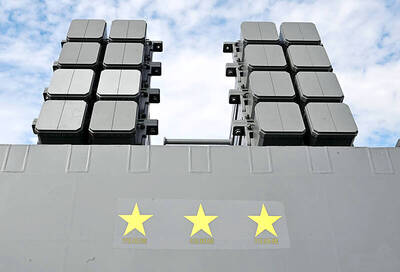
UPGRADE: The Kang Ding-class frigate is replacing its Chaparall missiles with Tien Chien II and Hua Yang VLS, which would provide it with long-range, 360° air defense Taiwan plans to produce 1,200 to 1,376 Hai Chien II missiles (海劍二, Sea Sword II) — also known as TC-2N — to serve as the standard air defense system of the navy’s surface combatant fleet, a source said yesterday. Last week, the Hai Chien II, the naval version of the Tien Kung II missile (天劍二, Sky Sword II), completed a live-fire test in waters off the National Chungshan Institute of Science and Technology’s Jiupeng facility (九鵬) in Pingtung County’s Manjhou Township (滿州). The MIM72 Chaparral and other dated air defense missiles that currently arm Taiwanese ships have inadequate range to combat Chinese


 RSS
RSS