


Lawmakers and rights groups yesterday called for a retrial or an extraordinary appeal for death row inmate Cheng Hsin-tze (鄭性澤), who was convicted of murdering a police officer in a case activists called “an obvious miscarriage of justice.”
“No clear evidence proved that Cheng shot a police officer in Fongyuan District (豐原), Greater Taichung, on Jan. 5, 2002, but he was still given the death penalty,” Democratic Progressive Party (DPP) Legislator Cheng Li-chiun (鄭麗君) told a press conference.
There were numerous flaws in the handling of the crime scene and the interrogation, and the judges presiding over the case were ignorant of evidence favoring the defendant, lawyer Law Bing-ching (羅秉成) said.
Cheng was accused of killing police officer Su Hsian-pi (蘇憲丕) with a Glock handgun in a shootout at a KTV, where Cheng, Luo Wu-hsiung (羅武雄) and four other men were partying. Luo also died in the shootout.
Cheng’s conviction was based on a confession, allegedly extracted through torture, and the testimony of witnesses, Law said.
Police investigators failed to take photographs of the crime scene, note the positions of the guns involved, collect fingerprints from the guns or perform ballistic analysis, the lawyer added.
However, throughout the 21 court proceedings relating to the case, the judges failed to recognize these errors, he said.
Citing the “Hsichih Trio” case, in which three former death row inmates were cleared of murder charges on Sept. 1, but only after 21 years of trials and appeals, Law said Cheng’s case “was simpler” and “it did not take a genius to know there were many things wrong in the investigation.”
A ballistic analysis would be enough to prove that Cheng did not fire one shot and a blood splatter analysis would also show that Cheng could not possibly have changed his position after being shot in the leg and fired at Su as the police investigators claimed, Law said.
“But those reports, along with the police department’s video recordings, have been missing from start to finish,” the lawyer said.
That was why legislators and rights groups demanded that the police submit all available information and a retrial be held, Law said.
DPP Legislator Yu Mei-nu (尤美女) appealed to Prosecutor-General Huang Shih-ming (黃世銘), saying Huang “would not be comfortable with signing Cheng’s execution order.”
“If the Hsichih Trio could be proved innocent after 21 years in a case which was much more complicated than Cheng’s, I don’t understand why Cheng does not at least deserve a retrial,” DPP Legislator Wu Yi-chen (吳宜臻) said.


An essay competition jointly organized by a local writing society and a publisher affiliated with the Chinese Communist Party (CCP) might have contravened the Act Governing Relations Between the People of the Taiwan Area and the Mainland Area (臺灣地區與大陸地區人民關係條例), the Mainland Affairs Council (MAC) said on Thursday. “In this case, the partner organization is clearly an agency under the CCP’s Fujian Provincial Committee,” MAC Deputy Minister and spokesperson Liang Wen-chieh (梁文傑) said at a news briefing in Taipei. “It also involves bringing Taiwanese students to China with all-expenses-paid arrangements to attend award ceremonies and camps,” Liang said. Those two “characteristics” are typically sufficient
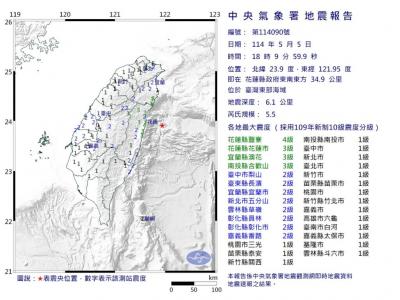
A magnitude 5.9 earthquake that struck about 33km off the coast of Hualien City was the "main shock" in a series of quakes in the area, with aftershocks expected over the next three days, the Central Weather Administration (CWA) said yesterday. Prior to the magnitude 5.9 quake shaking most of Taiwan at 6:53pm yesterday, six other earthquakes stronger than a magnitude of 4, starting with a magnitude 5.5 quake at 6:09pm, occurred in the area. CWA Seismological Center Director Wu Chien-fu (吳健富) confirmed that the quakes were all part of the same series and that the magnitude 5.5 temblor was

The brilliant blue waters, thick foliage and bucolic atmosphere on this seemingly idyllic archipelago deep in the Pacific Ocean belie the key role it now plays in a titanic geopolitical struggle. Palau is again on the front line as China, and the US and its allies prepare their forces in an intensifying contest for control over the Asia-Pacific region. The democratic nation of just 17,000 people hosts US-controlled airstrips and soon-to-be-completed radar installations that the US military describes as “critical” to monitoring vast swathes of water and airspace. It is also a key piece of the second island chain, a string of
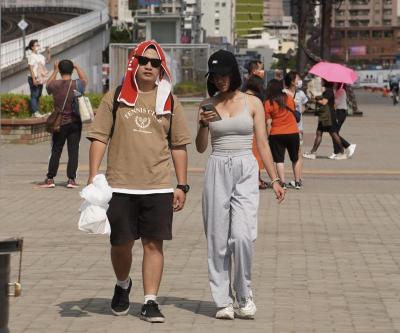
The Central Weather Administration has issued a heat alert for southeastern Taiwan, warning of temperatures as high as 36°C today, while alerting some coastal areas of strong winds later in the day. Kaohsiung’s Neimen District (內門) and Pingtung County’s Neipu Township (內埔) are under an orange heat alert, which warns of temperatures as high as 36°C for three consecutive days, the CWA said, citing southwest winds. The heat would also extend to Tainan’s Nansi (楠西) and Yujing (玉井) districts, as well as Pingtung’s Gaoshu (高樹), Yanpu (鹽埔) and Majia (瑪家) townships, it said, forecasting highs of up to 36°C in those areas


 RSS
RSS