


The Life Conservationist Association (LCA) yesterday urged people to stop giving children inappropriate ideas about how to treat animals by taking them to animal shows or exhibitions that in fact practice cruelty against animals, during a press conference organized by the group in Taipei.
The association showed footage and photographs of animals being forced to perform stunts in order to entertain people at recreational farms, including making miniature pigs jump into ponds and race through loops of fire, forcing monkeys to walk upside-down along a narrow plank and fishing for toads in a pond and then handling them and taking photographs.
“Many animals are being hurt or even sacrificed for the amusement of human beings,” said LCA secretary-general Shih Chuan-fa (釋傳法), adding that in order to understand the situation in Taiwan, the association filmed the animals at several leisure farms nationwide where they had uncovered widespread animal abuse while being called environmental or life education.
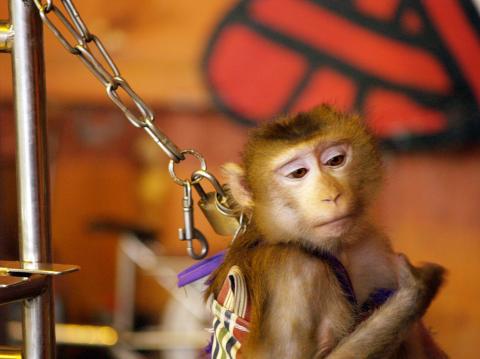
Photo provided courtesy of the Life Conservationist Association
The association urged the public to avoid the “touching, riding, feeding and fishing” of animals as well as urging the farms to avoid forcing animals into “inhumane displays and forced performances” given that this can cause harm to the animals while also providing bad examples for children on how to treat animals.
“There is a gap between the recognition of animal protection and the actual practice of protecting them,” said Kurtis Pei (裴家騏), a professor at National Pingtung University’s Institute of Wildlife Preservation.
While many people say that animal cruelty is wrong, they often find it hard to resist the urge to touch or applaud animals on display, he added.
“Most of the animals are in a state of fear when they are being handled by humans, because in their natural environment they are only touched by other animals when they are captured,” Pei said, adding that people often mistakenly believe that patting or caressing an animal is a way to show love and friendliness, but the truth is that the death rate at zoos and leisure farms remain high.
Direct contact with animals may also cause disease to pass between animals and humans, such as the case of an orangutan kept at a leisure farm which was recently diagnosed as having tuberculosis after it was sent to the Pingtung Rescue Center for Endangered Wild Animals for a health test, Pei said.
Lai Wei-jen (賴威任), office director of the Kuroshio Ocean Education Foundation, said that confining whales and dolphins in small pools, such as those seen at sea parks, often causes a decline in their echolocation abilities while also increasing the possibility of disease .
Liu Shiang-yao (劉湘瑤), an associate professor at National Taiwan Normal University’s Graduate Institute of Science Education, said footage which showed adults forcing a scared boy to pat a baby crocodile with its mouth taped up while complimenting the “brave” boy was obviously a distorted way to teach children about respect for living beings and wildlife conservation.
“What are we teaching the children by tying up a baby animal that we fear and then claiming victory by taming or torturing it?” she asked.
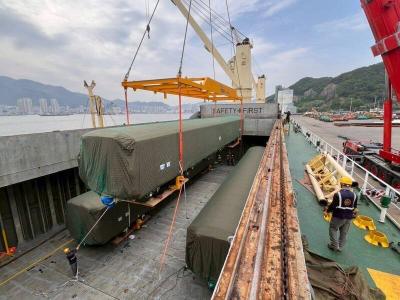
The first of 10 new high-capacity trains purchased from South Korea’s Hyundai Rotem arrived at the Port of Taipei yesterday to meet the demands of an expanding metro network, Taipei Rapid Transit Corp (TRTC) said yesterday. The train completed a three-day, 1,200km voyage from the Port of Masan in South Korea, the company said. Costing NT$590 million (US$18.79 million) each, the new six-carriage trains feature a redesigned interior based on "human-centric" transportation concepts, TRTC said. The design utilizes continuous longitudinal seating to widen the aisles and optimize passenger flow, while also upgrading passenger information displays and driving control systems for a more comfortable
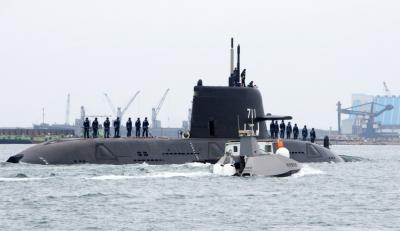
Taiwan's first indigenous defense submarine, the SS-711 Hai Kun (海鯤, or Narwhal), departed for its 13th sea trial at 7am today, marking its seventh submerged test, with delivery to the navy scheduled for July. The outing also marked its first sea deployment since President William Lai (賴清德) boarded the submarine for an inspection on March 19, drawing a crowd of military enthusiasts who gathered to show support. The submarine this morning departed port accompanied by CSBC Corp’s Endeavor Manta (奮進魔鬼魚號) uncrewed surface vessel and a navy M109 assault boat. Amid public interest in key milestones such as torpedo-launching operations and overnight submerged trials,
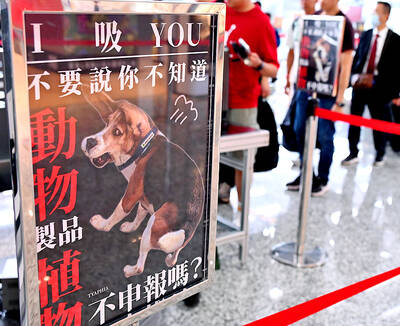
Quarantine awareness posters at Taiwan Taoyuan International Airport have gone viral for their use of wordplay. Issued by the airport branch of the Animal and Plant Health Inspection Agency, the posters feature sniffer dogs making a range of facial expressions, paired with advisory messages built around homophones. “We update the messages for holidays and campaign needs, periodically refreshing materials to attract people’s attention,” quarantine officials said. “The aim is to use the dogs’ appeal to draw focus to quarantine regulations.” A Japanese traveler visiting Taiwan has posted a photo on X of a poster showing a quarantine dog with a

Taiwan’s coffee community has launched a “one-person-one-e-mail” campaign, calling for people to send a protest-e-mail to the World Coffee Championships (WCC) urging it to redesignate Taiwanese competitors as from “Taiwan,” rather than “Chinese Taipei.” The call followed sudden action last week after the WCC changed all references to Taiwanese competitors from “Taiwan” to “Chinese Taipei,” including recent World Latte Art champion Bala (林紹興), who won the World Latte Art Championship in San Diego earlier this month. When Bala received the trophy, he was referred to as representing Taiwan, as well as in the announcement on the WCC’s Web site, until it


 RSS
RSS