


There have been mixed comments after a long-running murder case came to an end on Friday after the defendants, known as the “Hsichih Trio,” were found not guilty.
The Taiwan High Court closed the 21-year-old case, saying its verdict was final and no further appeals were to be allowed, in accordance with the Fair and Speedy Criminal Trials Act (刑事妥速審判法).
It was the third time that Su Chien-ho (蘇建和), Liu Bin-lang (劉秉郎) and Chuang Lin-hsun (莊林勳) were acquitted in the High Court since their case was reopened in 2000.
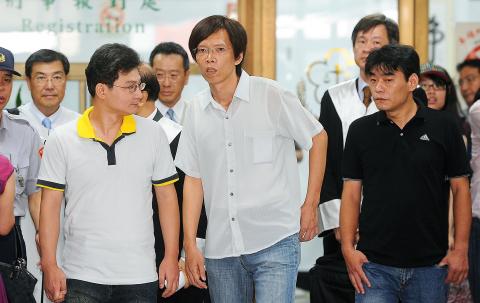
Photo: Liu Hsin-de, Taipei Times
The three men were charged with the murder of Wu Ming-han (吳銘漢) and his wife, Yeh Ying-lan (葉盈蘭), who were found dead in their apartment on March 24, 1991. The couple had been stabbed a total of 79 times.
Five months after the murder, police arrested a soldier, Wang Wen-hsiao (王文孝). His brother, Wang Wen-chung (王文忠), whom he had implicated, was also arrested and he then named three classmates — Su, Liu and Chuang — as accomplices.
Wang Wen-hsiao was later found guilty and sentenced to death by a military court. Before his execution in January 1992, Wang maintained that the other three suspects had been involved in the murders.
Wang Wen-chung served two years in jail after being convicted of being an accomplice.
The three men were tried several times over many years and were sentenced to death five times. However, five separate justice ministers refused to sign death warrants for the three.
A report by US-based forensic expert Henry Lee (李昌鈺) played a key role in the case. Lee concluded that the crime may have been committed by a single assailant.
The three men are now free under the law, which stipulates that if a case is retried more than three times over a period of six years and a not-guilty verdict is returned three times, prosecutors are not allowed any further appeals.
Friday’s verdict has elicited mixed responses from groups.
Chen Shu-chen (陳淑貞), director of the Taipei Branch of the Association For Victim Support, said the law must be amended to protect the rights of victims. The aim of the law is to facilitate a speedy trial, but it could also result in a blurring of the truth, she said.
She raised the question of whether the law, which was enacted in 2010, had been “tailored for the Hsichih Trio.”
The law is aimed at ending long-running cases, but it has not helped to shed light on the truth in this particular case, nor has it helped the victims, she added.
Lu Chin-te (陸晉德), whose son was kidnapped and murdered in another high-profile case, said the law favors perpetrators and ignores the rights of the victims.
It is tantamount to handing defense lawyers an ace, which allows them to drag out the trial process for as long as possible to help their clients wriggle off the hook, Lu said.
On the other hand, Su Yiu-chen (蘇友辰), president of the Chinese Association for Human Rights and the trio’s defense lawyer, said the Fair and Speedy Criminal Trials Act is not a bad law.
“It is better to have the law than not have it,” he said.
The law will prompt prosecutors to be more careful in their investigations and to compile more solid evidence, he added.
Lawyer Chan Shun-kuei (詹順貴) said if defendants are freed because of the law, victims still have the right to sue for compensation. Victims can also question why judicial authorities failed to gather enough evidence to convict defendants, Chan said.
If judicial authorities were negligent in collecting evidence, then the issue of national compensation for the victims would arise, he said.
Wu Ching-chin (吳景欽), associate professor of Aletheia University, said law enforcement officials involved in the Hsichih Trio case should be held responsible for the previous guilty verdicts and the three suspects should now seek compensation.
If the three defendants pursue avenues for compensation for their wrongful imprisonment of more than 11 years each, they could each receive up to NT$21 million (US$701,000).
Taiwan Crime Victims’ Human Rights Association has criticized the law, saying that it offers scant protection for victims and could also be contradicting the Constitution.
The association said it does not want to see victims crying in the dark, while perpetrators go free.
Authorities should revise the law to uphold a fair and just judicial system, it said.
The sloppy handling of evidence gathered at the crime scene 21 years ago and a lack of forensics expertise at the time resulted in a weak case against the trio, but several judges still sentenced the three men to death based on the suspects’ statements and forensic reports, the association said.
Wu Ming-han’s family continue to believe that the three men were guilty because Wang had maintained they had been involved.
However, if the crime scene was compromised and forensic evidence lacked credibility, prosecutors would get nowhere with the case no matter how many times they appealed, observers said.
With the case now closed, judicial reforms over the past two decades should be reviewed and forensic expertise should be strengthened so that the rights of defendants and victims could be equally protected, observers added.

Considering that most countries issue more than five denominations of banknotes, the central bank has decided to redesign all five denominations, the bank said as it prepares for the first major overhaul of the banknotes in more than 24 years. Central bank Governor Yang Chin-lung (楊金龍) is expected to report to the Legislative Yuan today on the bank’s operations and the redesign’s progress. The bank in a report sent to the legislature ahead of today’s meeting said it had commissioned a survey on the public’s preferences. Survey results showed that NT$100 and NT$1,000 banknotes are the most commonly used, while NT$200 and NT$2,000

The Centers for Disease Control (CDC) yesterday reported the first case of a new COVID-19 subvariant — BA.3.2 — in a 10-year-old Singaporean girl who had a fever upon arrival in Taiwan and tested positive for the disease. The girl left Taiwan on March 20 and the case did not have a direct impact on the local community, it said. The WHO added the BA.3.2 strain to its list of Variants Under Monitoring in December last year, but this was the first imported case of the COVID-19 variant in Taiwan, CDC Deputy Director-General Lin Ming-cheng (林明誠) said. The girl arrived in Taiwan on

South Korea is planning to revise its controversial electronic arrival card, a step Taiwanese officials said prompted them to hold off on planned retaliatory measures, a South Korean media report said yesterday. A Yonhap News Agency report said that the South Korean Ministry of Foreign Affairs is planning to remove the “previous departure place” and “next destination” fields from its e-arrival card system. The plan, reached after interagency consultations, is under review and aims to simplify entry procedures and align the electronic form with the paper version, a South Korean ministry official said. The fields — which appeared only on the electronic form

The Ministry of Foreign Affairs (MOFA) is suspending retaliation measures against South Korea that were set to take effect tomorrow, after Seoul said it is updating its e-arrival system, MOFA said today. The measures were to be a new round of retaliation after Taiwan on March 1 changed South Korea's designation on government-issued alien resident certificates held by South Korean nationals to "South Korea” from the "Republic of Korea," the country’s official name. The move came after months of protests to Seoul over its listing of Taiwan as "China (Taiwan)" in dropdown menus on its new online immigration entry system. MOFA last week


 RSS
RSS