


Taiwan has paid too little attention to the civil movement in Hong Kong and could be the next in line to be absorbed by Beijing if the trend continues, politicians and political observers said at a panel discussion in Taipei yesterday.
Hong Kong, which was handed back to China by the UK in 1997, could serve as a perfect example for Taiwan in its efforts to defy Chinese political pressure and influence, said Wang Dan (王丹), a Chinese dissident who now teaches at National Tsinghua University in Hsinchu.
Wang was one of the guest speakers at a panel discussion on the theme of “Taiwan’s Hong Kong-ization,” which is also the theme of a book published by New Society for Taiwan, a think tank and co-organizer of the event.
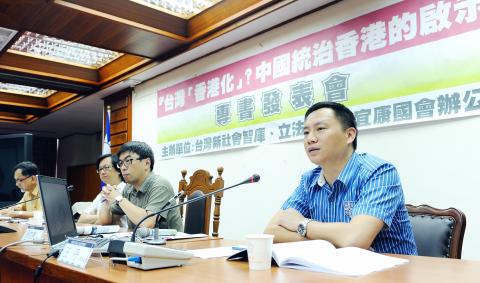
Photo: Chang Chia-ming, Taipei Times
Democratic Progressive Party (DPP) Legislator Tuan Yi-kang (段宜康), the other co-organizer, moderated the discussion.
Taiwan has already been “Hong Kong-ized,” Wang said, because government agencies, institutions and media outlets have all learned to “self-discipline” themselves in what can and cannot be done in much the same fashion as their Hong Kong counterparts prior to the 1997 handover.
Second, as with Hong Kong, China has used its economic power to influence Taiwanese politics, Wang said.
Wang agreed with the idea of advocating a “cross-strait alliance of civil movements” between people in China, Hong Kong and Taiwan, saying that it could be the only effective way to stop Taiwan from “Hong Kong-ization.”
Wang predicted that the increasing political participation of those born after 1990 would play a critical role in Hong Kong’s civil movement in the future because this young generation is now “even more anti-communist than their parents and more active in speaking their minds and participating in politics.”
Emily Lau (劉慧卿), a member of the Legislative Council of Hong Kong and vice president of the Hong Kong Democratic Party, said via video teleconference that China had not won the hearts of people in Hong Kong even 15 years after the handover.
The “one country, two systems” mechanism was originally designed by Beijing for Taiwan, but it was implemented in Hong Kong first, Lau said, adding that the results and process of the implementation could serve as a reference for Taiwan.
Chang Tieh-chih (張鐵志), a political commentator, said China has been getting impatient with the civil movement in Hong Kong in recent years, but everything it did “pushed Hong Kong people further from China.”
Hong Kong paid little attention to Taiwan in the past, former DPP legislator Lin Chuo-shui (林濁水) said, even though both have walked similar historical paths — both were ceded by China after wars and both advanced economically before China.
However, both sides appeared to “connect” to each other after the 1997 handover as people in Hong Kong looked to Taiwan as a political inspiration and model.
In a recent poll, Taiwan ranked as the favorite foreign nation among Hong Kong residents, he said, adding that “a democratic Taiwan out of China’s control would be a pillar for Hong Kong’s democratic movement.”

Considering that most countries issue more than five denominations of banknotes, the central bank has decided to redesign all five denominations, the bank said as it prepares for the first major overhaul of the banknotes in more than 24 years. Central bank Governor Yang Chin-lung (楊金龍) is expected to report to the Legislative Yuan today on the bank’s operations and the redesign’s progress. The bank in a report sent to the legislature ahead of today’s meeting said it had commissioned a survey on the public’s preferences. Survey results showed that NT$100 and NT$1,000 banknotes are the most commonly used, while NT$200 and NT$2,000

The Centers for Disease Control (CDC) yesterday reported the first case of a new COVID-19 subvariant — BA.3.2 — in a 10-year-old Singaporean girl who had a fever upon arrival in Taiwan and tested positive for the disease. The girl left Taiwan on March 20 and the case did not have a direct impact on the local community, it said. The WHO added the BA.3.2 strain to its list of Variants Under Monitoring in December last year, but this was the first imported case of the COVID-19 variant in Taiwan, CDC Deputy Director-General Lin Ming-cheng (林明誠) said. The girl arrived in Taiwan on

South Korea is planning to revise its controversial electronic arrival card, a step Taiwanese officials said prompted them to hold off on planned retaliatory measures, a South Korean media report said yesterday. A Yonhap News Agency report said that the South Korean Ministry of Foreign Affairs is planning to remove the “previous departure place” and “next destination” fields from its e-arrival card system. The plan, reached after interagency consultations, is under review and aims to simplify entry procedures and align the electronic form with the paper version, a South Korean ministry official said. The fields — which appeared only on the electronic form

The Ministry of Foreign Affairs (MOFA) is suspending retaliation measures against South Korea that were set to take effect tomorrow, after Seoul said it is updating its e-arrival system, MOFA said today. The measures were to be a new round of retaliation after Taiwan on March 1 changed South Korea's designation on government-issued alien resident certificates held by South Korean nationals to "South Korea” from the "Republic of Korea," the country’s official name. The move came after months of protests to Seoul over its listing of Taiwan as "China (Taiwan)" in dropdown menus on its new online immigration entry system. MOFA last week


 RSS
RSS