


Owners of independent bookstores yesterday discussed their current predicament and the cultural importance of their businesses at a forum held by the Ministry of Culture in Taipei.
Chen Long-hao (陳隆昊), who has run the Tonshan Bookstore for the past 30 years, said business had steadily declined over the past 15 years.
“First, it was the Internet, then the big chain stores arrived. The final straw was digital books,” he said.
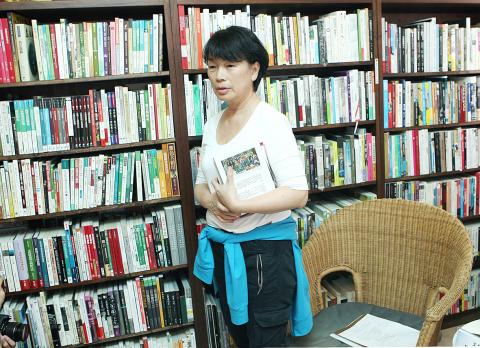
Photo: CNA
Liao Ying-liang (廖英良), owner of Tunghai Books in Greater -Taichung, said that in central and southern Taiwan, independent bookstores have to sell books to libraries or run cafes or restaurants to survive.
Su Chih-hung (蘇至弘), owner of NTHU Books, echoed that sentiment, saying that about 120 towns and villages in Taiwan do not have bookstores.
Meanwhile, Chen Pei-yu (陳培瑜) of the Kaifeng Kama Children’s Bookstore, emphasized the bookstores’ role as not just a place where people read and buy books, but as a platform for individuals to meet through readings, book clubs, exhibitions, film screenings and other art-related activities.
Minister of Culture Lung Ying-tai (龍應台) agreed that the government has not paid enough attention to independent bookstores. She said that those who run independent bookstores are not businesspeople, but should rather be viewed as -“curators of knowledge,” adding that their undertakings are of great cultural significance.
Lung said out that according to the Cultural and Creative Industries Development Act (文化創意產業發展法), businesses in that sector are entitled to a variety of funding and loans aimed at fostering, assisting and promoting their development.
The minister also broached the subject of a unified approach for pricing books, because large chain stores and online bookstores can get far greater discounts from publishing houses than independent establishments.
Architect, writer and academic Roan Ching-yueh (阮慶岳) said that rather than seeing independent bookstores as needing help, they should be considered as representatives of community spirit that have been overlooked in the wake of economic globalization.
Others shared similar views.
“If the market [for independent bookstores] gets bigger and we make more money, then we will no longer be ‘independent,’” said Liao of Tunghai Books. “We are not here to ask for money. I think the question is whether or not independent bookstores are important to society.”
In response to questions regarding government funding, Lung said that people should not think of the Ministry of Culture as having “lots of money to spend.”
However, “the ministry thinks highly of independent bookstores and hopes to help them remain culturally relevant,” she added.
The meeting is one of nine forums organized by the ministry to seek opinions on the nation’s cultural development and policy proposals from professionals in various fields. Over the next month, topics that will be discussed include film subsidies, public media and a review of the Cultural Heritage Conservation Act (文化資產保存法).
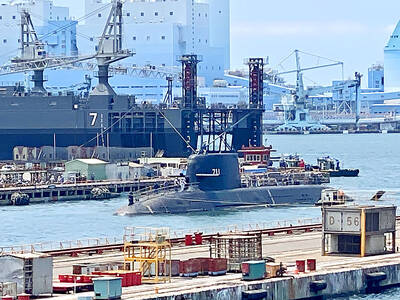
AGING: While Japan has 22 submarines, Taiwan only operates four, two of which were commissioned by the US in 1945 and 1946, and transferred to Taiwan in 1973 Taiwan would need at least 12 submarines to reach modern fleet capabilities, CSBC Corp, Taiwan chairman Chen Cheng-hung (陳政宏) said in an interview broadcast on Friday, citing a US assessment. CSBC is testing the nation’s first indigenous defense submarine, the Hai Kun (海鯤, Narwhal), which is scheduled to be delivered to the navy next month or in July. The Hai Kun has completed torpedo-firing tests and is scheduled to undergo overnight sea trials, Chen said on an SET TV military affairs program. Taiwan would require at least 12 submarines to establish a modern submarine force after assessing the nation’s operational environment and defense

A white king snake that frightened passengers and caused a stir on a Taipei MRT train on Friday evening has been claimed by its owner, who would be fined, Taipei Rapid Transit Corp (TRTC) said yesterday. A person on Threads posted that he thought he was lucky to find an empty row of seats on Friday after boarding a train on the Bannan (Blue) Line, only to spot a white snake with black stripes after sitting down. Startled, he jumped up, he wrote, describing the encounter as “terrifying.” “Taipei’s rat control plan: Release snakes on the metro,” one person wrote in reply, referring
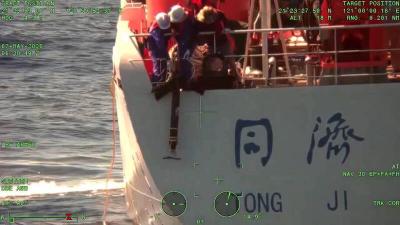
The coast guard today said that it had disrupted "illegal" operations by a Chinese research ship in waters close to the nation and driven it away, part of what Taipei sees a provocative pattern of China's stepped up maritime activities. The coast guard said that it on Thursday last week detected the Chinese ship Tongji (同濟號), which was commissioned only last year, 29 nautical miles (54km) southeast of the southern tip of Taiwan, although just outside restricted waters. The ship was observed lowering ropes into the water, suspected to be the deployment of scientific instruments for "illegal" survey operations, and the coast
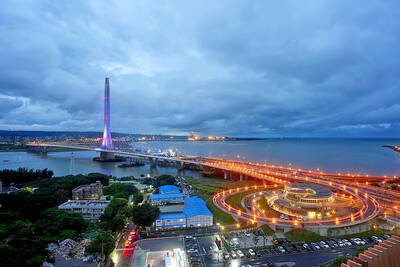
An inauguration ceremony was held yesterday for the Danjiang Bridge, the world’s longest single-mast asymmetric cable-stayed bridge, ahead of its official opening to traffic on Tuesday, marking a major milestone after nearly three decades of planning and construction. At the ceremony in New Taipei City attended by President William Lai (賴清德), Premier Cho Jung-tai (卓榮泰), Minister of Transportation and Communications Chen Shih-kai (陳世凱) and New Taipei City Mayor Hou Yu-ih (侯友宜), the bridge was hailed as both an engineering landmark and a long-awaited regional transport link connecting Tamsui (淡水) and Bali (八里)


 RSS
RSS