


The vice principal of the National Cheng Kung University in Greater Tainan is set to donate his extensive collection of more than 900 antique locks, which he has amassed over the past decades, to a state-owned museum where it will be better preserved and serve research purposes.
“[Making this donation] feels as if I’m marrying off my own daughter and hoping it is to a decent family,” Yan Hong-sen (顏鴻森) said.
“It was only after thorough consideration and seeing the sincerity of the National Science and Technology Museum [NSTM], which has specifically employed researchers specializing antique padlocks [for my potential donation], that I eventually resolved to ‘give my daughter away,’” said Yan, who doubles as a chair professor at the university’s Department of Mechanical Engineering.
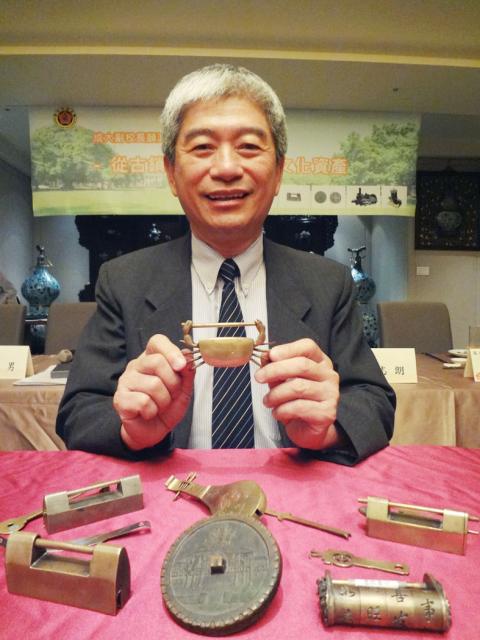
Photo: Lin Hsiao-yun, Taipei Times
As an antique locks enthusiast and an engineering specialist, Yan has accumulated more than 900 antique locks over 26 years, a substantial collection he is set to donate to the museum in stages, starting in November.
“I was worried that if these antique locks were buried along with me [when I die], people who know their value may attempt to prise open my coffin and rob my tomb,” Yan jokingly said of his decision to give his collection away.
Changing his tone, Yan said that as he had collected the locks without carrying out detailed research on each one, he believed their value would be better appraised by professional institutions and specialists, as they would preserve them properly and delve into their backgrounds.
Yan’s infatuation with antique padlocks began after he saw one of his professors’ collection of mechanical steelyard scales during his studies for a doctoral program at Purdue University in the US.
In 1986, after attending a meeting in Taipei, Yan came across an antique brass lock for sale at a temporary stall on an overpass in front of Taipei’s Main Station.
The lock was a bit smaller than Yan’s palm and priced at just NT$250, but it caught his attention immediately and ignited his enthusiasm for collecting antique locks.
His fascination was so great that it motivated him to conduct academic research on antique locks and write a dissertation about them, a move which helped swiftly cement his international reputation as a “padlock master.”
A story once recounted by former minister of education Ovid Tzeng (曾志朗) perfectly illustrated Yan’s expertise in the field as well as his well-earned esteem, both domestically and globally.
According to Tzeng, an elderly woman in the UK wrote to the China-based Chinese Academy of Sciences, which serves as China’s scientific think tank, asking for help to open a locked coffer left behind by her deceased husband, following several failed attempts by locksmiths in her country to unlock it.
Having their hands tied, the think tank subsequently turned to Yan for assistance. Yan promptly conducted research to ascertain the age and fabrication of the lock after receiving a picture of the padlock from the widow. He then made a key and shipped it to the UK, with which the woman was finally able to unlock the container, Tzeng said.
In response to Yan’s generosity, the museum’s director, Chen Hsun-hsiang (陳訓祥), expressed sincere gratitude to Yan and pledged to keep his cherished collection well preserved.
“[Yan’s] donation is the largest ever made to the museum and we will spare no effort in preserving it,” Chen said.
Translated by Stacy Hsu, Staff Writer
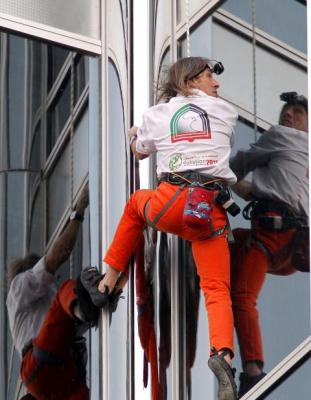
Alain Robert, known as the "French Spider-Man," praised Alex Honnold as exceptionally well-prepared after the US climber completed a free solo ascent of Taipei 101 yesterday. Robert said Honnold's ascent of the 508m-tall skyscraper in just more than one-and-a-half hours without using safety ropes or equipment was a remarkable achievement. "This is my life," he said in an interview conducted in French, adding that he liked the feeling of being "on the edge of danger." The 63-year-old Frenchman climbed Taipei 101 using ropes in December 2004, taking about four hours to reach the top. On a one-to-10 scale of difficulty, Robert said Taipei 101
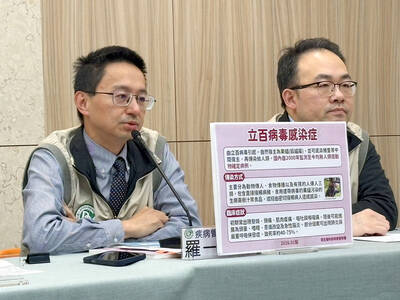
Nipah virus infection is to be officially listed as a category 5 notifiable infectious disease in Taiwan in March, while clinical treatment guidelines are being formulated, the Centers for Disease Control (CDC) said yesterday. With Nipah infections being reported in other countries and considering its relatively high fatality rate, the centers on Jan. 16 announced that it would be listed as a notifiable infectious disease to bolster the nation’s systematic early warning system and increase public awareness, the CDC said. Bangladesh reported four fatal cases last year in separate districts, with three linked to raw date palm sap consumption, CDC Epidemic Intelligence

Two Taiwanese prosecutors were questioned by Chinese security personnel at their hotel during a trip to China’s Henan Province this month, the Mainland Affairs Council (MAC) said yesterday. The officers had personal information on the prosecutors, including “when they were assigned to their posts, their work locations and job titles,” MAC Deputy Minister and spokesman Liang Wen-chieh (梁文傑) said. On top of asking about their agencies and positions, the officers also questioned the prosecutors about the Cross-Strait Joint Crime-Fighting and Judicial Mutual Assistance Agreement, a pact that serves as the framework for Taiwan-China cooperation on combating crime and providing judicial assistance, Liang

US climber Alex Honnold left Taiwan this morning a day after completing a free-solo ascent of Taipei 101, a feat that drew cheers from onlookers and gained widespread international attention. Honnold yesterday scaled the 101-story skyscraper without a rope or safety harness. The climb — the highest urban free-solo ascent ever attempted — took just more than 90 minutes and was streamed live on Netflix. It was covered by major international news outlets including CNN, the New York Times, the Guardian and the Wall Street Journal. As Honnold prepared to leave Taiwan today, he attracted a crowd when he and his wife, Sanni,


 RSS
RSS