


Last year, veteran Beijing opera singer Tai Chi-hsia (戴綺霞) set a record when she performed in the classic show The Drunken Concubine at the age of 94.
With more than 80 years of experience in the traditional stage art, Tai — now 95 — is one of Taiwan’s most renowned operatic performers and she has continued to be at the top of her game by practicing her skills every day for 30 minutes while also devoting time to teach the ancient theatrical skills to younger performers.
“Beijing opera is my life-long passion and we must pass on the traditional arts to future generations … I plan to continue performing Beijing opera and sing until I am 100 years old,” she said.
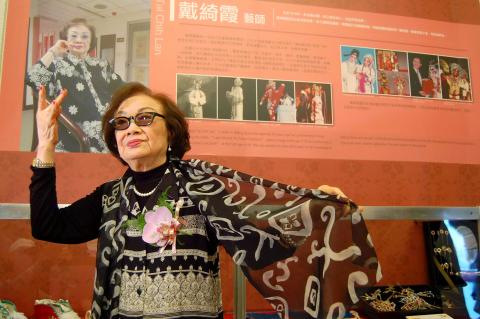
Photo: Chiu Shao-wen, Taipei Times
Her masterful skills and dedication to promoting the traditional arts have now won her recognition from the Taipei City Government.
Yesterday the city’s Department of Cultural Affairs presented the long-time performer, alongside four other traditional arts performers, with awards for their achievements in the fields of traditional art including hand puppetry, Taiwanese lion dance and beikuan (北管) music.
Another Beijing opera master who received an award was 67-year-old Tsao Fu-yung (曹復永) who was one of the first performers of the art form to be born and trained in Taiwan and is a key figure in the modernization of Beijing opera.
Tsao plays the well-known xiaosheng (小生, the leading character in traditional opera) or kunqu (崑曲) in Taiwanese kun opera and helped to successfully combine elements from Beijing opera with Taiwanese opera. Later on in his career he began to direct Taiwanese opera shows, creating more possibilities for traditional arts in the country.
“I always tell my Taiwanese and Beijing opera students that they must be persistent and master traditional arts, one must never be content and always strive to be the best,” he said.
Chu Ching-song (朱清松), a practitioner of bei-kuan music and renowned Taiwanese puppet theater musician Chang Chin-tu (張金土) and Wu Bo-xun (吳伯勳), leader of the Golden Lion Dance Group in Dalongtong, also received awards for their contribution to the arts.
An exhibition on the works of the five masters is being held at the Ximen Red House from 11am to 9pm until June 10 and the winners will attend to share their experience with the public during the exhibition.

Considering that most countries issue more than five denominations of banknotes, the central bank has decided to redesign all five denominations, the bank said as it prepares for the first major overhaul of the banknotes in more than 24 years. Central bank Governor Yang Chin-lung (楊金龍) is expected to report to the Legislative Yuan today on the bank’s operations and the redesign’s progress. The bank in a report sent to the legislature ahead of today’s meeting said it had commissioned a survey on the public’s preferences. Survey results showed that NT$100 and NT$1,000 banknotes are the most commonly used, while NT$200 and NT$2,000

The Centers for Disease Control (CDC) yesterday reported the first case of a new COVID-19 subvariant — BA.3.2 — in a 10-year-old Singaporean girl who had a fever upon arrival in Taiwan and tested positive for the disease. The girl left Taiwan on March 20 and the case did not have a direct impact on the local community, it said. The WHO added the BA.3.2 strain to its list of Variants Under Monitoring in December last year, but this was the first imported case of the COVID-19 variant in Taiwan, CDC Deputy Director-General Lin Ming-cheng (林明誠) said. The girl arrived in Taiwan on

South Korea is planning to revise its controversial electronic arrival card, a step Taiwanese officials said prompted them to hold off on planned retaliatory measures, a South Korean media report said yesterday. A Yonhap News Agency report said that the South Korean Ministry of Foreign Affairs is planning to remove the “previous departure place” and “next destination” fields from its e-arrival card system. The plan, reached after interagency consultations, is under review and aims to simplify entry procedures and align the electronic form with the paper version, a South Korean ministry official said. The fields — which appeared only on the electronic form

The Ministry of Foreign Affairs (MOFA) is suspending retaliation measures against South Korea that were set to take effect tomorrow, after Seoul said it is updating its e-arrival system, MOFA said today. The measures were to be a new round of retaliation after Taiwan on March 1 changed South Korea's designation on government-issued alien resident certificates held by South Korean nationals to "South Korea” from the "Republic of Korea," the country’s official name. The move came after months of protests to Seoul over its listing of Taiwan as "China (Taiwan)" in dropdown menus on its new online immigration entry system. MOFA last week


 RSS
RSS