


The military conducted two drills on beaches in southern Taiwan yesterday, with one of them featuring a newly deployed locally made landing craft for the first time in an exercise, officials said.
As part of the annual Han Kuang military exercises, the navy assembled a joint force, which included marines and soldiers from the air force and the army, to simulate an amphibious landing in Fangshan Township (枋山), Pintung County.
More than 6,000 troops took part in the drill, with the marines beginning the operation by clearing underwater obstacles with explosives. After fighter jets and attack helicopters came in to provide cover from the air, ships and landing crafts closed in on the shore, dropping off military vehicles to take over the beach.
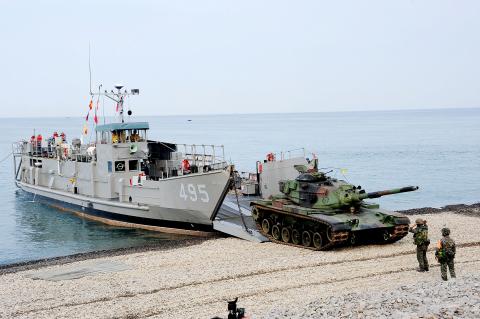
Photo: Tsai Tsung-Hsien, Taipei Times
According to Captain Chao Yuan-hsun (趙元勳), the speedy Ho Yung (合永) utility landing craft, which was delivered to the navy in October, was being deployed in a drill for the first time. Meanwhile, in a second drill, more than 700 troops, mainly reservists, conducted defensive maneuvers against simulated enemy combatants making an amphibious landing off Greater Tainan.
While 14 CM-11 tanks were deployed in the drill, which was open to the public, many people watching on the sidelines said they did not get the feel of a battlefield because no real shots were fired.
Asked about the decision to play the sound of gunfire on speakers instead of using weapons, military spokesperson Yang Lin-chuan (楊林川) said the drill had achieved its purpose of testing the armed forces.
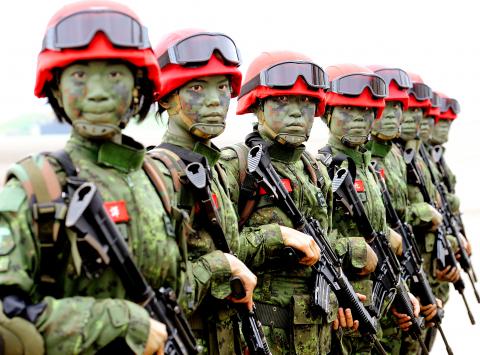
Photo: Fang Pin-chao, Taipei Times
The issue was also raised by lawmakers from both governing and opposition parties in the Legislature’s Foreign and National Defense Committee in Taipei yesterday.
Deputy Minister of National Defense Andrew Yang (楊念祖) said that firing missiles or bullets is not the main purpose of the Han Kuang drills, which are more about examining military strengths and the country’s defense needs.
Separately, at the Hsinchu Air Force Base in northern Taiwan yesterday, an exercise to test the nation’s anti-paratroop combat readiness was conducted as part of the Han Kuang military exercises.
More than 200 paratroopers participated in the drill held at the Hsinchu Air Force Base — the base in Taiwan proper that is closest to China — to act as opposing Chinese forces, the Ministry of National Defense said.
The drill also incorporated AH-1W Super Cobra helicopters, C-130 transport planes and dozens of advanced weapons to demonstrate Taiwan’s ability to fend off airborne invaders.
The drill saw more than 1,500 troops mobilized, mainly from the army and the air force, the ministry said.
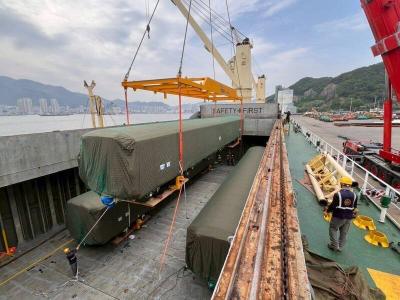
The first of 10 new high-capacity trains purchased from South Korea’s Hyundai Rotem arrived at the Port of Taipei yesterday to meet the demands of an expanding metro network, Taipei Rapid Transit Corp (TRTC) said yesterday. The train completed a three-day, 1,200km voyage from the Port of Masan in South Korea, the company said. Costing NT$590 million (US$18.79 million) each, the new six-carriage trains feature a redesigned interior based on "human-centric" transportation concepts, TRTC said. The design utilizes continuous longitudinal seating to widen the aisles and optimize passenger flow, while also upgrading passenger information displays and driving control systems for a more comfortable
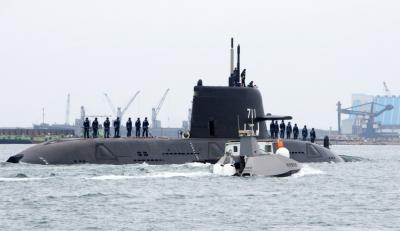
Taiwan's first indigenous defense submarine, the SS-711 Hai Kun (海鯤, or Narwhal), departed for its 13th sea trial at 7am today, marking its seventh submerged test, with delivery to the navy scheduled for July. The outing also marked its first sea deployment since President William Lai (賴清德) boarded the submarine for an inspection on March 19, drawing a crowd of military enthusiasts who gathered to show support. The submarine this morning departed port accompanied by CSBC Corp’s Endeavor Manta (奮進魔鬼魚號) uncrewed surface vessel and a navy M109 assault boat. Amid public interest in key milestones such as torpedo-launching operations and overnight submerged trials,
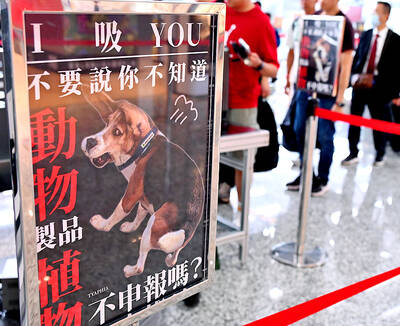
Quarantine awareness posters at Taiwan Taoyuan International Airport have gone viral for their use of wordplay. Issued by the airport branch of the Animal and Plant Health Inspection Agency, the posters feature sniffer dogs making a range of facial expressions, paired with advisory messages built around homophones. “We update the messages for holidays and campaign needs, periodically refreshing materials to attract people’s attention,” quarantine officials said. “The aim is to use the dogs’ appeal to draw focus to quarantine regulations.” A Japanese traveler visiting Taiwan has posted a photo on X of a poster showing a quarantine dog with a

Taiwan’s coffee community has launched a “one-person-one-e-mail” campaign, calling for people to send a protest-e-mail to the World Coffee Championships (WCC) urging it to redesignate Taiwanese competitors as from “Taiwan,” rather than “Chinese Taipei.” The call followed sudden action last week after the WCC changed all references to Taiwanese competitors from “Taiwan” to “Chinese Taipei,” including recent World Latte Art champion Bala (林紹興), who won the World Latte Art Championship in San Diego earlier this month. When Bala received the trophy, he was referred to as representing Taiwan, as well as in the announcement on the WCC’s Web site, until it


 RSS
RSS