

Legislators across party lines yesterday urged the government to take action against rising commodity prices as hikes in fuel and food costs eat into incomes and to step up efforts to boost the job market.
Democratic Progressive Party Legislator Chen Ou-po (陳歐珀) said the starting salary of NT$22,000 (US$740) to NT$25,000 per month for new college graduates was not enough to meet higher living costs.
He suggested that the government review Taiwan’s temporary contract job system, which tends to keep pay levels and benefits low, and consider increasing unemployment benefits and employment subsidies.
People First Party Legislator Thomas Lee (李桐豪) said that a pay raise of 3 percent for average workers in January last year was not enough to offset the rising cost of living. The problem was particularly daunting for individuals in the 15 to 24 age bracket, which faces an unemployment rate of 12.7 percent, he said.
Chinese Nationalist Party (KMT) Legislator Chen Pi-han (陳碧涵) said the government should put more emphasis on helping younger workers, with 41.7 percent of the nation’s jobless population in the 20 to 29 age bracket. She said authorities should look into the compatibility of university-level courses and market demand.
KMT Legislator Pan Wei-kang (潘維剛) highlighted the nation’s increasing brain drain as other countries offer favorable terms to recruit skilled professionals. Singapore, for example, has friendly immigration policies while China uses high fees for research and accommodation subsidies, she said.
The lawmakers’ remarks came a day after state-run oil CPC Corp, Taiwan announced that the price for liquefied petroleum gas sold in cylinders would rise NT$2 per kilogram and that for liquefied natural gas piped to users would go up NT$0.5 per cubic meter, effective yesterday.

A Hualien pomelo farmer refused to sell to China after the country announced it would permit more Taiwanese pomelo imports, prompting widespread support from Taiwanese consumers, who rallied to buy his fruit. China’s Taiwan Affairs Office last month said that China’s General Administration of Customs registered an additional 79 Taiwanese pomelo orchards and packing facilities in Hualien County, allowing more Taiwanese producers to export pomelos to China. “I am a Hualien fruit farmer and I refuse to sell to China,” Liu Tzu-hao (劉子豪) from Ruisui Township (瑞穗) said in an online post. Liu is a well-known farmer in the community and has served
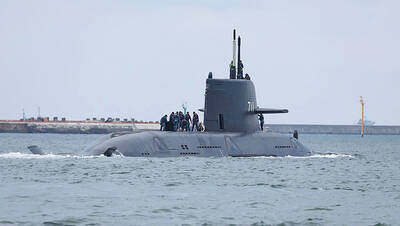
UPDATE: The submarine would need to undergo combined systems testing and crew training for navy personnel before it is ready for mission, an expert said Taiwan’s first domestically built submarine, the Hai Kun (Narwhal, 海鯤), could be delivered to the navy as early as next month, military expert and Taiwan Association for Security and Development chairman Chi Tung-yun (紀東昀) said yesterday. The submarine was yesterday morning observed departing for its 21st sea trial and its 15th submerged test. The vessel missed the initial delivery deadline of November last year due to “testing delays,” its primary contractor, shipbuilder CSBC Corp, Taiwan, said in June. The contractor also cited “political pressure from China” in procuring critical equipment. All testing operations are in the final stages, with the

OCT. 31: The antiviral drugs Tamiflu and Eraflu have been distributed to about 4,000 medical facilities nationwide for people in seven groups who develop flu-like symptoms As the domestic influenza epidemic enters its peak season and continues to escalate, the Centers for Disease Control (CDC) yesterday announced that publicly funded influenza antiviral drugs for seven eligible groups have been extended to Oct. 31, allowing those who develop flu-like symptoms to receive the medication without undergoing a rapid influenza test. The CDC has extended the expanded use of flu antiviral drugs to seven groups: healthcare and influenza-prevention personnel; residents and staff at nursing homes, long-term care facilities and similar institutions; kindergarten and daycare workers and home-based caregivers; students from kindergarten through high school, vocational high school and the
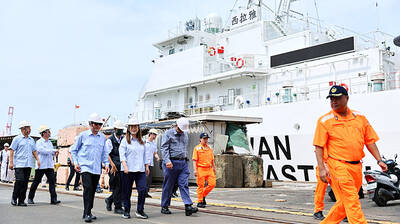
Ocean Affairs Council (OAC) Minister Kuan Bi-ling (管碧玲) on Wednesday said decommissioned coast guard vessels were given to the Philippines to enhance regional rescue capacity and would not affect Taiwanese fishers’ rights and benefits. Kuan made the remarks after confirmation on Tuesday that a 500-tonne Coast Guard Administration (CGA) patrol and rescue vessel would be given to the Philippine Coast Guard. The donation ceremony was reportedly done in Manila, but whether the vessel — previously numbered “CG123” and named Kinmen (金門) — has been handed over has yet to be confirmed. China’s Taiwan Affairs Office (TAO) on Wednesday criticized the donation for “taking


 RSS
RSS