


The National Communications Commission (NCC) yesterday said it had asked Want Want-China Broadband to brief the commission on how it handled the repercussions of remarks by Want Want China Times Group chairman Tsai Eng-meng (蔡衍明) in an interview with the Washington Post last month, adding that the company must provide written information as soon as it receives an official notice from the commission.
The media regulator made the announcement during a review of change of management applications from 11 cable service providers previously owned by multiple system operator China Network Systems (CNS), which was purchased by Want Want China Broadband last year.
Chen Kuo-long (陳國龍), director of the commission’s business management department, said the official notice would be delivered within two weeks.
Kao Fu-yao (高福堯), director of the commission’s legal department, said the commission had asked the company to clarify a number of things, including the Washington Post incident.
“At this point, the commission is trying to understand some basic facts and has yet to discuss whether the company should make any substantial commitment,” Kao said. “Based on the NCC Organization Act (通傳會組織法), the commission is charged with preserving the independence of media, which we will consider when we review the case.”
The Jan. 21 Post article quoted the Taiwanese billionaire as saying “unification with China is going to happen sooner or later,” whether people like it or not.
Commenting on the decision to fire an editor at the Chinese-language China Times for describing a top Chinese negotiator on Taiwan as “third rate,” Tsai said the person was dismissed because the description offended people, not just the Chinese.
In the interview with Andrew Higgins, Tsai also said he did not believe the reports of a massacre in Tianamen Square in 1989 were true.
Last week, however, he said in a letter in the China Times that he was wiling to apologize to the victims of the Tianamen Square Massacre if his comments offended them, adding that his words had been “severely twisted” by the journalist.
Media experts also criticized Want Want China Times Group for using its own media outlets to report the Post incident, but failing to balance those reports by including different opinions.
Kao said the case involved several media laws, including the Cable Television Act (有線廣播電視法), the Statute For Investment By Foreign Nationals (外國人投資條例) and the Telecommunications Act (電信法).
The commission will review the information provided by Want Want-China Times and decide whether it should hold more public hearings on the case or take other actions, he said.
Prior to the meeting yesterday, several university professors urged the commission to reject the Want Want China Times-CNS deal, saying it would create a “cross-media monster” that controls the press, TV and almost one-third of the cable TV market.
Kao also confirmed that NCC Deputy Chairperson Chen Jeng-chang (陳正倉), as well as commissioners Chung Chi-hui (鍾起惠) and Weng Hsiao-ling (翁曉玲), had withdrawn from reviewing the case.
The three have yet to pursue legal action against Want Want China Times, after the group threatened to sue them for giving it such a difficult time in approving the Want Want Group’s purchase of China Times Group in 2009. The group later published their photos on the front page of the China Times in a manner resembling those of wanted criminals.
Meanwhile, the commission said it had decided to send some of the media coverage on the altercation involving singer-actress Makiyo and her friends and a taxi driver to the Content Review Committee, formed by media experts not affiliated with the commission, for review.
“Some channels have repeatedly broadcast images and content reinforcing physical and psychological violence, which could be harmful to children and teenagers and violate regulations governing TV ratings,” it said.
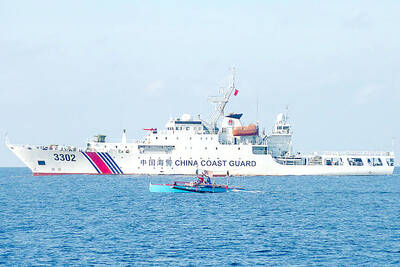
EXPANSIONIST: China deploys an average of 40 to 50 warships and coast guard vessels daily in the South China Sea, despite pledges not to militarize the region, an official said China is attempting to expand its influence across the First Island Chain and increase pressure on Japan by sending coast guard vessels into waters off of Taiwan under the pretext of maritime negotiations with Japan and the Philippines, a national security official said yesterday. China’s recent actions in the waters east of Taiwan and Japan and the Philippines’ exclusive economic zones (EEZ) are attempts to establish dominance in First Island Chain waters, said the official who declined to be named, adding that this is “expansion disguised as law enforcement.” Framing China’s actions solely as a cross-strait issue is a serious misjudgment that
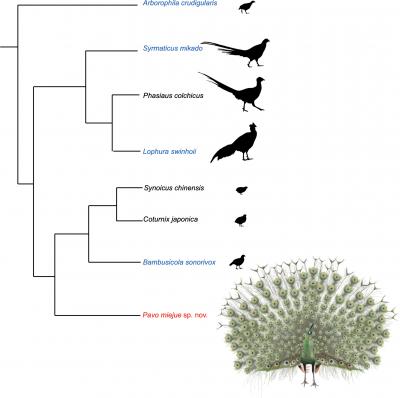
Through analyzing fossil evidence, a research team at National Taiwan University (NTU) discovered the largest endemic bird to have lived in Taiwan, naming it Pavo miejue, or extinct peafowl (滅絕孔雀). The Mikado pheasant, which is printed on the back of the NT$1,000 bank note, was previously believed to be the biggest endemic bird to Taiwan. The research team’s findings suggest that Pavo miejue lived during the Pleistocene epoch tens of thousands of years ago. It is the first endemic extinct bird species discovered and formally named in Taiwan. The study was coauthored by NTU Institute of Ecology and Evolutionary Biology professor Tsai Cheng-hsiu (蔡政修),
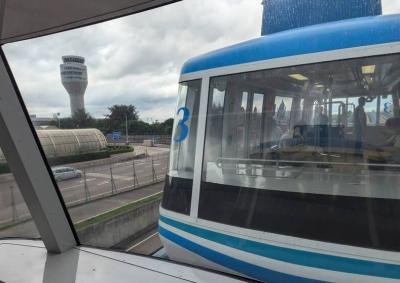
Taiwan Taoyuan International Airport is to suspend its automated Skytrain service connecting Terminal 1 and Terminal 2 starting on July 1 to facilitate connection works for the upcoming Terminal 3, the airport operator said today. Passengers and staff who need to travel between the two terminals after the suspension can instead use the Taoyuan MRT or the airport's 24-hour shuttle bus service, Taoyuan International Airport Corp said. The Taoyuan MRT Airport Line directly links the two terminals, while the shuttle buses are to operate around the clock, the company added. The Skytrain provides free transportation between the airport’s two terminals for travelers and
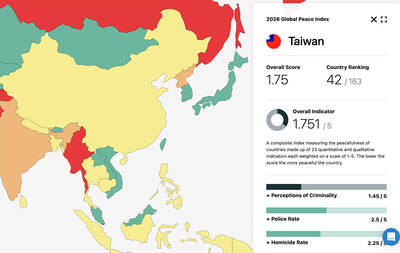
Taiwan ranked 42nd in terms of peacefulness among 163 countries, down five places from last year, according to this year’s Global Peace Index. With an overall score of 1.751, Taiwan dropped from 37th last year, the report published by the global Institute for Economics and Peace showed. The overall score measures a country’s level of peacefulness using 23 quantitative and qualitative indicators across three domains — ongoing domestic and international conflict, societal safety and security, and militarization. While Taiwan ranked 42nd worldwide, it was listed in ninth place among the 19 Asian-Pacific countries in the report, after New Zealand, Singapore, Japan, Malaysia,


 RSS
RSS