


The Taipei District Court yesterday approved the provisional seizure of the assets of former minister of national defense Chen Chao-min (陳肇敏) and seven others implicated in the wrongful execution of airman Chiang Kuo-ching (江國慶) in 1997.
The ruling was handed down after the Ministry of National Defense asked the court on Tuesday to grant the provisional seizure of Chen’s assets, as he was the head of Air Combat Command at the time of the incident, as well as the assets of officers involved in the case to prevent them from transferring funds from their bank accounts.
On Oct. 27, the Northern Military District Court ruled that, under the Criminal Compensation Act (刑事補償法), Chiang’s mother, Wang Tsai-lien (王彩蓮), is to receive NT$131.85 million (US$4.37 million) in compensation. The court held the eight military officers involved in the case responsible for the reparation.
The Taipei District Court has notified the Northern Military District Court of the ruling to implement the legal procedures.
These are likely to include the freezing of any assets registered in the names of Chen and the seven officers, such as property, cars and bank accounts.
As to whether other officers involved the matter would be asked to help repay the money the ministry has paid to Chiang’s mother, the compensation committee would need to conduct further research before releasing any names or amounts, said an official with the ministry’s Judicial Department, Shen Shih-wei (沈世偉).
If the officers are unwilling to compensate the family, the Northern Military District Court would file civil lawsuits against them, Shen said.
In 1996, Chiang was falsely accused of the rape and murder of a five-year-old girl at Air Combat Command in Taipei. He was convicted and executed in 1997.
In May last year, Taipei prosecutors identified the real murderer as another air force member.
In September, Chiang was acquitted of murder in a posthumous retrial by a military court.
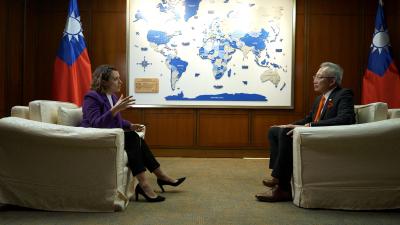
“China is preparing to invade Taiwan,” Deputy Minister of Foreign Affairs Francois Wu (吳志中) said in an exclusive interview with British media channel Sky News for a special report titled, “Is Taiwan ready for a Chinese invasion?” the Ministry of Foreign Affairs said today in a statement. The 25-minute-long special report by Helen Ann-Smith released yesterday saw Sky News travel to Penghu, Taoyuan and Taipei to discuss the possibility of a Chinese invasion and how Taiwan is preparing for an attack. The film observed emergency response drills, interviewed baseball fans at the Taipei Dome on their views of US President

ECONOMIC BENEFITS: The imports from Belize would replace those from Honduras, whose shrimp exports have dropped 67 percent since cutting ties in 2023 Maintaining ties with Taiwan has economic benefits, Ministry of Foreign Affairs officials said yesterday, citing the approval of frozen whiteleg shrimp imports from Belize by the Food and Drug Administration (FDA) as an example. The FDA on Wednesday approved the tariff-free imports from Belize after the whiteleg shrimp passed the Systematic Inspection of Imported Food, which would continue to boost mutual trade, the ministry said. Taiwan’s annual consumption of whiteleg shrimps stands at 30,000 tonnes, far exceeding domestic production, the ministry said. Taiwan used to fill the gap by importing shrimps from Honduras, but purchases slumped after Tegucigalpa severed diplomatic ties with Taiwan
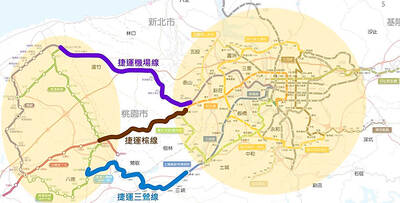
The Executive Yuan yesterday approved a southwestern extension of the Sanying MRT Line from New Taipei to Bade District (八德) in Taoyuan, with a goal of starting construction by late 2026. The 4.03-kilometer extension, featuring three new stations, will run from the current terminus at Yingtao Fude Station (LB12) in New Taipei City to Dannan Station (LB14), where it will connect with Taoyuan’s Green Line, New Taipei City Metro Corp said in a statement. This extension will follow the completion of core Sanying Line, a 14.29-kilometer medium-capacity system linking Tucheng (土城), Sansia (三峽)

CARGO LOSS: About 50 containers at the stern of the ‘Ever Lunar’ cargo ship went overboard, prompting the temporary closure of the port and disrupting operations Evergreen Marine Corp, Taiwan’s largest container shipper, yesterday said that all crew members aboard the Ever Lunar (長月) were safe after dozens of containers fell overboard off the coast of Peru the previous day. The incident occurred at 9:40am on Friday as the Ever Lunar was anchored and waiting to enter the Port of Callao when it suddenly experienced severe rolling, Evergreen said in a statement. The rolling, which caused the containers to fall, might have been caused by factors including a tsunami triggered by an earthquake in Russia, poor winter sea conditions in South America or a sudden influx of waves,


 RSS
RSS