


Starting today, the free wireless service initially launched in Taipei City in July will be expanded to outdoor areas, including major boulevards and commercial districts, as the city government plans to increase the wireless coverage rate to 100 percent by next year.
The service, called “TPE-Free,” has been available since July for anyone in the city, including foreign visitors, in MRT stations, city libraries, administrative centers and branches of Taipei City Hospital. People in the city can now enjoy free wireless service along 39 major roads, including Zhongxiao E Road, Renai Road and Zhongshan S Road.
Eight major commercial districts, e.g. Xinyi, Zhongxiao and Ximending, are also included in the free wireless service coverage range. The service is further available on 500 city buses.
Taipei Mayor Hau Lung-bin (郝龍斌) yesterday said the city government would list a budget of about NT$100 million (US$ 3 million) next year to expand the service to night markets and parks.
“We will turn Taipei into a wireless city, and make wireless service as convenient as breathing or drinking water,” he said at the launch ceremony.
According to Chang Chia-sheng (張家生), commissioner of the city’s Department of Information Technology, the number of people who have registered TPE-Free accounts reached 700,000 this month.
The department has set up 2,000 access points around the city and the service has a 512Kbps connection speed.
The expansion of the city’s free wireless service came after President Ma Ying-jeou (馬英九) announced on Tuesday that the free wireless service would be available at more than 2,500 government agencies starting on Friday.
Hau said the city government would incorporate the central government’s plan, since most of the government agencies are located in Taipei.
Taiwanese and Alien Resident Certificate holders can register for a free account using their mobile phone number, while foreign visitors can use their passport number to apply for the service at Taipei International Airport (Songshan) and visitor information centers throughout the city.

“China is preparing to invade Taiwan,” Deputy Minister of Foreign Affairs Francois Wu (吳志中) said in an exclusive interview with British media channel Sky News for a special report titled, “Is Taiwan ready for a Chinese invasion?” the Ministry of Foreign Affairs said today in a statement. The 25-minute-long special report by Helen Ann-Smith released yesterday saw Sky News travel to Penghu, Taoyuan and Taipei to discuss the possibility of a Chinese invasion and how Taiwan is preparing for an attack. The film observed emergency response drills, interviewed baseball fans at the Taipei Dome on their views of US President

ECONOMIC BENEFITS: The imports from Belize would replace those from Honduras, whose shrimp exports have dropped 67 percent since cutting ties in 2023 Maintaining ties with Taiwan has economic benefits, Ministry of Foreign Affairs officials said yesterday, citing the approval of frozen whiteleg shrimp imports from Belize by the Food and Drug Administration (FDA) as an example. The FDA on Wednesday approved the tariff-free imports from Belize after the whiteleg shrimp passed the Systematic Inspection of Imported Food, which would continue to boost mutual trade, the ministry said. Taiwan’s annual consumption of whiteleg shrimps stands at 30,000 tonnes, far exceeding domestic production, the ministry said. Taiwan used to fill the gap by importing shrimps from Honduras, but purchases slumped after Tegucigalpa severed diplomatic ties with Taiwan
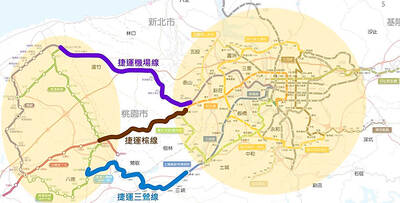
The Executive Yuan yesterday approved a southwestern extension of the Sanying MRT Line from New Taipei to Bade District (八德) in Taoyuan, with a goal of starting construction by late 2026. The 4.03-kilometer extension, featuring three new stations, will run from the current terminus at Yingtao Fude Station (LB12) in New Taipei City to Dannan Station (LB14), where it will connect with Taoyuan’s Green Line, New Taipei City Metro Corp said in a statement. This extension will follow the completion of core Sanying Line, a 14.29-kilometer medium-capacity system linking Tucheng (土城), Sansia (三峽)

CARGO LOSS: About 50 containers at the stern of the ‘Ever Lunar’ cargo ship went overboard, prompting the temporary closure of the port and disrupting operations Evergreen Marine Corp, Taiwan’s largest container shipper, yesterday said that all crew members aboard the Ever Lunar (長月) were safe after dozens of containers fell overboard off the coast of Peru the previous day. The incident occurred at 9:40am on Friday as the Ever Lunar was anchored and waiting to enter the Port of Callao when it suddenly experienced severe rolling, Evergreen said in a statement. The rolling, which caused the containers to fall, might have been caused by factors including a tsunami triggered by an earthquake in Russia, poor winter sea conditions in South America or a sudden influx of waves,


 RSS
RSS