


Controversy on Thursday surrounded a mural in front of the Taipei Museum of Contemporary Art by local avant-garde artist Yao Jui-chung (姚瑞中) in which the word “Taiwanese” is transliterated into the Chinese characters for Ta wan ni ssu (他玩妳死), meaning “He plays, you die.”
The characters were used in the title of Yao’s painting, which features a red demon copulating with a green animal-headed female while she gives a thumbs up with her right hand.
Visiting with officials from the Museum and the Bureau of Cultural Affairs, Taipei City Councilor Wang Shih-chien (王世堅) said the painting insinuated that Taiwanese were represented by the female figure, who Wang said was being raped.
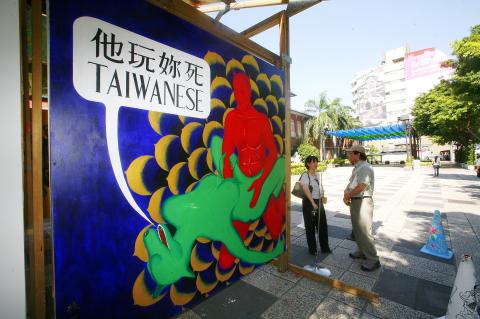
Photo: Liu Jong, Taipei Times
Wang said the creative, artistic process should have absolute freedom, but art should not be derogatory to others and engage in self-defamation.
In addition, because the painting was placed at the front of the museum plaza and right next to a pedestrian sidewalk on Chang-an W Road, people in the surrounding neighborhood might complain about what could be perceived as the city government’s use of taxpayer money to subsidize creations that set a “bad example” for children, Wang said.
Although there is a notice warning that the painting is “R-rated,” which says children under the age of 12 should be accompanied by parents when viewing the painting, local residents said the warning is meaningless in a public space.
Museum executive director Shih Jui-jen (石瑞仁) said the museum respected artists’ right to freely express themselves and that “nude does not necessarily represent sex.”
Shih and Wang argued about the issue at the site and the incident was finally resolved when Kuo Pei-yu (郭珮瑜), third section chief of the Bureau of Cultural Affairs, agreed to move the painting to the inner part of the plaza.
Kuo said the museum hoped to be able to relocate the painting within a week.
Yao said the intention of his painting was to approach the notions of country and nationality in a humorous manner and that the work had nothing to do with the pan-green or pan-blue camps.
The mural is part of a series titled Cynic’s Republic, which includes other pieces that use other nations’ names, such as Japan and China, Yao said, adding that the paintings were simply an expression of esthetics and that critics were overreacting.
Yao said the red devil represented the evil forces of authority, while the beast-headed female represented the silent public and the cynic because even while being raped, she was still giving the thumbs up.
The figure of the female was also a representation of chaos in Taiwan, Yao said.
In 2007, a similar painting by Yao was shown at the Shanghai Art Fair with a title that transliterated to Chuai ni ssu (踹你死), meaning “to kick you to death.” The work was removed from the exhibition after a day.
“I thought this was something that only happened in authoritarian countries,” Yao said of the affair.
New Taiwan Wall Painting Team curator Jiang Yao-xian (蔣耀賢) said the artists themselves had come up with the funds for the exhibitions.
No government subsidies were involved and controversy over one painting is unfair, Jiang said.
Art critic Huang Hai-ming (黃海鳴) said Yao was a well-known contemporary artist who was known to be concerned with political problems.
Haung said Yao is not concerned about sex, but he is trying to satirize politics through art, and this is one of Yao’s important characteristics.
TRANSLATED BY JAKE CHUNG, STAFF WRITER
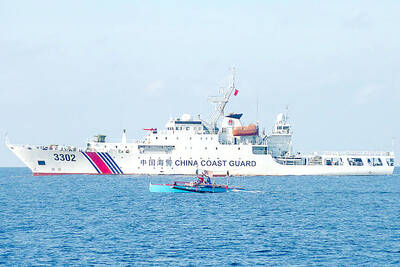
EXPANSIONIST: China deploys an average of 40 to 50 warships and coast guard vessels daily in the South China Sea, despite pledges not to militarize the region, an official said China is attempting to expand its influence across the First Island Chain and increase pressure on Japan by sending coast guard vessels into waters off of Taiwan under the pretext of maritime negotiations with Japan and the Philippines, a national security official said yesterday. China’s recent actions in the waters east of Taiwan and Japan and the Philippines’ exclusive economic zones (EEZ) are attempts to establish dominance in First Island Chain waters, said the official who declined to be named, adding that this is “expansion disguised as law enforcement.” Framing China’s actions solely as a cross-strait issue is a serious misjudgment that
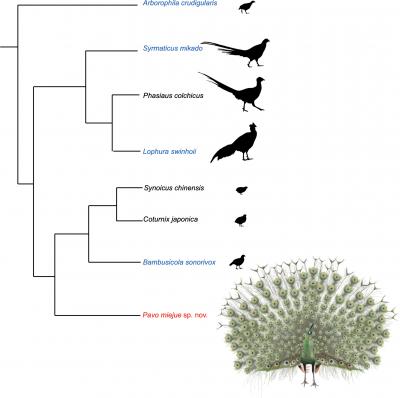
Through analyzing fossil evidence, a research team at National Taiwan University (NTU) discovered the largest endemic bird to have lived in Taiwan, naming it Pavo miejue, or extinct peafowl (滅絕孔雀). The Mikado pheasant, which is printed on the back of the NT$1,000 bank note, was previously believed to be the biggest endemic bird to Taiwan. The research team’s findings suggest that Pavo miejue lived during the Pleistocene epoch tens of thousands of years ago. It is the first endemic extinct bird species discovered and formally named in Taiwan. The study was coauthored by NTU Institute of Ecology and Evolutionary Biology professor Tsai Cheng-hsiu (蔡政修),
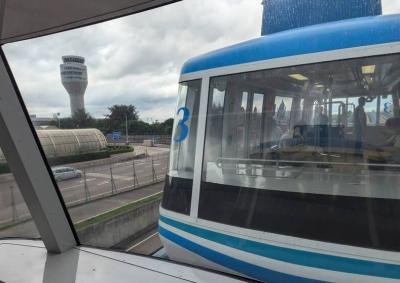
Taiwan Taoyuan International Airport is to suspend its automated Skytrain service connecting Terminal 1 and Terminal 2 starting on July 1 to facilitate connection works for the upcoming Terminal 3, the airport operator said today. Passengers and staff who need to travel between the two terminals after the suspension can instead use the Taoyuan MRT or the airport's 24-hour shuttle bus service, Taoyuan International Airport Corp said. The Taoyuan MRT Airport Line directly links the two terminals, while the shuttle buses are to operate around the clock, the company added. The Skytrain provides free transportation between the airport’s two terminals for travelers and
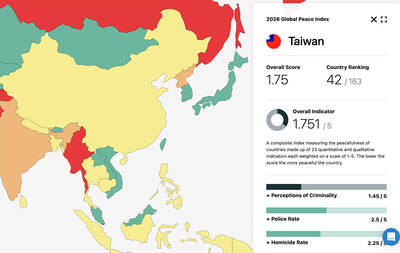
Taiwan ranked 42nd in terms of peacefulness among 163 countries, down five places from last year, according to this year’s Global Peace Index. With an overall score of 1.751, Taiwan dropped from 37th last year, the report published by the global Institute for Economics and Peace showed. The overall score measures a country’s level of peacefulness using 23 quantitative and qualitative indicators across three domains — ongoing domestic and international conflict, societal safety and security, and militarization. While Taiwan ranked 42nd worldwide, it was listed in ninth place among the 19 Asian-Pacific countries in the report, after New Zealand, Singapore, Japan, Malaysia,


 RSS
RSS