


Nuclear safety, green energy and international security are expected to be high on the agenda as Democratic Progressive Party (DPP) Chairperson Tsai Ing-wen (蔡英文) makes her first trip abroad since being nominated as the party’s presidential candidate.
Tsai left yesterday evening for a week-long trip to Germany and the UK, coming two weeks before she is expected to depart on another visit to the Philippines and another to the US in the next few months.
A tour of her alma mater, the London School of Economics and Political Science (LSE), is expected to be a highlight of the visit, and the DPP candidate will meet experts and participate in a conference there on climate change.
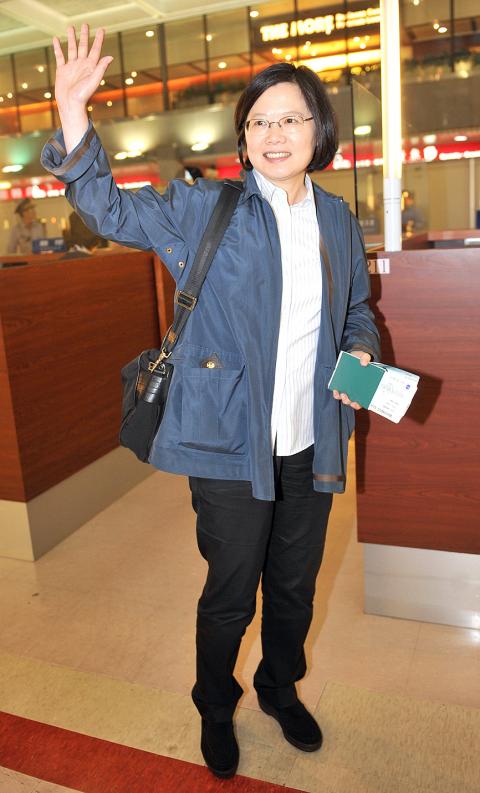
Photo: Yao Chieh-hsiu, Taipei Times
On Thursday morning, she will also visit the University of London’s School of Oriental and African Studies, where she will deliver a speech on her views on security in the Asia-Pacific region as well as cross-strait developments, party officials said.
The visit to LSE, from where Tsai received a doctorate in law, was not publicized until late last week. Even as she departed yesterday, officials did not disclose the exact timing and arrangement of the tour because of concerns that it could be viewed with hostility by Beijing.
DPP spokesperson Chen Chi-mai (陳其邁) said the main purpose of the European trip was for Tsai to learn more about EU green energy policy, nuclear safety and the recent decision by Germany to phase out nuclear power by 2022.
Tsai has proposed a plan to phase out nuclear power in Taiwan by 2025 pending the development of other sources of renewable energy. The DPP says it will implement the plan if it gains governance next year.
“We hope that Germany’s experience can provide some important reference for when the DPP returns to government,” Tsai told reporters at Taiwan Taoyuan International Airport.
“Many people in Taiwan know that we cannot achieve 100 percent safety in nuclear power, but the challenges we face are greater as Germany is among the most enthusiastic in developing sustainable energy,” she said.
Tsai will also meet local Taiwanese associations, representatives from European think tanks and politicians, including UK and German parliamentarians, Chen said.
Her first planned stop is Berlin Central Station this afternoon.
She will visit the Reichstag building to sit down with a local think tank and German politicians the next day with an evening speech to the European Federation of Taiwanese Associations at 7pm.
DPP officials said that Tsai would arrive in the UK on Wednesday to meet Taiwanese expatriate groups. She is expected to pay a visit to British politicians on Thursday afternoon at 3pm, before flying back to Taiwan the next evening.
Both flights will transit through Hong Kong and Tsai will be accompanied by former Cabinet spokesperson and representative to Germany Shieh Jhy-wey (謝志偉) and Hsiao Bi-khim (蕭美琴), the deputy head of DPP’s policy think tank.
Tsai is scheduled to return to Taiwan on Saturday.

Considering that most countries issue more than five denominations of banknotes, the central bank has decided to redesign all five denominations, the bank said as it prepares for the first major overhaul of the banknotes in more than 24 years. Central bank Governor Yang Chin-lung (楊金龍) is expected to report to the Legislative Yuan today on the bank’s operations and the redesign’s progress. The bank in a report sent to the legislature ahead of today’s meeting said it had commissioned a survey on the public’s preferences. Survey results showed that NT$100 and NT$1,000 banknotes are the most commonly used, while NT$200 and NT$2,000

The Centers for Disease Control (CDC) yesterday reported the first case of a new COVID-19 subvariant — BA.3.2 — in a 10-year-old Singaporean girl who had a fever upon arrival in Taiwan and tested positive for the disease. The girl left Taiwan on March 20 and the case did not have a direct impact on the local community, it said. The WHO added the BA.3.2 strain to its list of Variants Under Monitoring in December last year, but this was the first imported case of the COVID-19 variant in Taiwan, CDC Deputy Director-General Lin Ming-cheng (林明誠) said. The girl arrived in Taiwan on

South Korea is planning to revise its controversial electronic arrival card, a step Taiwanese officials said prompted them to hold off on planned retaliatory measures, a South Korean media report said yesterday. A Yonhap News Agency report said that the South Korean Ministry of Foreign Affairs is planning to remove the “previous departure place” and “next destination” fields from its e-arrival card system. The plan, reached after interagency consultations, is under review and aims to simplify entry procedures and align the electronic form with the paper version, a South Korean ministry official said. The fields — which appeared only on the electronic form

The Ministry of Foreign Affairs (MOFA) is suspending retaliation measures against South Korea that were set to take effect tomorrow, after Seoul said it is updating its e-arrival system, MOFA said today. The measures were to be a new round of retaliation after Taiwan on March 1 changed South Korea's designation on government-issued alien resident certificates held by South Korean nationals to "South Korea” from the "Republic of Korea," the country’s official name. The move came after months of protests to Seoul over its listing of Taiwan as "China (Taiwan)" in dropdown menus on its new online immigration entry system. MOFA last week


 RSS
RSS