


Designer Khieng Puong’s (方國強) designs for the new uniforms of Far Eastern Air Transport’s (FAT) flight attendants, which debuted on the company’s first official domestic flight on April 18 after the company fell into financial troubles in 2008, have earned him a lot of media attention.
Founder of the Khieng Atelier brand, Cambodia-born Puong worked under the famous French designer Emanuel Ungaro for 12 years, holding at one point the position of chief designer of accessories at Ungaro. Puong later married Wang Jui-jung (王瑞容), daughter of late Taiwanese tycoon Wang Yung-ching (王永慶).
Puong demonstrated complete mastery of FAT’s characteristic gray-and-red color theme and used it to design a suit that capitalizes on the contrast of metallic gray and eastern-red. To that, he added gray stockings on red-colored BESO high heels, a brand and style popularized by the popular TV show The Fierce Wife (犀利人妻).
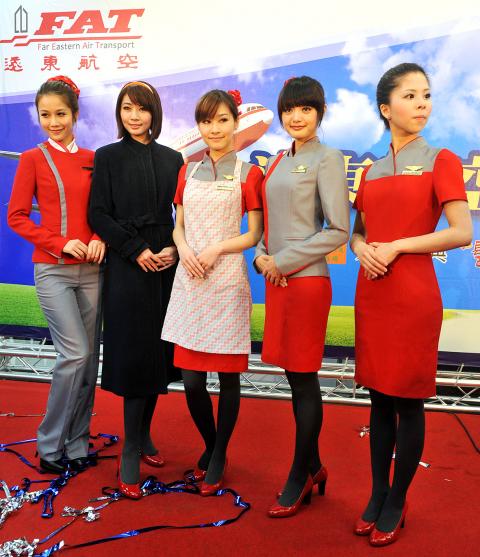
Photo: Chien Jung-fung, Taipei Times
Another highly visible uniform designed by Puong is the orange-and-white suit for Taiwan Mobile Co. The fake two-piece vest and shirt with a miniskirt, combined with the sweet cellphone-savvy schoolgirl style used in the company’s cellphone ads, sought to give customers a feeling of refreshment and friendliness.
Puong has also designed uniforms for staff at the W Hotel in Taipei and Hotel One in Greater Taichung.
Although the all-black uniform that the W Hotel staff wear looks simple, Puong said it brought out the spirit of the hotel’s service, which he defined as “handling all matters for the traveler as efficiently and imperceptibly as possible, but also respecting the traveler’s personal space.”
Skilled at and famous for making “one-of-a-kind” uniforms, Puong sees himself as the “promoter of corporations” as he designs uniforms for every type of person according to their style and figure, thus making it possible for them to go to work looking their very best.
While people have an almost fanatical attraction to “beautiful women in uniform,” Puong has taken the imagination to a whole new level, making high-class custom-tailored clothing itself the object of beauty.
For him, the spirit of uniforms should be summed up in one word: wow — adding that he disagreed with the view that uniforms are synonymous with rigidity.
“A successful uniform should make its owner want to wear it when she goes shopping,” Puong said.
When Puong came to Taiwan with his wife in 1999, he didn’t understand a word of Mandarin and had to communicate with his father-in-law, who spoke Hoklo (also known as Taiwanese), using Teochew — which are closely related — which often ended with both sides not completely understanding each other.
Puong can now communicate with customers in Taiwan with ease and his products have become very popular amongst corporate businessmen’s wives and the wealthy.
Taiwan is now capable of making excellent quality custom-made clothing, he said, but in terms of corporate uniforms, it has yet to find the unique “spirit.”
Using high-quality custom-made clothes, Puong hopes to polish the image of Taiwanese corporations and, in so doing, raise the quality of their service.
TRANSLATED BY JAKE CHUNG, STAFF WRITER

Considering that most countries issue more than five denominations of banknotes, the central bank has decided to redesign all five denominations, the bank said as it prepares for the first major overhaul of the banknotes in more than 24 years. Central bank Governor Yang Chin-lung (楊金龍) is expected to report to the Legislative Yuan today on the bank’s operations and the redesign’s progress. The bank in a report sent to the legislature ahead of today’s meeting said it had commissioned a survey on the public’s preferences. Survey results showed that NT$100 and NT$1,000 banknotes are the most commonly used, while NT$200 and NT$2,000

The Centers for Disease Control (CDC) yesterday reported the first case of a new COVID-19 subvariant — BA.3.2 — in a 10-year-old Singaporean girl who had a fever upon arrival in Taiwan and tested positive for the disease. The girl left Taiwan on March 20 and the case did not have a direct impact on the local community, it said. The WHO added the BA.3.2 strain to its list of Variants Under Monitoring in December last year, but this was the first imported case of the COVID-19 variant in Taiwan, CDC Deputy Director-General Lin Ming-cheng (林明誠) said. The girl arrived in Taiwan on

South Korea is planning to revise its controversial electronic arrival card, a step Taiwanese officials said prompted them to hold off on planned retaliatory measures, a South Korean media report said yesterday. A Yonhap News Agency report said that the South Korean Ministry of Foreign Affairs is planning to remove the “previous departure place” and “next destination” fields from its e-arrival card system. The plan, reached after interagency consultations, is under review and aims to simplify entry procedures and align the electronic form with the paper version, a South Korean ministry official said. The fields — which appeared only on the electronic form

The Ministry of Foreign Affairs (MOFA) is suspending retaliation measures against South Korea that were set to take effect tomorrow, after Seoul said it is updating its e-arrival system, MOFA said today. The measures were to be a new round of retaliation after Taiwan on March 1 changed South Korea's designation on government-issued alien resident certificates held by South Korean nationals to "South Korea” from the "Republic of Korea," the country’s official name. The move came after months of protests to Seoul over its listing of Taiwan as "China (Taiwan)" in dropdown menus on its new online immigration entry system. MOFA last week


 RSS
RSS