


Lawmakers across party lines yesterday were divided over a decision by military prosecutors not to prosecute former minister of national defense Chen Chao-min (陳肇敏) and other military officers involved in the wrongful conviction of Chiang Kuo-ching (江國慶), who was executed 15 years ago.
Democratic Progressive Party (DPP) Legislator Tsai Huang-liang (蔡煌瑯) said he was disappointed that the Supreme Prosecutors’ Office Special Investigation Panel (SIP) had chosen not to file charges.
“Justice hasn’t been served because those who wrongly convicted Chiang have not been held accountable. This is unacceptable. We reject the reasoning that the case has exceeded the statute of limitations,” Tsai said.
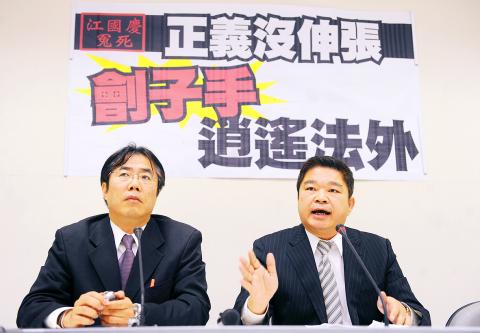
Photo: Liao Chen-huei, Taipei Times
Chiang was found guilty of raping and murdering a five-year-old girl in 1996 and executed the next year. The Military Supreme Court Prosecutors’ Office reopened the case in June last year after the Control Yuan censured the original military court over the case, citing seven major flaws in the trial, which included the coercion of Chiang’s confession by military investigators.
Chen, who at the time was chief of the air force, was one of about 30 current and former officers involved in Chiang’s arrest, trial and execution. The government watchdog found that he erred in appointing counterintelligence officers to investigate the case and claimed during the investigation that Chiang had admitted to him of committing the crime.
“Evidently, Chen and other military officers were guilty of misusing the law in the adjudication of this case,” Tsai said.
Chinese Nationalist Party (KMT) Legislator Hsieh Kuo-liang (謝國樑) said the KMT caucus respected the SIP’s decision not to prosecute, but insisted that Chen and other military officers involved should be held administratively accountable.
Control Yuan members Ma Yi-kung (馬以工) and Shen Mei-chen (沈美真), who led the investigation into the case, yesterday called for a speedy trial to clear Chiang’s name and for the withdrawal of awards conferred on military officers for solving the case.
Ma said that the indictment written by the Military Supreme Court Prosecutors’ Office could have a revolutionary impact on the use of confessions in criminal cases.
Both he and Shen declined to answer questions on what the Control Yuan might do to hold Chen and the other officers accountable, but said the case would be reopened if Chiang’s family or lawyers filed an appeal with the Control Yuan against Chen.
However, Shen said that it was unlikely that Chen’s administratively responsibility would be re-examined as the statute of limitations for civil servants in such cases is 10 years, as prescribed in the Act on Discipline of Civil Servants (公務員懲戒法).
Even if the act was amended as suggested by some lawmakers, it could still not be applied retroactively, Shen said.
“Being found guilty in the court of public opinion and bringing the real murderer to justice is the best punishment for Chen,” Shen said.

Considering that most countries issue more than five denominations of banknotes, the central bank has decided to redesign all five denominations, the bank said as it prepares for the first major overhaul of the banknotes in more than 24 years. Central bank Governor Yang Chin-lung (楊金龍) is expected to report to the Legislative Yuan today on the bank’s operations and the redesign’s progress. The bank in a report sent to the legislature ahead of today’s meeting said it had commissioned a survey on the public’s preferences. Survey results showed that NT$100 and NT$1,000 banknotes are the most commonly used, while NT$200 and NT$2,000

The Centers for Disease Control (CDC) yesterday reported the first case of a new COVID-19 subvariant — BA.3.2 — in a 10-year-old Singaporean girl who had a fever upon arrival in Taiwan and tested positive for the disease. The girl left Taiwan on March 20 and the case did not have a direct impact on the local community, it said. The WHO added the BA.3.2 strain to its list of Variants Under Monitoring in December last year, but this was the first imported case of the COVID-19 variant in Taiwan, CDC Deputy Director-General Lin Ming-cheng (林明誠) said. The girl arrived in Taiwan on

South Korea is planning to revise its controversial electronic arrival card, a step Taiwanese officials said prompted them to hold off on planned retaliatory measures, a South Korean media report said yesterday. A Yonhap News Agency report said that the South Korean Ministry of Foreign Affairs is planning to remove the “previous departure place” and “next destination” fields from its e-arrival card system. The plan, reached after interagency consultations, is under review and aims to simplify entry procedures and align the electronic form with the paper version, a South Korean ministry official said. The fields — which appeared only on the electronic form

The Ministry of Foreign Affairs (MOFA) is suspending retaliation measures against South Korea that were set to take effect tomorrow, after Seoul said it is updating its e-arrival system, MOFA said today. The measures were to be a new round of retaliation after Taiwan on March 1 changed South Korea's designation on government-issued alien resident certificates held by South Korean nationals to "South Korea” from the "Republic of Korea," the country’s official name. The move came after months of protests to Seoul over its listing of Taiwan as "China (Taiwan)" in dropdown menus on its new online immigration entry system. MOFA last week


 RSS
RSS