


The main suspect in Taiwan’s -longest-running criminal case will remain behind bars after the High Court upheld the death penalty for the man accused of spearheading the kidnap and murder of a 10-year-old boy more than 20 years ago.
The court upheld Chiou Ho-shun’s (邱和順) death penalty for the 12th time and confirmed sentences of 10 and 17 years for two accomplices in the alleged murder of Lu Cheng (陸正), who disappeared on his way home from school in Hsinchu.
The case, in administrative limbo because of the Supreme Court’s refusal to confirm the sentence, has long drawn national attention, with judicial reform advocates saying there are numerous flaws in the evidence and confessions, elicited through torture.
After the verdict was announced, Chiou told the court: “I haven’t killed anyone. Why don’t judges have the courage to find me not guilty,” raising his hands as a symbol of being wrongly accused.
The 10-year-old was kidnapped as he was walking home on Dec. 21, 1987, in a high-profile incident that shook the public. The Lu family received a ransom note for NT$5 million and made a NT$1 million payment nine days later, but Lu was never released.
After a tip-off in September the following year, police arrested three juveniles, who quickly confessed to the kidnapping and to the separate murder of an insurance agent. Chiou, in detention for another case at the time, was implicated as head of the criminal ring.
In total, 12 suspects were charged — with police obtaining confessions from all but one of them. As more details surfaced, however, discrepancies emerged in their accounts, including contradictions on where Lu’s body was. Over the years, charges against most of the suspects were dismissed.
Chiou, his then-girlfriend, Wu Shu-chen (吳淑貞), and Lin Kun-ming (林坤明) are the only defendants still in court 24 years after the murder. Wu was given 10 years by the High Court yesterday, one year less than in a previous ruling, and Lin, 17.
Lawyers for the defendants have maintained that the case is riddled with problems, including a lack of forensic evidence linking any of the three to the crime. The murder weapon, Lu’s body and his clothes were never found and the prosecution has based its case solely on confessions.
However, two prosecutors and 10 police officers involved in the case were impeached by the Control Yuan more than a decade ago for using violence and threats to obtain quick confessions, although the confessions were still accepted as evidence.
“This court battle is a stain on our country’s legal [history],” a joint statement from Chiou’s lawyers said after yesterday’s verdict was announced. “The court failed to bravely recognize the mistakes of the past and continues to gloss over [the facts].”
Signaling an apparent unwillingness to accept the High Court findings, the Supreme Court has rejected all 11 previous death penalty rulings, sending them back for repeated retrials that have prolonged the indefinite detentions of Chiou and Lin. Wu has been allowed to live at home.
Groups of judicial reform advocates and opponents of the death penalty gathered outside the court as the verdict was announced.
The latest decision was flawed, said Lin Feng-jeng (林峰正), executive director of the Judicial Reform Foundation, because the High Court has not yet resolved the inconsistencies that led the Supreme Court to call for retrials.
“It’s like asking a student to retake a test without having a textbook. How can we accept the results of this test?” Lin Feng-jeng asked.
The nine-member pro bono law team representing the defendants said they expect to appeal the ruling to the Supreme Court.
“We staunchly believe that they are innocent and that they are wrongly accused. We just want the courts to return their innocence and let them go home,” said Greg Yo (尤伯祥), one of the lawyers.
Prosecutors have pointed to separate incidents in the past two decades that they say are indicative of the trio’s guilt.
Previously, Wu was seen kneeling and apologizing to the victim’s family members, while testimony against Chiou was also given by a minor, surnamed Teng, that pointed police to a seaside location where Lu’s body was allegedly disposed of.


UPGRADE: The Kang Ding-class frigate is replacing its Chaparall missiles with Tien Chien II and Hua Yang VLS, which would provide it with long-range, 360° air defense Taiwan plans to produce 1,200 to 1,376 Hai Chien II missiles (海劍二, Sea Sword II) — also known as TC-2N — to serve as the standard air defense system of the navy’s surface combatant fleet, a source said yesterday. Last week, the Hai Chien II, the naval version of the Tien Kung II missile (天劍二, Sky Sword II), completed a live-fire test in waters off the National Chungshan Institute of Science and Technology’s Jiupeng facility (九鵬) in Pingtung County’s Manjhou Township (滿州). The MIM72 Chaparral and other dated air defense missiles that currently arm Taiwanese ships have inadequate range to combat Chinese

REASONS FOR TRAVEL: An assistant professor said that proposed amendments to penalize drivers if they used drugs overseas would not deter people from traveling People who operate a motor vehicle under the influence of marijuana would have their driver’s license revoked, even if they used the substance while overseas, the Ministry of Transportation and Communications said yesterday, citing proposed amendments to the Road Traffic Management and Penalty Act (道路交通管理處罰條例). The amendments would also authorize the government to revoke the licenses of people determined to have used Category 1 or Category 2 narcotics, even if they were not operating a vehicle while under the influence of drugs, as well as ban them from taking the license test for three years, the ministry said. People aged 18 or
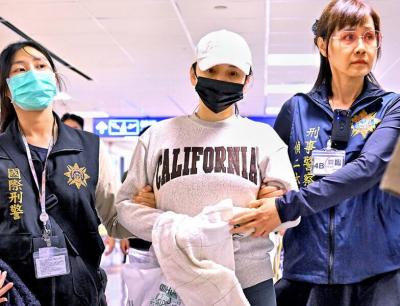
Johanne Liou (劉喬安), a Taiwanese woman who shot to unwanted fame during the Sunflower movement protests in 2014, returned to Taiwan last night after being deported from the US. She is to stand trial in Taiwan for charges involving embezzlement, fraud and drug crimes. The Criminal Investigation Bureau (CIB) said it took her into custody at Taiwan Taoyuan International Airport and would first question her before transferring her to the New Taipei District Prosecutors’ Office. She was arrested upon disembarking a flight from San Francisco that landed shortly before 7pm. Liou absconded to the US in 2019 after jumping bail
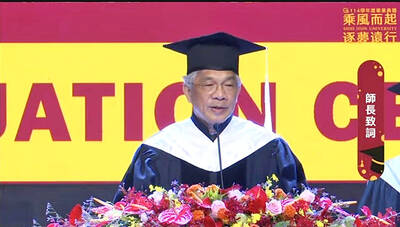
Shih Hsin University President Chen Ching-he (陳清河) yesterday issued a public apology for comments made in his commencement speech last week, stating that he has asked the school to suspend his duties and halt his wages for two months as a show of contrition. At the commencement ceremony on May 30, Chen said, “If you don’t manage your time well, or your own emotions, or your health, then I am telling every one of you — put a quick end to ‘you,’ because the world has no need for ‘you.’” The comments have sparked significant controversy online, and Chen through an open


 RSS
RSS