


The head of the National Security Bureau (NSB) yesterday said China’s first aircraft carrier would likely start training exercises at sea toward the end of this year.
Bureau Director Tsai Der-sheng (蔡得勝) told a meeting of the the legislature’s National Defense and Foreign Affairs Committee that while the aircraft carrier — an old carrier purchased from Ukraine in 1998, which has undergone refurbishing work in Dalian since 2002 — would commence training operations around that time, it should be noted that the vessel also has combat capabilities.
Tsai’s comment was in response to a question by Chinese Nationalist Party (KMT) Legislator Lin Yu-fang (林郁方) on whether the aircraft carrier was solely for training or if it could play a combat role.
Tsai said the Chinese were also developing combat aircraft based on Russian models capable of landing in and taking off from aircraft carriers.
On rumors that Beijing could rename the Varyag, “Shi Lang,” after the Qing Dynasty admiral who conquered what is now known as Taiwan in 1681, Tsai said if this was the case, then the political implications would be obvious.
Lin told the meeting the impact of China’s first aircraft -carrier would be most felt in the South China Sea, which would compel countries in the region to strengthen their military deployment in the sea.
As Taiping Island (太平島) is very far from Taiwan, any military dispute occurring there would make it difficult for Taiwan to have the upper hand militarily.
Lin also asked Tsai to comment on the impact of a downsizing of the Republic of China military police, which usually ensures security during residential elections.
Tsai said plans by the Ministry of National Defense to cut 1,000 military police personnel and reassign 2,500 to other units would, in the long term, affect security details.
Tsai also confirmed that a new generation of secure cellphones developed by a Taiwanese firm for bureau officials would enter service tomorrow.
The most important function of the cellphone was its ability to keep calls confidential, Tsai said, adding that the tracking function has been disabled and though the cellphone does have a camera function, it is usually turned off.
The new secure cellphone has an encoded chip that enables the deletion of classified data and turns the phone into a normal unsecured cellphone if abnormal activity is detected, a bureau official said.

FUKUOKA SITUATION: Japanese media reported that the pathogen is expected to be identified by the summer, while the CDC downplayed the idea that it was hMPV A “mysterious cold-like illness” reported in Japan’s Fukuoka Prefecture does not seem to be a new disease, but Japanese authorities have been asked about the situation, the Centers for Disease Control (CDC) said yesterday. The Fukuoka Prefectural Medical Association on Wednesday told a news conference that a “mystery cold” that has become a hot topic on social media is “highly likely to be caused by some kind of viral infection,” Japan’s KBC News reported. “Many people are experiencing symptoms starting with a sore throat, followed by a runny nose, phlegm and a severe cough,” KBC News reported, citing association officials. Health authorities are

Nvidia Corp CEO Jensen Huang (黃仁勳) arrived in Taiwan yesterday ahead of upcoming AI and technology events, saying he plans to meet with clients and Taiwan Semiconductor Manufacturing Co Chairman C.C. Wei (魏哲家) during his visit. After landing at Taipei Songshan Airport, Huang posed for photos with fans and handed out Yakult drinks to reporters and supporters waiting at the scene, saying he has “a lot to do” during the trip. Asked about reports that Nvidia’s planned headquarters site in Taipei’s Beitou Shilin Technology Park could break ground on May 27, Huang said that if the company holds an event, he would

The Ministry of Finance this afternoon announced the winning numbers for the March-April uniform invoice lottery. The winning number for the NT$10 million (US$318,060) special prize is 19531471, and the winning number for the NT$2 million grand prize is 85941329. Three numbers were drawn for the NT$200,000 first prize: 07225810, 20231230 and 83518781. Those with receipts matching the last seven digits of any of the first-prize numbers will win the NT$40,000 second prize, while those matching the last six digits will win the NT$10,000 third prize. Those whose receipts match the last five digits of the first-prize numbers can claim the NT$4,000 fourth prize,
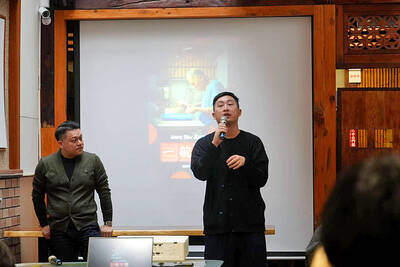
Taiwan Travelogue (臺灣漫遊錄), which earlier this week became the first Taiwanese novel to win the International Booker Prize, is to be adapted into a television series through a Taiwan-Japan coproduction, producer Chang Chen-yu (張辰漁) said yesterday. Chang, a producer at World Softest Production Film Co, wrote on Facebook that the company had been searching for projects with international appeal that retain a strong Taiwanese identity after colleagues and Japanese partners strongly recommended the novel. After reading the book, Chang said he immediately decided to pursue the screen rights. “A great story has the power to transcend time and borders, and connect countless people,”


 RSS
RSS