


Most people would agree that working in big cities can be a recipe for tension and frustration, but for those equipped with stress management skills, urban living can still be an enjoyable experience.
Just ask Pradeep Kumar Rawat. The Indian diplomat, who lives in bustling Taipei, loves city life, but has found simple formulas help to keep stress levels down.
“Whenever free, I take a walk in the Sun Yat-sen Memorial Hall next to my apartment to enjoy the wonderful ambiance,” he said in a recent interview.
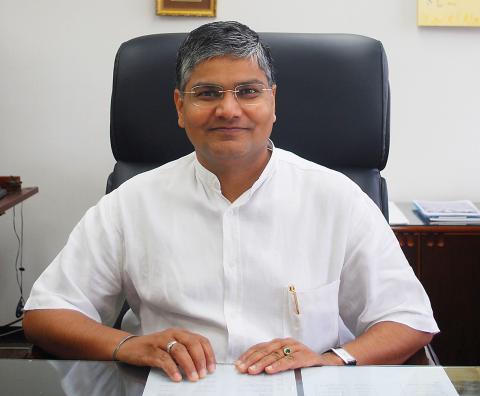
Photo: CNA
“If I have more time, I explore the surrounding mountains and relax my mind in a different environment,” he said.
Rawat is the director-general of the India-Taipei Association, India’s representative office in Taiwan. He has been a diplomat for about 20 years and was stationed in Hong Kong before being dispatched to Taipei a year-and-a-half ago. Though some may think diplomats live a charmed life, Rawat must deal with more pressure and longer days than the typical city dweller.
He wakes up at 5:45am with his wife every day to see his daughter off to school and comes home as late as 11pm from business gatherings.
However, Rawat, who always wears a genuine smile, said beating stress and finding happiness is most often found in the small things, like going out for a Chinese-style vegetarian meal or practicing abdominal breathing.
“Contrary to most people’s impression that Indians do yoga to reduce stress, whenever I feel pressured, I take deep breaths and drink hot water. Simple as that,” he said. “Prayers also help cope with stress because it reminds people that there is someone more powerful and wiser taking control over how events will unfold in our lives.”
Rawat said stress levels in India were probably even higher than in Taiwan, given the country’s big population, less than convenient transportation and unstable electricity infrastructure.
“Doctors working in local public hospitals, for example, answer to a great number of financially deprived patients, but don’t have enough resources to help them,” he said.
Since the “dormitory culture” is not as widespread in India as it is in Taiwan, he said family members usually live together and are able to diffuse some stress that way.
The outgoing diplomat also takes every opportunity to chat with local residents, even during short walks in Yangmingshan (陽明山), because he believes that talking to random hikers is a creative and stress-free way to promote cultural exchanges between countries.
“Not many capitals have the same advantageous location as Taipei,” he said. “Once tired of the city, you can travel to anywhere in less than a couple of hours.”
The frequent traveler said that Greater Kaohsiung was the best getaway destination for easing fatigue.
“As soon as you land, you’ll see wide venues and feel refreshed,” said Rawat, who also urged worn-out urbanites to come up with some of their own ideas to combat pressure.
“It is true of people working in cities everywhere around the world that they face pressure,” he said, “but coming up with creative ways to cope with stress is important.”

Considering that most countries issue more than five denominations of banknotes, the central bank has decided to redesign all five denominations, the bank said as it prepares for the first major overhaul of the banknotes in more than 24 years. Central bank Governor Yang Chin-lung (楊金龍) is expected to report to the Legislative Yuan today on the bank’s operations and the redesign’s progress. The bank in a report sent to the legislature ahead of today’s meeting said it had commissioned a survey on the public’s preferences. Survey results showed that NT$100 and NT$1,000 banknotes are the most commonly used, while NT$200 and NT$2,000

The Centers for Disease Control (CDC) yesterday reported the first case of a new COVID-19 subvariant — BA.3.2 — in a 10-year-old Singaporean girl who had a fever upon arrival in Taiwan and tested positive for the disease. The girl left Taiwan on March 20 and the case did not have a direct impact on the local community, it said. The WHO added the BA.3.2 strain to its list of Variants Under Monitoring in December last year, but this was the first imported case of the COVID-19 variant in Taiwan, CDC Deputy Director-General Lin Ming-cheng (林明誠) said. The girl arrived in Taiwan on

South Korea is planning to revise its controversial electronic arrival card, a step Taiwanese officials said prompted them to hold off on planned retaliatory measures, a South Korean media report said yesterday. A Yonhap News Agency report said that the South Korean Ministry of Foreign Affairs is planning to remove the “previous departure place” and “next destination” fields from its e-arrival card system. The plan, reached after interagency consultations, is under review and aims to simplify entry procedures and align the electronic form with the paper version, a South Korean ministry official said. The fields — which appeared only on the electronic form

The Ministry of Foreign Affairs (MOFA) is suspending retaliation measures against South Korea that were set to take effect tomorrow, after Seoul said it is updating its e-arrival system, MOFA said today. The measures were to be a new round of retaliation after Taiwan on March 1 changed South Korea's designation on government-issued alien resident certificates held by South Korean nationals to "South Korea” from the "Republic of Korea," the country’s official name. The move came after months of protests to Seoul over its listing of Taiwan as "China (Taiwan)" in dropdown menus on its new online immigration entry system. MOFA last week


 RSS
RSS