


Despite a ban on pseudo news and a requirement that all advertisements should be clearly labeled, news-like advertisements from government institutions or government-owned businesses that are vaguely labeled are still common, media reform activists said yesterday.
“Since pseudo news was banned in January, many government-owned businesses are now paying to get newspapers to publish promotional or propaganda articles labeled ‘advertorial features,’” Media Watch chairman Kuang Chung-hsiang (管中祥) told a news conference in Taipei. “But a majority of the public don’t know what ‘advertorials’ are and could still confuse such articles as real news reports.”
Citing the result of a poll conducted by Media Watch with more than 700 valid samples, Kuang said more than 90 percent of respondents said they didn’t know what an advertorial was and only 5.4 percent said they knew what it was.
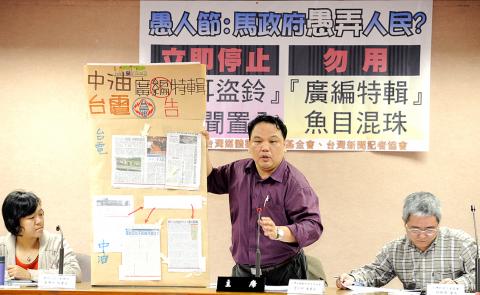
Photo: Lo Pei-der, Taipei Times
ADVERTISEMENTS
“Government agencies or government-owned businesses should stop publishing advertorials in newspapers and correctly label such articles as advertisements, as required by the law,” he said.
Association of Taiwan Journalists chairman Lin Chau-yi (林朝億) agreed with Kuang.
He said that the Government Budget Act (預算法) stipulates that when government agencies or businesses with more than 50 percent of their funding coming from the government pay to publish information in the media, “the information must be labeled as ‘advertising’ and it must say who paid for it.”
Advertorials that fail to meet these requirements are unlawful and the accounting department that approved the budget, as well as the auditor who reviewed and approved the accounting report, would be breaking the law, he said.
The activists also showed newspaper clippings of advertorials from several Chinese-language newspapers.
On most of the clips, the word “advertorial” is written in fine print in a corner below the article.
“The labeling is not very obvious, and some do not have labels at all,” Lin said.
Environmentalists who attended the press conference voiced their worries that government-sponsored advertisement could kill room for public debate on some public issues.
PETROCHEMICALS
Wild at Heart Legal Defense Foundation executive secretary Wang Chia-chen (王佳真) said that amid debate on whether a petrochemical industrial park should be built along the coast of Changhua County, the Ministry of Economic Affairs ran advertisements in the country’s four major Chinese--language newspapers saying how inconvenient life would be without the petrochemical industry.
“We never said we’re opposed to the petrochemical industry. We’re just opposed to building oil refineries in an ecologically sensitive area and raising the question on whether the petrochemical industry should expand at this time,” Wang said. “But the economics ministry’s ‘threatening’ [message] to the public is killing the room for debate.”
The activists urged the government to follow the law and fulfill the commitments it has made.
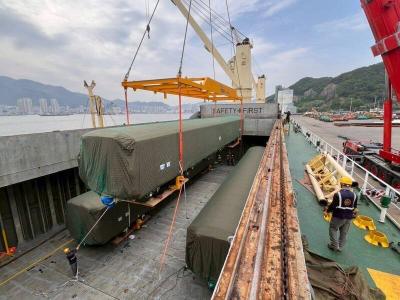
The first of 10 new high-capacity trains purchased from South Korea’s Hyundai Rotem arrived at the Port of Taipei yesterday to meet the demands of an expanding metro network, Taipei Rapid Transit Corp (TRTC) said yesterday. The train completed a three-day, 1,200km voyage from the Port of Masan in South Korea, the company said. Costing NT$590 million (US$18.79 million) each, the new six-carriage trains feature a redesigned interior based on "human-centric" transportation concepts, TRTC said. The design utilizes continuous longitudinal seating to widen the aisles and optimize passenger flow, while also upgrading passenger information displays and driving control systems for a more comfortable
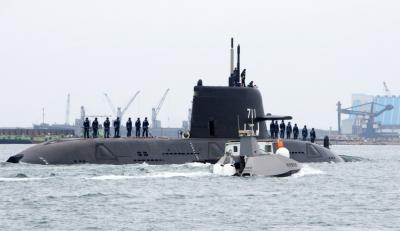
Taiwan's first indigenous defense submarine, the SS-711 Hai Kun (海鯤, or Narwhal), departed for its 13th sea trial at 7am today, marking its seventh submerged test, with delivery to the navy scheduled for July. The outing also marked its first sea deployment since President William Lai (賴清德) boarded the submarine for an inspection on March 19, drawing a crowd of military enthusiasts who gathered to show support. The submarine this morning departed port accompanied by CSBC Corp’s Endeavor Manta (奮進魔鬼魚號) uncrewed surface vessel and a navy M109 assault boat. Amid public interest in key milestones such as torpedo-launching operations and overnight submerged trials,
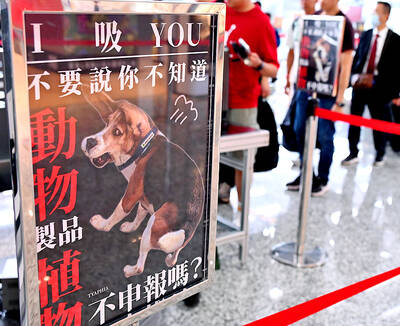
Quarantine awareness posters at Taiwan Taoyuan International Airport have gone viral for their use of wordplay. Issued by the airport branch of the Animal and Plant Health Inspection Agency, the posters feature sniffer dogs making a range of facial expressions, paired with advisory messages built around homophones. “We update the messages for holidays and campaign needs, periodically refreshing materials to attract people’s attention,” quarantine officials said. “The aim is to use the dogs’ appeal to draw focus to quarantine regulations.” A Japanese traveler visiting Taiwan has posted a photo on X of a poster showing a quarantine dog with a

Taiwan’s coffee community has launched a “one-person-one-e-mail” campaign, calling for people to send a protest-e-mail to the World Coffee Championships (WCC) urging it to redesignate Taiwanese competitors as from “Taiwan,” rather than “Chinese Taipei.” The call followed sudden action last week after the WCC changed all references to Taiwanese competitors from “Taiwan” to “Chinese Taipei,” including recent World Latte Art champion Bala (林紹興), who won the World Latte Art Championship in San Diego earlier this month. When Bala received the trophy, he was referred to as representing Taiwan, as well as in the announcement on the WCC’s Web site, until it


 RSS
RSS