


The Democratic Progressive Party (DPP) is more likely to retake the presidency if Beijing fears that its yielding economic benefits to Taiwan or recognizing the Republic of China (ROC) would be abused by the DPP should it return to power, an expert attending a cross-strait forum said on Wednesday.
Yen Chen-shen (嚴震生), director of the International Relations Center at National Chengchi University, said that by continuing to block Taiwan’s bid to become a full member of the World Health Assembly simply because it is worried that the DPP would abuse its goodwill should Taiwan become a full member of the assembly, China was making a DPP return to power more likely.
Yen said as Taiwan, China, South Korea and possibly Japan will elect new leaders some time in the next two years, a new political climate is set to take hold in the region. It remains to be seen whether it will impact Taiwan and cross-strait relations, he said.
Since Taipei and Beijing have held six high-level talks and signed 15 agreements since 2008, Yen said the Taiwanese public has come to expect the two sides to deliver something every six months.
“I am afraid the appetite of the Taiwanese public will grow bigger and better,” he said during a panel discussion organized by the Straits Exchange Foundation to discuss the prospects of cross-strait relations.
Jack Lee (李允傑), a professor of economics at National Open University, said that since Taipei and Beijing failed to ink an agreement on investment protection last week, both sides have now entered a phase that will involve tackling more intractable issues, making future negotiations far harder.
“When it comes to politics and sovereignty, it is hard to untie the knot,” he said. “I don’t think mainland China is ready to treat Taiwan with equality and acknowledge the existence of the ROC.”
Yang Kai-huang (楊開煌), a -public affairs professor at Ming Chuan University, said negotiating on an equal footing is difficult and it is normal that negotiations drag on for years.
“How can we set a deadline and expect the government to sign a free-trade agreement within a short period of time? If that is what the public wants, the fastest way to accomplish the goal is to sell out Taiwan,” he said. “The government has the obligation to educate the public that negotiations take time.”
Yang, however, urged the Chinese Nationalist Party (KMT) government to come up with a comprehensive cross-strait strategy as the DPP has done with its “10-year policy platform.”
“We know what President Ma Ying-jeou (馬英九) does not want [referring to Ma’s “three noes” policy] but he never tells us exactly what he wants,” he said. “It will be only lip service if he says he wants peace, stability and development across the Taiwan Strait.”
The “three noes” refers to no discussion of unification with Beijing during Ma’s presidency, no pursuit or support of de jure Taiwanese independence and no use of military force to resolve the issue.
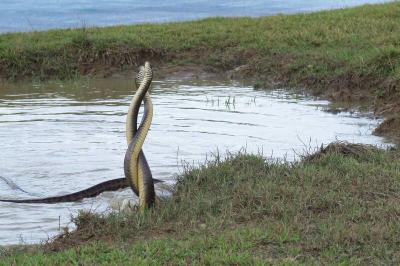
Kenting National Park service technician Yang Jien-fon (楊政峰) won a silver award in World Grand Prix Photography Awards Spring Season for his photograph of two male rat snakes intertwined in combat. Yang’s colleagues at Kenting National Park said he is a master of nature photography who has been held back by his job in civil service. The awards accept entries in all four seasons across six categories: architectural and urban photography, black-and-white and fine art photography, commercial and fashion photography, documentary and people photography, nature and experimental photography, and mobile photography. Awards are ranked according to scores and divided into platinum, gold and

More than half of the bamboo vipers captured in Tainan in the past few years were found in the city’s Sinhua District (新化), while other districts had smaller catches or none at all. Every year, Tainan captures about 6,000 snakes which have made their way into people’s homes. Of the six major venomous snakes in Taiwan, the cobra, the many-banded krait, the brown-spotted pit viper and the bamboo viper are the most frequently captured. The high concentration of bamboo vipers captured in Sinhua District is puzzling. Tainan Agriculture Bureau Forestry and Nature Conservation Division head Chu Chien-ming (朱健明) earlier this week said that the
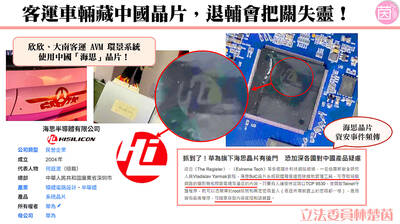
BREACH OF CONTRACT: The bus operators would seek compensation and have demanded that the manufacturer replace the chips with ones that meet regulations Two bus operators found to be using buses with China-made chips are to demand that the original manufacturers replace the systems and provide compensation for breach of contract, the Veterans Affairs Council said yesterday. Democratic Progressive Party Legislator Michelle Lin (林楚茵) yesterday said that Da Nan Bus Co and Shin-Shin Bus Co Ltd have fielded a total of 82 buses that are using Chinese chips. The bus models were made by Tron-E, while the systems provider was CYE Electronics, Lin said. Lin alleged that the buses were using chips manufactured by Huawei subsidiary HiSilicon Co, which presents a national security risk if the

The National Immigration Agency has banned two Chinese from returning to Taiwan, after they published social media content it described as disrespectful to national sovereignty. The agency imposed a two-month ban on a Chinese man surnamed Liang (梁) and a permanent ban on a woman surnamed Yang (楊), an influencer with 23 million followers, in October last year and last week respectively. Minister of the Interior Liu Shyh-fang (劉世芳) yesterday said on the sidelines of a legislative meeting that Chinese visitors to Taiwan are required to comply with the rules and regulations governing their entry permits. The government has handled the ban and


 RSS
RSS