


The wife of a Nobel laureate suffering from Alzheimer’s disease on Monday urged governments worldwide to allocate more resources for the treatment of the disease, which takes a great toll on affected families.
Speaking in Taipei to Alzheimer’s patients and their relatives about the condition of her husband, 77-year-old Chinese-born US citizen Charles Kao (高錕), Gwen Kao (also known by her maiden name, Huang Meiyun, 黃美芸) admitted that she felt some regret about not being more aware of the debilitating disease.
“I wish I had learned more about Alzheimer’s before,” said Gwen Kao, who recalled that the family usually laughed about her husband’s increasing absent--mindedness when he would forget his wallet and keys, rather than being aware that his forgetfulness was an early indicator of the disease.
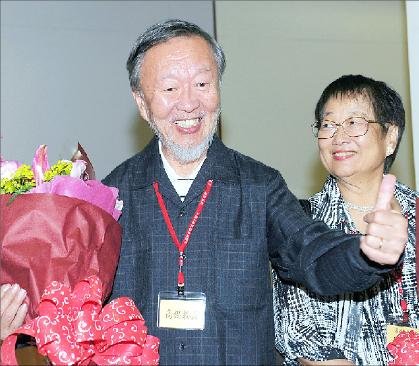
PHOTO: CNA
Gwen Kao was invited to speak by the National Science Council and the Taiwan Alzheimer’s Disease Association.
The fame of her Nobel Prize--winning husband, who is known as the “Father of Fiber Optics,” is helping her raise awareness about the disease so that others may be more prepared to deal with its consequences than she was.
Charles Kao’s condition first received widespread media attention when he won the Nobel Prize in physics last year, since his wife had to deliver his address at the award ceremony in Stockholm because he has difficulty speaking.
Gwen Kao said that prior to the Nobel award ceremony, the Hong Kong government was not well informed about Alzheimer’s.
She furthered the cause in September when she established the Charles K. Kao Foundation for Alzheimer’s Disease in Hong Kong, which is devoted to helping families of Alzheimer’s patients by improving dementia-related services.
Aside from raising public awareness about the disease, Gwen Kao has also urged cooperation among organizations and governments to allocate more resources for Alzheimer’s care.
Describing the onset of her husband’s Alzheimer’s, Gwen Kao said the first warning signs came when her husband took a train that was going in the opposite direction of where he intended.
A normal person would have corrected the mistake immediately, but her husband did not know what to do and ended up calling her, Gwen Kao said.
She said the disease left her husband insecure and dependent on others. Aware of his own limitations, he preferred to have her take care of everything, including all the paperwork required by the institutions he was involved with after his retirement.
His brain continued to deteriorate to the extent that he couldn’t even finish a simple jigsaw puzzle or remember new dancing steps. He would stop several times and then go to bed frustrated, Gwen Kao said, adding that the emotional toll was tremendous.
“It’s not like a normal death where the body is gone,” she said. “The wound stays open and never heals.”

FUKUOKA SITUATION: Japanese media reported that the pathogen is expected to be identified by the summer, while the CDC downplayed the idea that it was hMPV A “mysterious cold-like illness” reported in Japan’s Fukuoka Prefecture does not seem to be a new disease, but Japanese authorities have been asked about the situation, the Centers for Disease Control (CDC) said yesterday. The Fukuoka Prefectural Medical Association on Wednesday told a news conference that a “mystery cold” that has become a hot topic on social media is “highly likely to be caused by some kind of viral infection,” Japan’s KBC News reported. “Many people are experiencing symptoms starting with a sore throat, followed by a runny nose, phlegm and a severe cough,” KBC News reported, citing association officials. Health authorities are

Nvidia Corp CEO Jensen Huang (黃仁勳) arrived in Taiwan yesterday ahead of upcoming AI and technology events, saying he plans to meet with clients and Taiwan Semiconductor Manufacturing Co Chairman C.C. Wei (魏哲家) during his visit. After landing at Taipei Songshan Airport, Huang posed for photos with fans and handed out Yakult drinks to reporters and supporters waiting at the scene, saying he has “a lot to do” during the trip. Asked about reports that Nvidia’s planned headquarters site in Taipei’s Beitou Shilin Technology Park could break ground on May 27, Huang said that if the company holds an event, he would

The Ministry of Finance this afternoon announced the winning numbers for the March-April uniform invoice lottery. The winning number for the NT$10 million (US$318,060) special prize is 19531471, and the winning number for the NT$2 million grand prize is 85941329. Three numbers were drawn for the NT$200,000 first prize: 07225810, 20231230 and 83518781. Those with receipts matching the last seven digits of any of the first-prize numbers will win the NT$40,000 second prize, while those matching the last six digits will win the NT$10,000 third prize. Those whose receipts match the last five digits of the first-prize numbers can claim the NT$4,000 fourth prize,

SIX SUBSIDIES: The monthly allowance for older farmers is to increase to NT$10,000, and NT$5,000 is to be given to homemakers under the national pension system, Lai said The government is to implement major welfare policies for disadvantaged groups, including raising the monthly allowance for older farmers to NT$10,000 and providing homemakers with NT$5,000 per month, President William Lai (賴清德) said yesterday. Lai made the remarks during a visit to Wangling Temple in Chiayi County, saying that the planned increases were being introduced amid economic growth and an increase in tax revenue. Touting a policy, in which the government plans to provide a monthly allowance of NT$5,000 for every child under the age of 18 in a bid to address Taiwan’s low birthrate, Lai said that if received for the


 RSS
RSS