


The close race between the two Taipei mayoral candidates has prompted the two camps to largely abandon traditional hard-line campaign strategies and de-emphasize party loyalty for the purpose of attracting support from swing voters, as the election looms in less than 10 days.
Both Taipei Mayor Hau Lung-bin (郝龍斌) of the Chinese Nationalist Party (KMT) and Democratic Progressive Party (DPP) Taipei mayoral candidate Su Tseng-chang (蘇貞昌) so far this month have refrained from holding large-scale campaign events to consolidate their base. Instead, they have filled daily schedules with visits to local districts to interact with residents.
For Hau, who has always been awkward expressing himself in public, communicating with voters face-to-face has not been his forte. To help him enhance his connection with voters, the KMT has arranged for President Ma Ying-jeou (馬英九), who doubles as the KMT chairman, and KMT -Secretary-General King Pu-tsung (金溥聰), to accompany Hau he intensively canvass the streets this month looking for support.
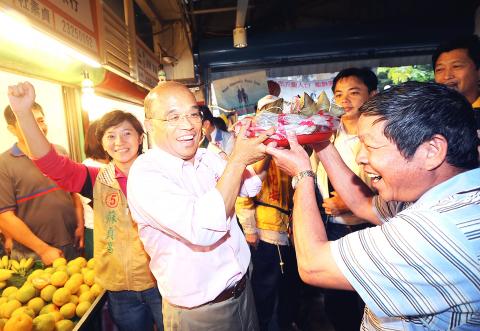
PHOTO: FANG PIN-CHAO, TAIPEI TIMES
Last week alone, Ma campaigned for the mayor on three consecutive days. He spent more than two hours at the Raohe Street night market on Saturday night, leading Hau to shake hands with visitors, and sat down chatting with vendors while eating stinky tofu.
The 58-year-old mayor has also learned to stay and chat with the crowd when attending municipal activities, rather than leaving immediately after addressing the events.
Although the KMT is holding a rally on Sunday for Hau, it is playing down its previous campaign theme of anti-corruption in response to former president Chen Shui-bian’s (陳水扁) most recent sentence of a total of 19 years of for corruption charges, and the KMY is turning it into a carnival-like event.
King said the rally, named “A Walk for -Taipei-Taipei Flies High,” will be filled with balloons and toys, and all of Taipei’s residents are welcome to share their thoughts about the city’s future.
The new strategy to tone down the traditional “deep-blue” rhetoric in Hau’s election campaign can also be found in his latest campaign ad, in which he carries a girl on his back wearing a pink T-shirt. The KMT’s blue party color was absent in the ad.
Su, on the other hand, has been leading a non-traditional campaign since the very beginning. With the slogan “Let Taipei surpass Taipei,” his campaign has focused more on social welfare issues and has adopted bright colors such as orange and pink for his campaign.
He has made use of popular online social networking services like Facebook and Plurk to discuss municipal issues and has replaced large-scale campaign activities with hip-hop concerts and “living room meetings” in all of the city’s 12 districts, where local residents have been invited to share their concerns with him.
As a seasoned politician who has maintained a grassroots style, Su interacts with voters more passionately than his KMT counterpart and never hesitates to shake hands or give hugs to supporters.
Su’s campaign spokesman Lee Hou-ching (李厚慶) said reshaping the political alignment in Taipei City, a traditional KMT stronghold, is a main reason behind Su’s decision to run in the election.
The increasing number of swing voters in this election campaign, Lee said, showed that the traditional support bases of the pan-blue and pan-green camps in the city can be changed.


UPGRADE: The Kang Ding-class frigate is replacing its Chaparall missiles with Tien Chien II and Hua Yang VLS, which would provide it with long-range, 360° air defense Taiwan plans to produce 1,200 to 1,376 Hai Chien II missiles (海劍二, Sea Sword II) — also known as TC-2N — to serve as the standard air defense system of the navy’s surface combatant fleet, a source said yesterday. Last week, the Hai Chien II, the naval version of the Tien Kung II missile (天劍二, Sky Sword II), completed a live-fire test in waters off the National Chungshan Institute of Science and Technology’s Jiupeng facility (九鵬) in Pingtung County’s Manjhou Township (滿州). The MIM72 Chaparral and other dated air defense missiles that currently arm Taiwanese ships have inadequate range to combat Chinese

REASONS FOR TRAVEL: An assistant professor said that proposed amendments to penalize drivers if they used drugs overseas would not deter people from traveling People who operate a motor vehicle under the influence of marijuana would have their driver’s license revoked, even if they used the substance while overseas, the Ministry of Transportation and Communications said yesterday, citing proposed amendments to the Road Traffic Management and Penalty Act (道路交通管理處罰條例). The amendments would also authorize the government to revoke the licenses of people determined to have used Category 1 or Category 2 narcotics, even if they were not operating a vehicle while under the influence of drugs, as well as ban them from taking the license test for three years, the ministry said. People aged 18 or

Johanne Liou (劉喬安), a Taiwanese woman who shot to unwanted fame during the Sunflower movement protests in 2014, returned to Taiwan last night after being deported from the US. She is to stand trial in Taiwan for charges involving embezzlement, fraud and drug crimes. The Criminal Investigation Bureau (CIB) said it took her into custody at Taiwan Taoyuan International Airport and would first question her before transferring her to the New Taipei District Prosecutors’ Office. She was arrested upon disembarking a flight from San Francisco that landed shortly before 7pm. Liou absconded to the US in 2019 after jumping bail
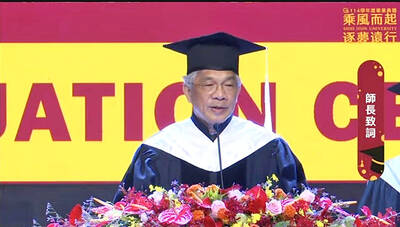
Shih Hsin University President Chen Ching-he (陳清河) yesterday issued a public apology for comments made in his commencement speech last week, stating that he has asked the school to suspend his duties and halt his wages for two months as a show of contrition. At the commencement ceremony on May 30, Chen said, “If you don’t manage your time well, or your own emotions, or your health, then I am telling every one of you — put a quick end to ‘you,’ because the world has no need for ‘you.’” The comments have sparked significant controversy online, and Chen through an open


 RSS
RSS