


Dozens of supporters of San-ying Aboriginal Community (三鶯部落) — including social activists, students, musicians, writers, artists, film directors and academics — yesterday visited the campaign headquarters of both the Democratic Progressive Party (DPP) and Chinese Nationalist Party (KMT) Sinbei mayoral candidates Tsai Ing-wen (蔡英文) and Eric Chu (朱立倫) to ask them to clarify their stand on the relocation of their community.
The Sanying Aboriginal Community is a small community where the vast majority of residents are Amis Aborigines from Hualien and Taitung counties who moved to Taipei to work as construction workers and miners about 30 years ago.
Since they could not afford housing in the city, they found a plot of unused land next to -Sanying Bridge (三鶯大橋) on the Dahan River (大漢溪) and built their own houses using whatever material they could find.
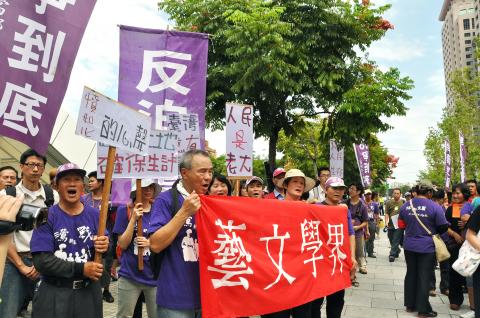
Photo: Kuo Yen-hui, Taipei Times
Over the past decade, the community has been razed by the county government several times as the houses were illegally constructed in a restricted zone. However, residents rebuilt their homes each time the village was flattened.
Although the county government built a block of rental apartments not far from the original Sanying Community for residents to move into, many continue to prefer the riverside village saying they could not afford the rent and utility bills.
As the issue remains unresolved, residents are keen to know how the future mayor plans to handle the issue.
“What we’re asking for is simple: Either allow the residents to stay where they are or find another plot of land for them to relocate,” said Chiang Yi-hau (江一豪), a core member of the Sanying Community Self-Help Association.
“We can discuss more details such as how to rent the land collectively, but at the very least we would like to know what they have in mind,” he said.
Film director Hou Hsiao-hsien (侯孝賢) said that “Aborigines are the real masters of this island” and deserve more respect from the government.
Writer Chu Tien-hsin (朱天心) pledged she would stand shoulder to shoulder with Sanying Community.
Eric Chu’s campaign spokesman Chang Chi-kai (張啟楷) received the activists and promised that the- candidate would visit the community in person within a week — but declined to say whether it would be an open visit.
More than 200 Sanying residents and activists visited the two campaign headquarters on Oct. 9, and both candidates promised to visit the community within two weeks, but failed to do so.
A staffer at Tsai’s campaign office, Tseng Tsung-kai (曾琮愷), met with the activists and promised that the office “will send someone to the community within a week.”
Tsai commented to the media in a separate setting later that “making promises [about Sanying Community] during the campaign is unrealistic.”
“To solve the Sanying issue, I must have a better understanding of it and take into consideration Aboriginal culture and the residents’ wishes,” she said.

Considering that most countries issue more than five denominations of banknotes, the central bank has decided to redesign all five denominations, the bank said as it prepares for the first major overhaul of the banknotes in more than 24 years. Central bank Governor Yang Chin-lung (楊金龍) is expected to report to the Legislative Yuan today on the bank’s operations and the redesign’s progress. The bank in a report sent to the legislature ahead of today’s meeting said it had commissioned a survey on the public’s preferences. Survey results showed that NT$100 and NT$1,000 banknotes are the most commonly used, while NT$200 and NT$2,000

The Centers for Disease Control (CDC) yesterday reported the first case of a new COVID-19 subvariant — BA.3.2 — in a 10-year-old Singaporean girl who had a fever upon arrival in Taiwan and tested positive for the disease. The girl left Taiwan on March 20 and the case did not have a direct impact on the local community, it said. The WHO added the BA.3.2 strain to its list of Variants Under Monitoring in December last year, but this was the first imported case of the COVID-19 variant in Taiwan, CDC Deputy Director-General Lin Ming-cheng (林明誠) said. The girl arrived in Taiwan on

South Korea is planning to revise its controversial electronic arrival card, a step Taiwanese officials said prompted them to hold off on planned retaliatory measures, a South Korean media report said yesterday. A Yonhap News Agency report said that the South Korean Ministry of Foreign Affairs is planning to remove the “previous departure place” and “next destination” fields from its e-arrival card system. The plan, reached after interagency consultations, is under review and aims to simplify entry procedures and align the electronic form with the paper version, a South Korean ministry official said. The fields — which appeared only on the electronic form

The Ministry of Foreign Affairs (MOFA) is suspending retaliation measures against South Korea that were set to take effect tomorrow, after Seoul said it is updating its e-arrival system, MOFA said today. The measures were to be a new round of retaliation after Taiwan on March 1 changed South Korea's designation on government-issued alien resident certificates held by South Korean nationals to "South Korea” from the "Republic of Korea," the country’s official name. The move came after months of protests to Seoul over its listing of Taiwan as "China (Taiwan)" in dropdown menus on its new online immigration entry system. MOFA last week


 RSS
RSS