


Hundreds of local and foreign visitors crowded the Taipei Confucius Temple early yesterday morning to watch the traditional bayi (八佾) dance and eat wisdom cakes in celebration of Confucius’ (孔子) 2,560th birthday.
The dance, a ritual performed to pay respect to emperors, was performed by 64 students and was only the second such performance in Taiwan in 12 years.
The temple sparked controversy when it performed the ritual two years ago to welcome President Ma Ying-jeou’s (馬英九) attendance at the ceremony, attracting criticism from opposition parties that the temple was “worshiping Emperor Ma” with the dance.
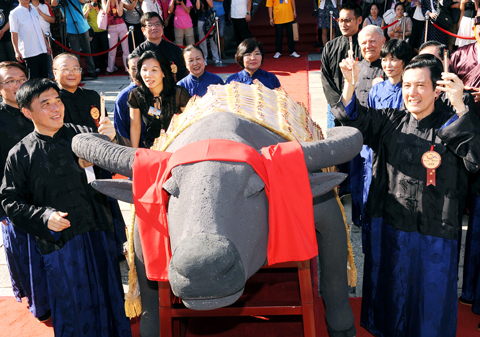
PHOTO: CHANG CHIA-MING, TAIPEI TIMES
Ma attended the ceremony again yesterday to pay his respects to the philosopher by burning incense and watching the bayi dance. The temple also opened the Lingxing Gate, the main entrance of the temple that is usually closed during the ceremony, and arranged for the president to enter the temple via the route traditionally taken by emperors.
Shih Su-li (施淑梨), the temple’s secretary, declined to confirm whether the temple performed the dance and opened the main entrance specifically for the president and insisted that all rituals and arrangements followed ancient traditions.
The temple usually performs the liuyi (六佾), a ritual performed to pay respects to feudal barons, to celebrate Confucius’ birthday.
Addressing the ceremony after the two-hour ritual, Ma cited the Analects to emphasize the importance of politicians taking a righteous path and said he chose to attend the ceremony to promote Confucianism.
“I have attended this ceremony twice because I think Confucianism and the rituals should be part of our lives ... Confucius taught us that a politician must take the righteous path, and if you take that path, your subordinates would not dare to take an evil path,” he said.
Ma is the first president to participate in the ceremony at the temple. Former president Chiang Kai-shek (蔣介石) visited the temple one day before the ceremony in 1968, Shih said.
The ceremony was presided over by Taipei Mayor Hau Lung-bin (郝龍斌).
The temple is one of the few Confucius temples that still performs ancient rites that strictly follow the ancient rules with 37 steps in the ceremony sequence.
After the performance of the ritual, some visitors rushed to the center plaza of the temple to “pull” writing brushes from an artificial cow’s back as part of the “pulling of wisdom hair” ritual, creating a chaotic scene when some ran into each other and fell down.
Shih said the temple had 2,000 brushes at the ceremony, and it did not expect to have so many people participate in the activity.

Taiwan has received more than US$70 million in royalties as of the end of last year from developing the F-16V jet as countries worldwide purchase or upgrade to this popular model, government and military officials said on Saturday. Taiwan funded the development of the F-16V jet and ended up the sole investor as other countries withdrew from the program. Now the F-16V is increasingly popular and countries must pay Taiwan a percentage in royalties when they purchase new F-16V aircraft or upgrade older F-16 models. The next five years are expected to be the peak for these royalties, with Taiwan potentially earning
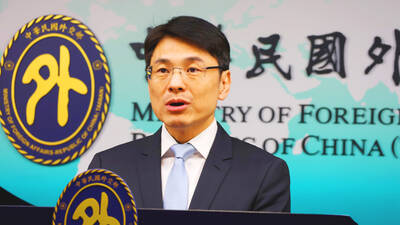
STAY IN YOUR LANE: As the US and Israel attack Iran, the ministry has warned China not to overstep by including Taiwanese citizens in its evacuation orders The Ministry of Foreign Affairs (MOFA) yesterday rebuked a statement by China’s embassy in Israel that it would evacuate Taiwanese holders of Chinese travel documents from Israel amid the latter’s escalating conflict with Iran. Tensions have risen across the Middle East in the wake of US and Israeli airstrikes on Iran beginning Saturday. China subsequently issued an evacuation notice for its citizens. In a news release, the Chinese embassy in Israel said holders of “Taiwan compatriot permits (台胞證)” issued to Taiwanese nationals by Chinese authorities for travel to China — could register for evacuation to Egypt. In Taipei, the ministry yesterday said Taiwan
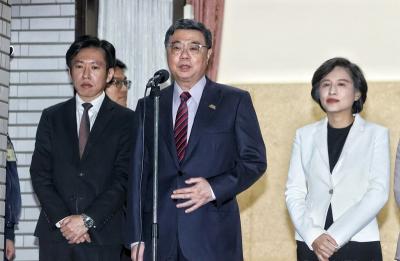
Taiwan is awaiting official notification from the US regarding the status of the Agreement on Reciprocal Trade (ART) after the US Supreme Court ruled US President Donald Trump's global tariffs unconstitutional. Speaking to reporters before a legislative hearing today, Premier Cho Jung-tai (卓榮泰) said that Taiwan's negotiation team remains focused on ensuring that the bilateral trade deal remains intact despite the legal challenge to Trump's tariff policy. "The US has pledged to notify its trade partners once the subsequent administrative and legal processes are finalized, and that certainly includes Taiwan," Cho said when asked about opposition parties’ doubts that the ART was
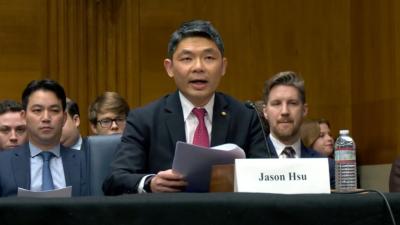
If China chose to invade Taiwan tomorrow, it would only have to sever three undersea fiber-optic cable clusters to cause a data blackout, Jason Hsu (許毓仁), a senior fellow at the Hudson Institute and former Chinese Nationalist Party (KMT) legislator, told a US security panel yesterday. In a Taiwan contingency, cable disruption would be one of the earliest preinvasion actions and the signal that escalation had begun, he said, adding that Taiwan’s current cable repair capabilities are insufficient. The US-China Economic and Security Review Commission (USCC) yesterday held a hearing on US-China Competition Under the Sea, with Hsu speaking on


 RSS
RSS