


The Bureau of National Health Insurance (BNHI) yesterday said it would relax restrictions governing certain groups of disadvantaged people with non-valid National Health Insurance (NHI) cards requiring medical care.
The move came after civic groups complained that about 300,000 people who, for various reasons, had NHI cards that were not valid, cannot afford to pay their health insurance premiums.
At present, that means when those individuals become sick, they face the additional financial burden of being unable to receive medical care under the national health insurance system.
The bureau said about 600,000 people owe money to the NHI system. About half have owed at least NT$7,500 for more than three months and have not paid their premiums when encouraged to do so by health authorities. As a result, their NHI cards are now invalid.
While some of the 600,000 cannot afford the premium payments, others can, but refuse to do so or have other unresolved issues, such as being out of the country, said Deng Shih-hui (鄧世輝), a section chief at the bureau.
While the second-generation health bill stipulates that NHI cards cannot be canceled when people are in certain dire circumstances, such as living in sheltered accommodation as a result of domestic violence, the bill has yet to be passed.
During an extraordinary legislative session late last month, legislators decided that the review of the bill to reform the NHI system would be delayed until December.
In the meantime, the BNHI said it would follow instructions from the Executive Yuan to relax restrictions on the provision of medical care to those with invalid NHI cards.
However, Deng said to be fair to those who make prompt NHI premium payments, the bureau would also step up efforts to investigate the validity of the reasons behind unpaid premiums and demand payment from those who are deemed able to pay.
The bureau is also encouraging disadvantaged invalid NHI cardholders to seek help and counseling from social services and to set up payment plans.
Additional reporting by Staff Writer
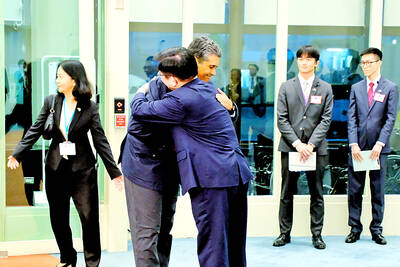
Palauan President Surangel Whipps Jr arrived in Taiwan last night to kick off his first visit to the country since beginning his second term earlier this year. After arriving at Taoyuan International Airport at around 6:30 pm, Whipps and his delegation were welcomed by Minister of Foreign Affairs Lin Chia-lung (林佳龍). Speaking to gathered media, the Palauan leader said he was excited and honored to be back in Taiwan on his first state visit to Taiwan since he was sworn in this January. Among those traveling with Whipps is Minister of State Gustav N. Aitaro, Public Infrastructure
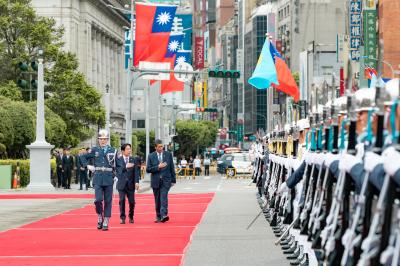
President William Lai (賴清德) yesterday thanked Palau for its continued support of Taiwan's international participation, as Taipei was once again excluded from the World Health Assembly (WHA) currently taking place in Switzerland. "Palau has never stopped voicing support for Taiwan" in the UN General Assembly, the WHO and other UN-affiliated agencies, Lai said during a bilateral meeting with visiting Palau President Surangel Whipps Jr. "We have been profoundly touched by these endorsements," Lai said, praising the Pacific island nation's firm support as "courageous." Lai's remarks came as Taiwan was excluded for the ninth consecutive year from the WHA, which is being held in

RESOLUTIONS DEBATE: Taiwan’s allies said that UN and WHA resolutions cited by China and other nations ‘do not determine Taiwan’s participation in WHO activities’ A proposal to invite Taiwan to this year’s World Health Assembly (WHA) was rejected on Monday, resulting in Taipei’s absence from the annual meeting for a ninth consecutive year, although partners spoke up for Taiwan’s participation at the first day of the meeting. The first agenda item after the opening was a “two-on-two debate” on a proposal to invite Taiwan to participate at the WHA as an observer. Similar to previous years, two countries made statements in favor of the proposal, while two others expressed their opposition. Philippine Secretary of Health Teodoro Herbosa, president of the 78th WHA, accepted the WHA General Committee’s
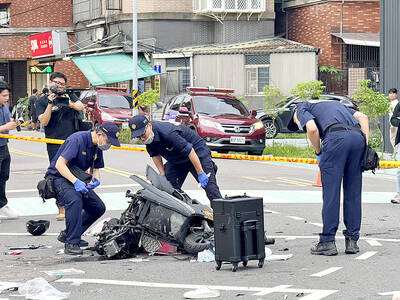
At least three people died and more than a dozen were injured yesterday afternoon when a vehicle struck a group of pedestrians in New Taipei City’s Sansia District (三峽). The incident happened at about 4pm when a car rammed into pedestrians at an intersection near Bei Da Elementary School. Witnesses said the sedan, being driven at a high speed, ran a red light, knocking scooters out of the way and hitting students crossing the road before careening into a median near the intersection of Guocheng and Guoguang streets. The incident resulted in three deaths and 13 injuries, including the driver, a 78-year-old man


 RSS
RSS