


Even though he has been diagnosed with cancer, 78-year-old Lin Tian-sheng (林添盛) was his usual energetic self when asked to talk about the art of banquet catering — an art he has refined over a long, illustrious career.
“As a chef in the banquet catering business, you have to put your heart into every dish you make,” Lin said of pan-toh (辦桌), the Taiwanese name for banquet catering. “You have to use seasonal ingredients. Many hotels don’t follow that tradition anymore.”
Lin is the nation’s most celebrated chef in the banquet catering industry. Given his more than 60 years of experience, the Tourism Bureau has started an oral history project about Lin to preserve his knowledge of banquet catering.
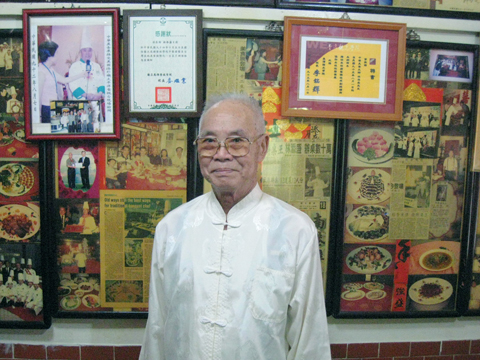
PHOTO: LI WEIN-YI, TAIPEI TIMES
At the invitation of Minister of Transportation and Communications Mao Chi-kuo (毛治國), who has known Lin for more than 20 years, Lin hosted a 10-course banquet in Mao’s house in Nangang on Saturday and told his stories to reporters.
Now retired, Lin has bequeathed his culinary skills to his second son, Lin Ming-tsang (林明燦), so that he could continue the family business.
“I stared learning from a master when I was 12 years old. During the first three years you must learn to follow the rules and develop a good character,” Lin said.
One time, the master tested his apprentices by spreading coins on the floor and asked them to sweep the floor, he said. Those found putting the coins in their pockets were asked to leave immediately.
“There were about 100 apprentices at the time. I’m the only one who made it,” Lin said, beaming with pride.
Lin also showed reporters the large ladles, spatulas and knifes he has used over the years, as well as those given to him by his master. He said he was taught to understand the meaning of each course, as well as the best way to appreciate it before he could even start cooking.
To eat pig knuckles, Lin said, one has to eat pig trotters, as it is believed that eating them will ward off bad luck. Stir-fried river eel symbolizes the ability to travel between yin and yang and is normally served at the annual Ghost Festival banquet. Abalone soup with bamboo shoots, symbolizing continuous circles of life, should be served at the feast held by parents when a child turns one-month old, he said.
A wedding banquet, meanwhile, cannot have two chefs. Instead of bringing double luck to the newlyweds, having two chefs will double the bad luck, he said.
Many have sought Lin’s advice and guidance over the years, hoping to tap into his extensive knowledge of the field.
Chef David Wu (吳大為), who won the top prize from France’s Le Cordon Bleu, said on his blog that his success was the result of Lin’s advice.
“He is a real expert on Taiwanese cuisine,” Wu said. “From him, I learned different ways to cook at wedding, funeral and birthday banquets. Not too many people in Taiwan know about these traditions and customs nowadays, let alone teach them. He was willing to teach you and give detailed instructions. I am very thankful for what he taught me.”
When Taiwan held its first culinary exhibition two decades ago, Lin also impressed many a palate with his “Feast For the Emperor,” a cornucopia of delicacies involving 80 courses served over an eight-hour period.
“Lin has acquired very solid skills since his time as an apprentice,” Mao said. “The details of his learning process, as well as the origins and customs of Taiwan’s banquet catering culture, deserve to be recorded — especially now that it has become one of the nation’s tourist attractions.”

Considering that most countries issue more than five denominations of banknotes, the central bank has decided to redesign all five denominations, the bank said as it prepares for the first major overhaul of the banknotes in more than 24 years. Central bank Governor Yang Chin-lung (楊金龍) is expected to report to the Legislative Yuan today on the bank’s operations and the redesign’s progress. The bank in a report sent to the legislature ahead of today’s meeting said it had commissioned a survey on the public’s preferences. Survey results showed that NT$100 and NT$1,000 banknotes are the most commonly used, while NT$200 and NT$2,000

The Centers for Disease Control (CDC) yesterday reported the first case of a new COVID-19 subvariant — BA.3.2 — in a 10-year-old Singaporean girl who had a fever upon arrival in Taiwan and tested positive for the disease. The girl left Taiwan on March 20 and the case did not have a direct impact on the local community, it said. The WHO added the BA.3.2 strain to its list of Variants Under Monitoring in December last year, but this was the first imported case of the COVID-19 variant in Taiwan, CDC Deputy Director-General Lin Ming-cheng (林明誠) said. The girl arrived in Taiwan on

South Korea is planning to revise its controversial electronic arrival card, a step Taiwanese officials said prompted them to hold off on planned retaliatory measures, a South Korean media report said yesterday. A Yonhap News Agency report said that the South Korean Ministry of Foreign Affairs is planning to remove the “previous departure place” and “next destination” fields from its e-arrival card system. The plan, reached after interagency consultations, is under review and aims to simplify entry procedures and align the electronic form with the paper version, a South Korean ministry official said. The fields — which appeared only on the electronic form

The Ministry of Foreign Affairs (MOFA) is suspending retaliation measures against South Korea that were set to take effect tomorrow, after Seoul said it is updating its e-arrival system, MOFA said today. The measures were to be a new round of retaliation after Taiwan on March 1 changed South Korea's designation on government-issued alien resident certificates held by South Korean nationals to "South Korea” from the "Republic of Korea," the country’s official name. The move came after months of protests to Seoul over its listing of Taiwan as "China (Taiwan)" in dropdown menus on its new online immigration entry system. MOFA last week


 RSS
RSS